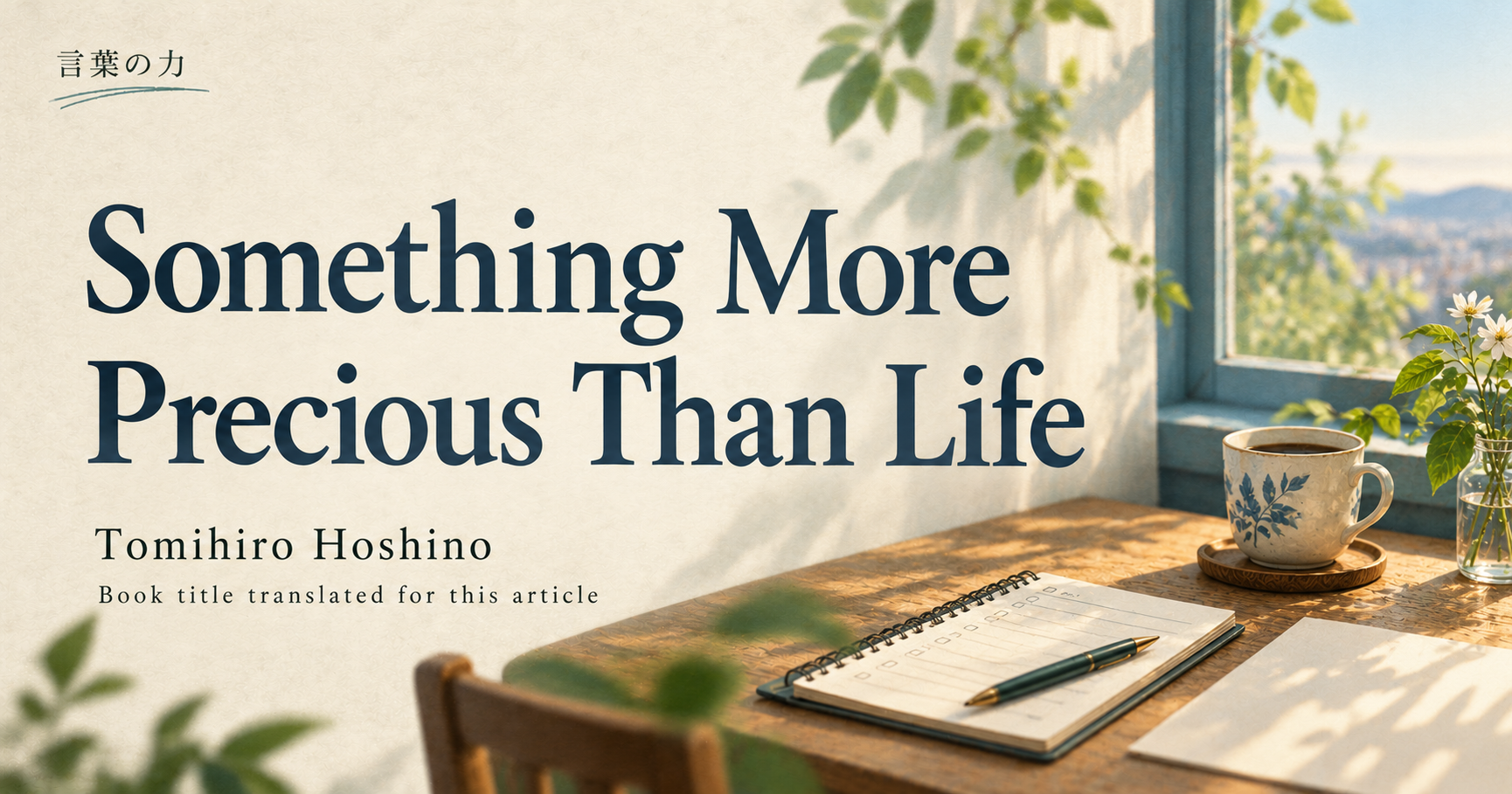
The Power of Words | Tomihiro Hoshino: When Your Day Becomes Only a To-Do List

Disclosure: This article includes affiliate links.

You did what needed doing today.

You answered work messages and finished the shopping. Yet by evening, you are not quite sure what all that busyness was for.

Rather than finding another way to work harder, take a moment to consider what you wanted to care for. Today, the title of a poetry-and-art collection offers a starting point.

Words for today

いのちより大切なもの

Tomihiro Hoshino — book title

For this article, we render the title as Something More Precious Than Life. This is our translation, not an official English title. The Japanese publisher, Inochi no Kotobasha / Forest Books, describes the collection as including poetry and artwork shaped by Christian faith, alongside an essay on the title theme. The words above are the book’s title, not a quoted line from a poem.

Our own reflection, starting from the title

This is not a summary of the book or an attempt to speak for Hoshino’s answer. Nor is it an invitation to treat your life as expendable or sacrifice yourself for something else.

What did you leave behind the busyness?

The tasks that keep a household running cannot simply disappear. Money and time matter. There is nothing inherently wrong with getting through your responsibilities.

Still, you can lose sight of what a task was meant to make possible. You came home early to talk with your family, then kept working while they spoke. Something you began for pleasure became a matter of how much you could finish.

Before criticizing your efficiency, ask: What was I actually trying to make room for?

You need not choose one thing that matters most

Family, work, friends, time alone: this reflection does not ask you to rank them. What you want to protect can differ with your circumstances and the day.

Today you may choose rest. Another day, you may keep a promise to someone. Choosing one does not mean the other has stopped mattering.

Leave some room for this discussion not to become another way of counting your shortcomings.

Include yourself among the people you care about

You may feel that pushing beyond your limits is acceptable when it is for someone else. But caring for another person and continually exhausting yourself are not the same thing.

You can say you cannot take something on today, ask for help, or change a plan. You can care about someone while being honest about your limits.

One thing for today: make space before adding more

Bring to mind one thing you want to care for. Then consider one nonessential task you could leave for another time.

You might stop checking every notification or postpone tidying that is not urgent. Use the space for a conversation or quiet rest. Necessary responsibilities do not have to be forced aside.

Caring for what matters need not mean adding another task. Sometimes it means leaving a little room.

Read in Japanese

日本語版を読む

Source

Inochi no Kotobasha: Tomihiro Hoshino’s いのちより大切なもの, poetry-and-art collection (Japanese). Reference for the title, author and publisher’s description. No poem text is reproduced or translated. Our examples and reflection are not a summary of the book.

A little inspiration for everyday living

In my Rakuten ROOM, I share everyday items we might put off buying for ourselves but would be happy to receive as gifts. Browse when you need something. (*^^*) You do not need to buy anything to consider what matters to you.

Shopping from outside Japan? Check Rakuten Global Express for current services, supported destinations, fees and restrictions before purchasing.

Pre-publication checklist — remove before publishing

Tenth manuscript for five themes, not a count of saved drafts. Draft only; no publication date or schedule. Three common English tags and Discovery applied. Person tag, category, mood navigation and English related-reading links need review. Japanese version is post 301; reciprocal link requires a separately approved update. Noriko Ibaragi and Shinmin Sakamura English drafts remain unsaved after HTTP 403 errors; do not invent links to them. Verify source wording, publisher’s description, title translation and image-use rights. This article uses the book title rather than the previously proposed poem excerpt. No full-poem quotation or translation, and no claim to summarize the book or speak for the author’s faith. Search demand unverified. Scenes are illustrative, not the owner’s experiences. Check mobile layout, remove editorial notes and let the owner decide publication.

Featured image not generated or assigned. Brief: landscape 1200×630, refined adult illustration with quiet playfulness, ivory, pale green and muted blue. A notebook with a schedule, an empty space beside it, and soft window light at lower right. No portrait or reproduction of Hoshino’s poetry paintings. Main text: Make Room for What Matters. Smaller text: Tomihiro Hoshino; The Power of Words. Main text is our editorial headline, not a quotation or book-title translation; do not add quotation marks. No imagery suggesting self-sacrifice or devaluing life. Review rights and series consistency before generation. Letter-by-letter image verification has not been performed.
The Power of Words | Taro Okamoto: What Is Behind Your ‘Better Not’?

Disclosure: This article includes affiliate links.

You find an opportunity that interests you, but never open the application form.

Work is busy. You lack experience. You should prepare a little more. These reasons may all be true. Yet you keep returning to the same page.

Do you not want to try, or do you want to try but feel afraid? These words offer a starting point for examining that difference.

Words for today

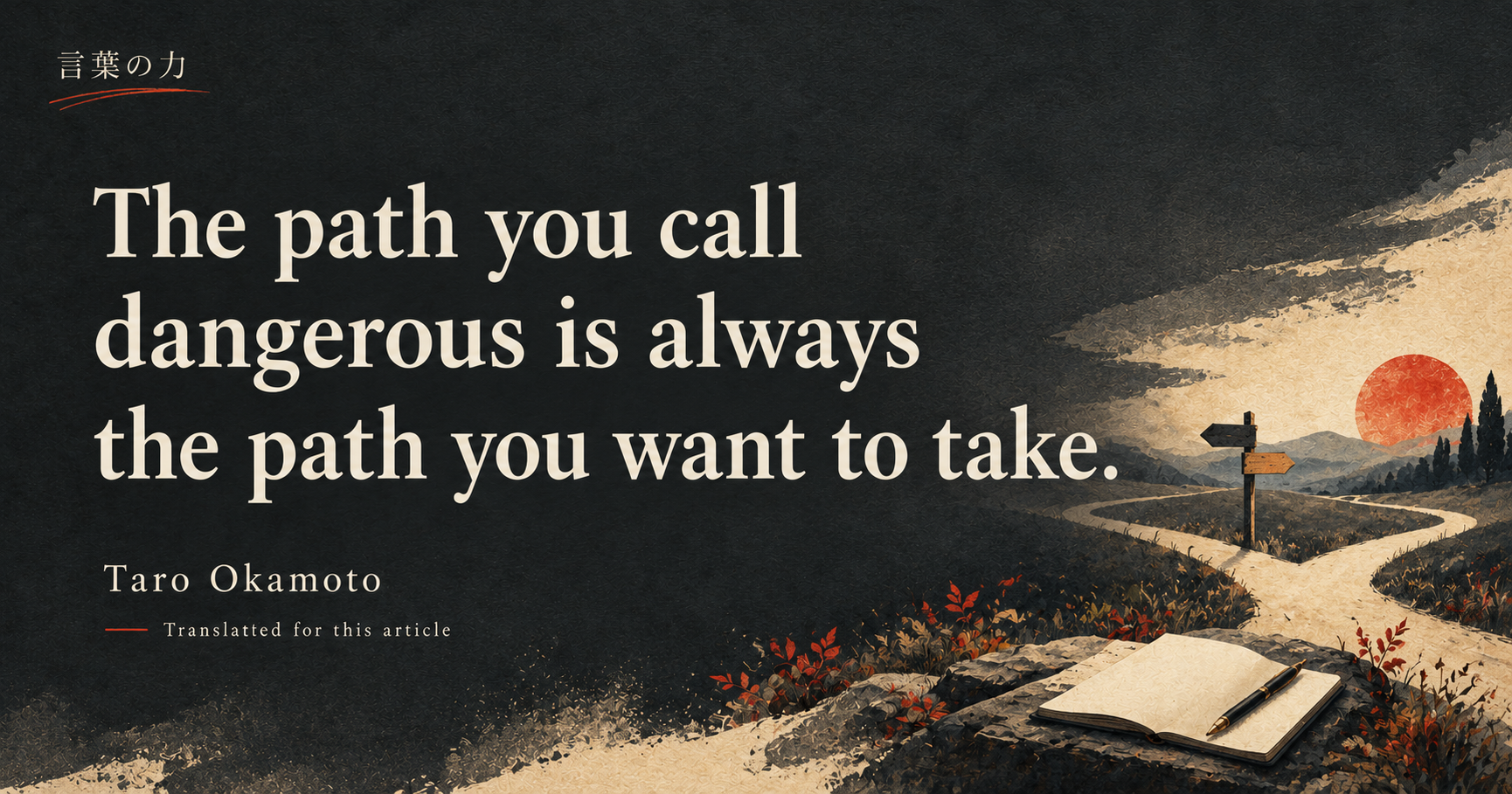
The path you call dangerous is always the path you want to take.

Taro Okamoto — translated for this article

Original: 危険だ、という道は必ず、自分の行きたい道なのだ。 Source: an excerpt from Okamoto’s book Jibun no Naka ni Doku o Mote published by Shin R25. The English above is this article’s translation, not an official translation.

An everyday reflection on these words

Separate fear from dislike

This is a forceful statement. We do not take it to mean that every dangerous choice is right. What follows is our own everyday reflection, not a complete account of Okamoto’s intentions.

Imagine being offered a new responsibility at work. Do you dislike the work itself, or fear being seen making a mistake? Both can sound like ‘I don’t want to,’ but they are different questions.

Before trying to erase your fear, write down what you are worried might happen: a gap in your knowledge, less income, a lack of time, or other people’s judgment. Separating those concerns can reveal which conditions need checking.

You do not have to stake everything at once

Being curious about another career does not require resigning tomorrow. Wanting to draw does not require buying a complete set of equipment.

Read one job requirement. Ask someone about their experience. Draw on a sheet of paper you already have. You can explore an interest while protecting your current commitments.

You may discover that the reality is different from what you imagined. You can reconsider. Trying something is not the same as placing yourself beyond the possibility of turning back.

Keep the safeguards that protect you

Physical danger, unaffordable debt, illegal activity, and pressure from another person should not be repackaged as personal growth.

Fear can contain an important warning. The question here is not whether you can prove your courage by courting danger. It is whether you have dismissed a genuine interest before giving yourself a chance to examine it.

One thing for today: imagine no one laughing

Choose one thing you keep thinking about. Ask yourself: If no one laughed at me, would I want to try?

If the answer is yes, write down one condition to investigate next. If it is no, choosing not to proceed deserves respect too.

You do not have to decide today. Begin by listening to what is behind your own ‘better not.’

Read in Japanese

日本語版を読む

Source

Shin R25: excerpt from Taro Okamoto’s Jibun no Naka ni Doku o Mote (Japanese). The quotation, our translation, and our reflection are identified separately. Edition and page number have not been verified.

A little inspiration for everyday living

In my Rakuten ROOM, I share everyday items we might put off buying for ourselves but would be happy to receive as gifts. Browse when you need something. (*^^*) You do not need to buy anything to begin exploring an interest.

Shopping from outside Japan? Check Rakuten Global Express for its current forwarding services, supported destinations, fees, and restrictions before making a purchase.

Pre-publication checklist — remove before publishing

Fourth of ten drafts for five selected themes. Draft only; no publication date or schedule requested. Three common English tags applied. Verify and assign Courage, Decision, person tag and category; thematic tag IDs have not been confirmed for this draft. Add verified English related-reading and mood-navigation links before publication. Do not guess their destinations. Japanese version is post 297; add the reciprocal English link to that post after creation, with separate approval. Verify original quotation, source context, translation and image-use rights, all links and mobile layout. Edition and page number unverified; search demand unverified. Scenes are illustrative, not the owner’s personal experiences. Featured image not generated or assigned. The owner reviews the text, removes editorial notes, and decides publication.

Featured-image brief: landscape 1200×630, refined adult editorial illustration with quiet playfulness. Charcoal, ivory and a restrained vermilion accent. A fork in a path and an open blank notebook at lower right; no dangerous cliff, weapons, portrait, or reproduction of existing artworks. Largest text must exactly match the article quotation: The path you call dangerous is always the path you want to take. Smaller text: Taro Okamoto; The Power of Words; Translation for this article. Change line breaks only, not words or punctuation. Prioritize legible serif typography and generous margins. Review image-use rights before generation. Compare the result letter by letter against the quotation. Image verification has not been performed.
The Power of Words | Kirin Kiki: When Someone Else’s Good News Makes You Feel Behind

Disclosure: This article includes affiliate links.

A classmate gets promoted. A friend shares holiday photos. Another family looks wonderfully happy.

You are pleased for them. That part is real. Yet after putting down your phone, your own ordinary day suddenly seems less impressive.

A moment ago, life felt reasonably normal. Now you are conducting an unexpected performance review of yourself.

Words for today

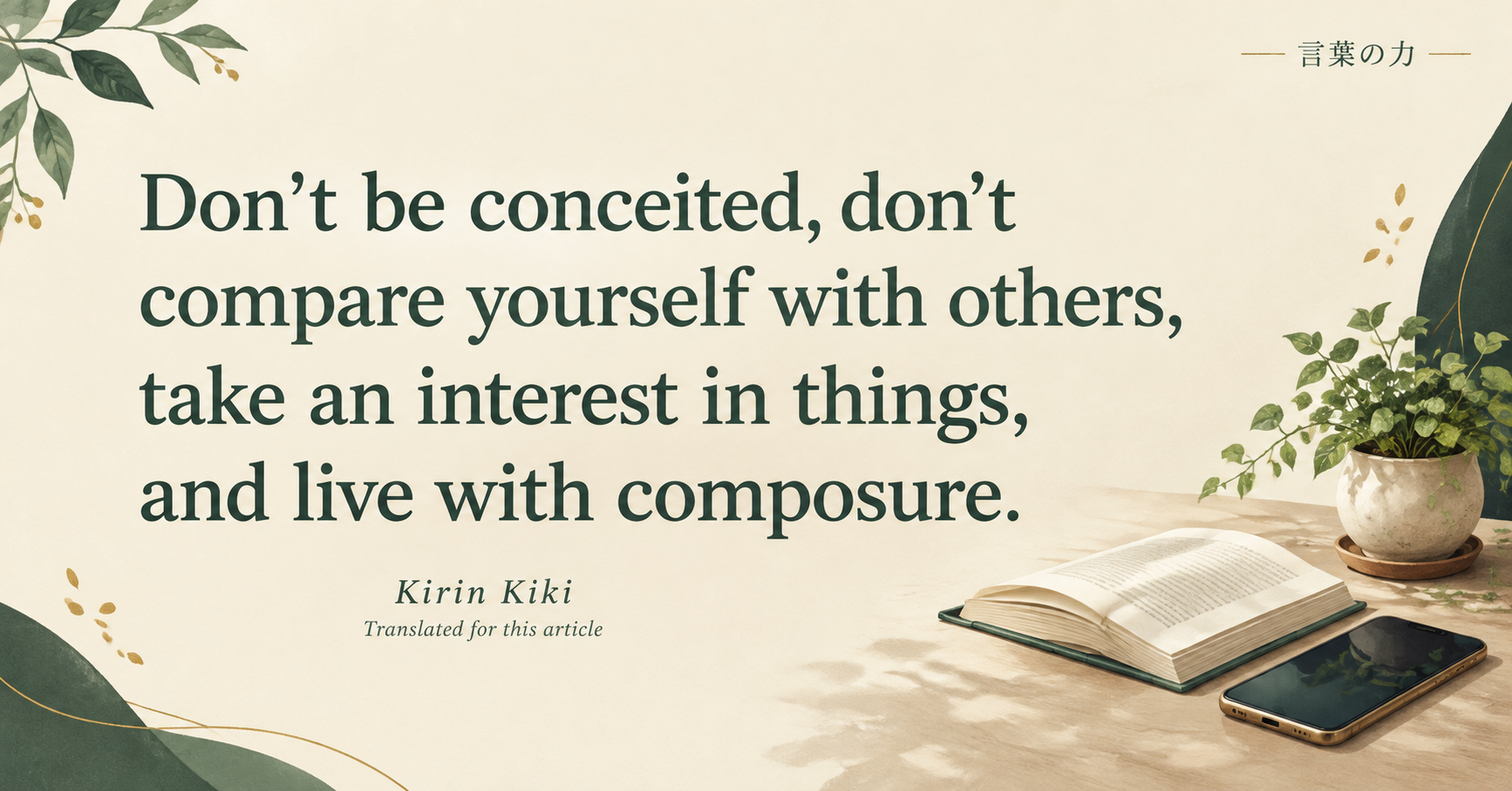
Don’t be conceited, don’t compare yourself with others, take an interest in things, and live with composure.

Kirin Kiki — translated for this article

Original: おごらず、人と比べず、面白がって、平気に生きればいい. According to Shukan Josei PRIME’s report of Kiki’s farewell ceremony, her daughter Yayako Uchida recalled these words as something her mother had told her. We present them as words passed on by her daughter, not as a direct transcript of a lecture by Kiki. The English above is this article’s translation, not an official translation.

An everyday reflection on these words

Their good news is not an instruction for you

A friend starting a new job is an event in your friend’s life. It is not a notification telling you to change yours immediately.

Still, while looking at the screen, you may begin grading your own days. What am I doing with my life?

You do not need to criticize yourself for comparing, either. First, notice what happened: you turned someone else’s news into your own score. Celebrating them and diminishing yourself do not have to come together.

Interest does not mean pretending everything is funny

For this reflection, taking an interest in things does not mean laughing away painful experiences. The following is our own everyday reading, not a claim to explain all of Kiki’s intentions.

It can mean returning your attention to something that quietly caught your interest: a shop on your way home, a neatly written line, or a pitch in a baseball game that made you look up.

These moments may not look as glamorous as someone else’s holiday. But something moved in your own day. Not posting it or receiving praise does not erase the enjoyment.

You can step back when composure feels out of reach

We need not read composure as a command to become someone who never gets hurt.

If scrolling is making you miserable, close the screen for now. Give yourself time before replying. Talk to someone you trust. Taking some distance is an option too.

One thing for today: return to a private pleasure

Think of one small thing you have wanted to enjoy. Open a book for one page, listen to a song, or look at the plant by your window. It need not cost money or become another appointment.

After visiting someone else’s life on a screen, come back to your own. Even without impressive news to share, your day may still contain something worth noticing.

How are you feeling? Explore more words for being yourself.

Related reading

Misuzu Kaneko: Someone Else’s Strength Does Not Make You Smaller
Shigeru Mizuki: You Do Not Have to Earn Your Day Off
日本語版を読む

Source

Shukan Josei PRIME: report of Kirin Kiki’s farewell ceremony (Japanese). The quotation is attributed through her daughter’s recollection. The translation and reflection are this article’s own.

A little inspiration for everyday living

In my Rakuten ROOM, I share everyday items we might put off buying for ourselves but would be happy to receive as gifts. Browse when you need something. (*^^*) Buying something is not the conclusion of this reflection.

Shopping from outside Japan? Rakuten Global Express offers international forwarding from Japan. Please check supported destinations, shipping fees, and item restrictions before using the service.

Pre-publication checklist — remove before publishing

Second of ten drafts for five selected themes. Draft only, no publication date or schedule requested. Three common English tags, Be Yourself and Discovery applied. Person tag and category still need review and assignment. Add the reciprocal English link to Japanese post 295 after creation. Verify source wording, quotation, translation and image-use rights, related articles’ publication status, links and mobile layout. Attribution is through the daughter’s recollection in a secondary report, not a direct recording of Kiki. Search demand unverified. Scenes are illustrative, not the owner’s experiences. Image not generated or assigned. Remove editorial notes after review; the owner decides publication.

Featured-image brief: 1200×630 landscape, refined adult editorial illustration with quiet playfulness, ivory, muted forest green and restrained gold. A face-down phone, open book and small plant at lower right; no portrait or logo. The largest text must exactly match the article quotation: Don’t be conceited, don’t compare yourself with others, take an interest in things, and live with composure. Smaller text: Kirin Kiki; The Power of Words; Translation for this article. Adjust line breaks only; do not shorten or change punctuation. Keep generous margins and readable serif typography. Do not generate or publish before reviewing image-use rights. Compare the generated image letter by letter against the English quotation; image verification has not been performed.
The Power of Words | Soichiro Honda: When Your Work Feels Hard to See

Disclosure: This article includes affiliate links.

You were busy all day. Yet when someone asks what you accomplished, it is surprisingly difficult to explain.

You answered a question, replenished supplies, and left a handover note so the next person would not get stuck.

No spectacular result. Nothing that earned applause in a meeting. On days like these, your own contribution can begin to look small.

Words for today

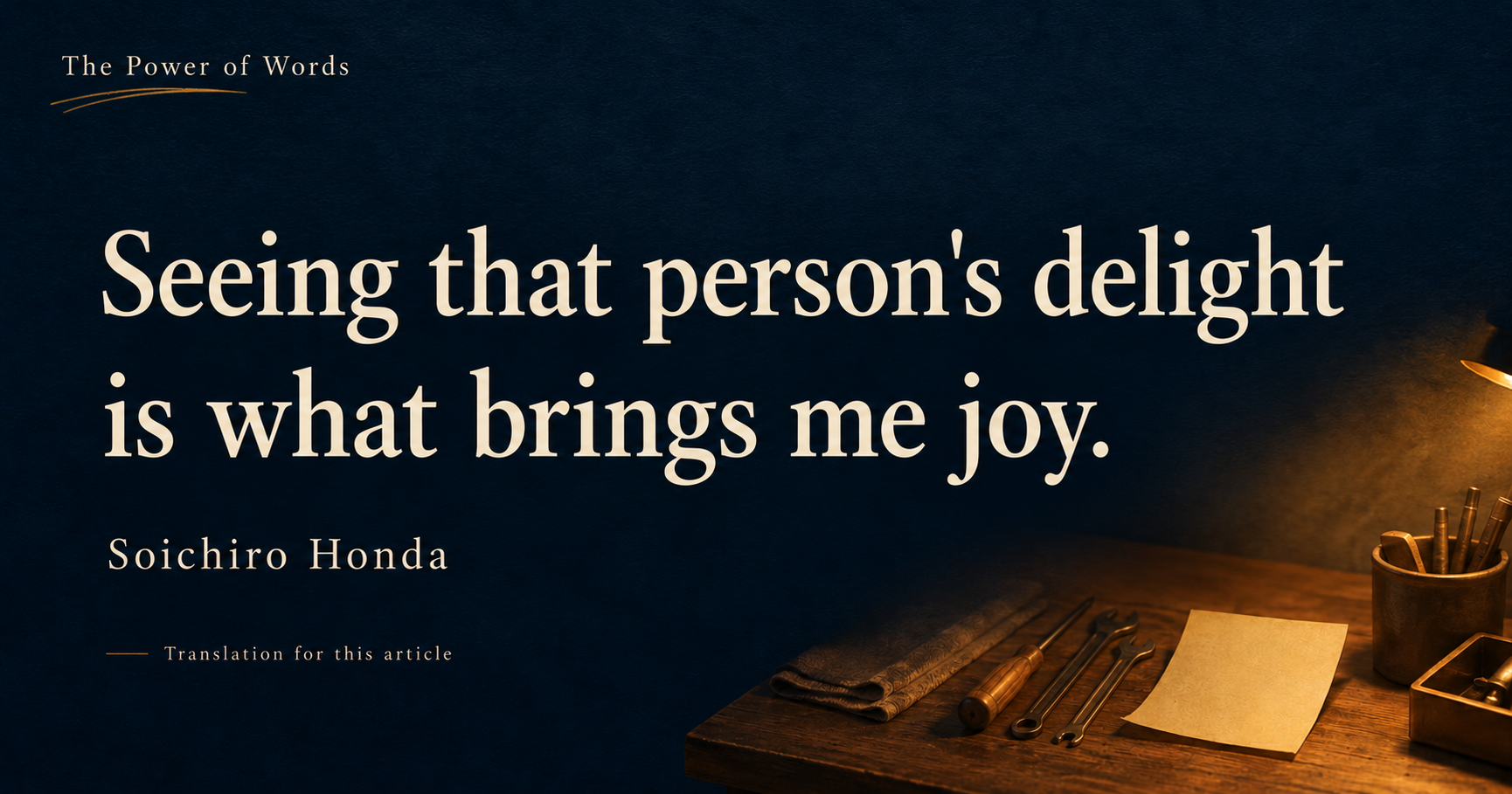
Seeing that person’s delight is what brings me joy.

Soichiro Honda — translated for this article

Original: その人の 喜んでくれた姿を見ることが 自分の喜びなんですね. Honda’s official Japanese page about its inherited philosophy presents these words alongside the story of a bicycle engine developed with his wife’s difficult shopping trips in mind. The English quotation above is this article’s translation, not an official Honda translation.

An everyday reflection on these words

Notice what changed for someone else

If you look for the value of your work only in sales figures or formal recognition, some days offer little evidence. But did something you did make another person’s task easier?

Consider a handover note. Instead of saying that something is in its usual place, you write: second shelf from the top, inside the blue box. That small detail may save the next person a search.

If they tell you it helped, you can accept that response as one sign of useful work. The following reflection applies the quotation to ordinary situations; it does not claim that Honda was speaking about these particular examples.

Care does not always mean taking on more

Thinking about others can easily turn into accepting another task. You could stay late. They might struggle if you refuse.

But this quotation need not become a reason to wear yourself down.

There are other ways to help: explain what you can finish today, connect a question to the right person instead of guessing, or turn a repeated explanation into a short guide.

Helping someone avoid the same difficulty next time is a form of consideration too.

A lack of thanks does not erase everything

Appreciation does not arrive every time. Someone may be too busy to notice. What you intended to help with may not be what they actually needed.

That does not make your worth depend on their reaction.

The point is not to turn other people’s gratitude into a scorecard. It is to picture the person on the other side of the task and ask what would genuinely help.

One thing for today: remove one point of confusion

Choose one piece of work and consider what the next person might have trouble finding or understanding: the file location, the section that needs checking, or the deadline for a reply.

If one extra sentence would clarify it, add that sentence and stop there.

It may not be a dramatic achievement. Still, someone may spend less time searching or understand what to do immediately.

When your contribution feels invisible, remember not only what you completed but whose day you made a little easier.

How are you feeling? Explore more words for connection.

Related reading

Benjamin Franklin: Your Quiet Actions Still Count
Kenji Miyazawa: A Gentle Place to Return To
日本語版を読む

Source

Honda’s official page: inherited philosophy (Japanese). The quotation, this article’s translation, and the original reflection are presented separately.

A little inspiration for everyday living

In my Rakuten ROOM, I share everyday items we might put off buying for ourselves but would be happy to receive as gifts. Feel free to browse when you need something. (*^^*)

Shopping from outside Japan? Rakuten Global Express offers international forwarding from Japan. Please check supported destinations, shipping fees, and item restrictions before using the service.

Pre-publication checklist — remove before publishing

Draft only; no publication date or schedule requested. Three common English tags, Connection and Integrity applied. The Soichiro Honda person tag remains to be created and assigned after confirmation. Check the category. Add the reciprocal English link to Japanese post 284 after this draft receives an ID. Verify related articles’ publication status, all links, quotation rights, translation, and mobile layout. The quotation’s original publication and date have not been established; do not invent them. Search demand has not been validated. Examples are illustrative, not claimed experiences of the site owner. Review and remove editorial notes before the owner decides to publish.

Featured image not generated or assigned. Prompt: landscape 1200×630; sophisticated, quietly playful adult editorial illustration matching the Japanese version; deep navy, warm ivory and amber; tidy workbench, tools and a handover note at lower right; no portrait or corporate logo. Largest quotation must be exactly: Seeing that person’s delight is what brings me joy. Smaller text: Soichiro Honda; The Power of Words; Translation for this article. Preserve wording and punctuation; adjust line breaks only. No article headline or invented slogan. Keep generous margins and readable text. Compare the generated image with this English quotation letter by letter before use; image verification has not yet been performed.

The Power of Words | Uesugi Yozan: Give That Postponed Task a Small Beginning

Disclosure: This article includes affiliate links.

Why does a difficult task suddenly make tidying your desk feel so urgent?

Before starting the report, you check your email. Before answering the email, you check your calendar. Somehow it is lunchtime. You tell yourself you were preparing—which is technically a kind of activity.

A task can look largest before you have touched it.

Words for today

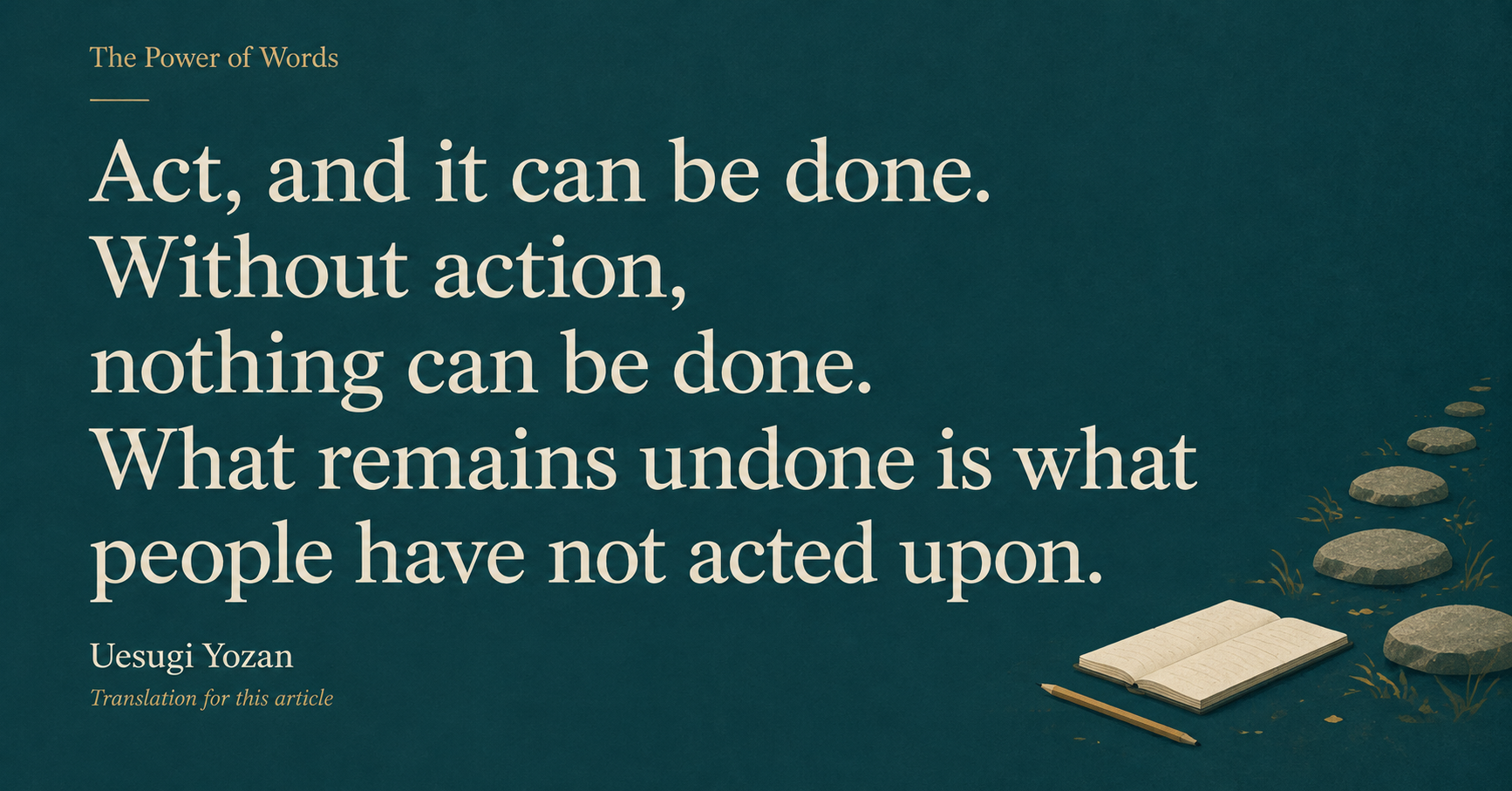
Act, and it can be done. Without action, nothing can be done. What remains undone is what people have not acted upon.

Uesugi Yozan — translated for this article

Original: なせば成る なさねば成らぬ 何事も 成らぬは人のなさぬなりけり. Yonezawa City’s account identifies these words in written guidance Yozan gave to retainers serving his heir, Akitaka, when Yozan moved to his retirement residence. The English wording above is this article’s translation, not an official English version.

An everyday reflection on these words

Touch the task before deciding it is impossible

The quotation places strong emphasis on action. Here, however, we will not use it to claim that effort guarantees success or that every unsuccessful person simply failed to try. The following is our own everyday application, not a complete account of Yozan’s intentions.

Instead, ask whether you have already declared something impossible without beginning it.

Consider a report due next week. Finishing it feels heavy. Opening the file and writing three headings is more concrete.

You might discover a section you can write immediately. Or you might find that essential information is missing. Either discovery gives you something that thinking alone did not.

Give beginning the name of an action

Get serious is difficult to put into a calendar. How would you know when you had done it?

Try naming a visible action instead. For a report, write its purpose at the top of the first page. For tidying, remove one empty box. For studying, read one question.

Small does not mean pointless.

If beginning reveals that you need help, you also gain a clearer question. Instead of saying only that you cannot do it, you can explain what you understand and which condition needs checking.

One thing for today: name your first move

Choose one postponed task and write its first physical action. Thinking about a new job becomes opening one listing. Reviewing your budget becomes opening this month’s statement.

You do not have to reach a final decision today. Let these words prompt a beginning rather than promise a result.

The desk can probably wait until afterward.

How are you feeling? Explore more words for courage.

Related reading

Laozi: A Long Journey Begins Where You Stand
Shinjiro Torii: Before Preparation Becomes a Place to Hide
日本語版を読む

Source

Yonezawa City: Uesugi Yozan’s history (Japanese). The quotation, this article’s translation, and the original reflection are presented separately.

A little inspiration for everyday living

In my Rakuten ROOM, I share everyday items we might put off buying for ourselves but would be happy to receive as gifts. Feel free to browse when you need something. (*^^*)

Shopping from outside Japan? Rakuten Global Express offers international forwarding from Japan. Please check supported destinations, shipping fees, and item restrictions before using the service.

Pre-publication checklist — remove before publishing

Draft only; no publication or schedule requested. Three common English tags and relevant existing tags applied. The Uesugi Yozan person tag remains to be created and assigned after confirmation. Check the category. Add the reciprocal English link to Japanese post 282 after this draft receives an ID. Verify related articles’ publication status, all links, quotation rights, translation, and mobile layout. Search demand has not been validated. Everyday scenes are illustrative, not the site owner’s claimed experiences. Review and remove these editorial notes before the owner decides to publish.

Featured image not generated or assigned. Prompt: landscape 1200×630; sophisticated, quietly playful adult editorial illustration, deep teal, warm ivory, muted gold; notebook, pencil and a small stepping stone at lower right; no portrait. Largest text must be exactly: Act, and it can be done. Without action, nothing can be done. What remains undone is what people have not acted upon. Smaller text: Uesugi Yozan; The Power of Words; Translation for this article. Change line breaks only; no shortening, paraphrasing or punctuation changes. Prioritize quotation readability and generous margins. The image quotation must match the English article, not the Japanese original or headline. Inspect the generated image letter by letter before use; image verification is not yet performed.

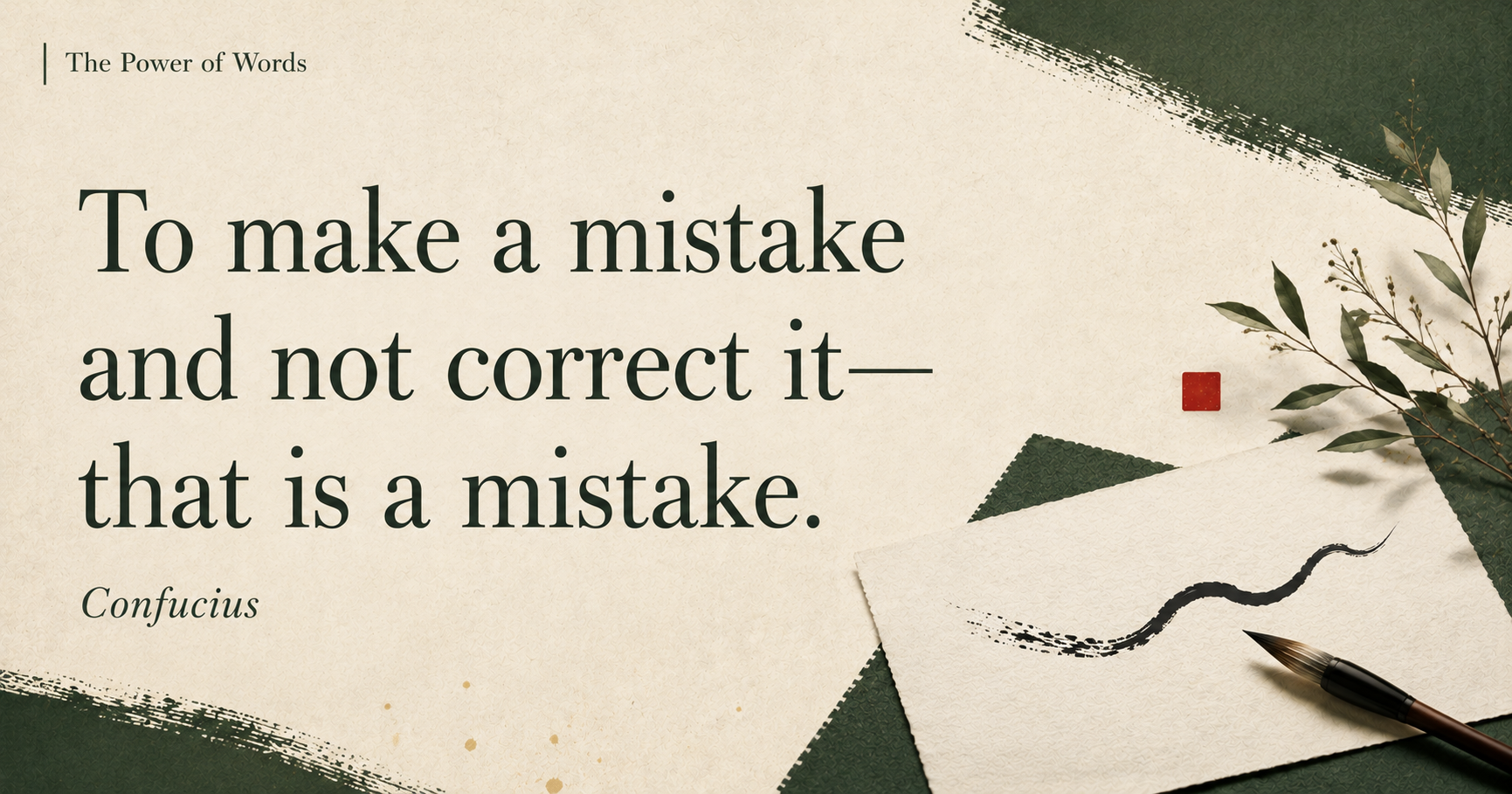
The Power of Words | Confucius: A Mistake Is Not the Whole of You

Words for today

過而不改、是謂過矣。

“To make a mistake and not correct it—that is a mistake.” — Confucius, Analects 15.30. Translation for this article.

Reflection

Sometimes a mistake returns long after the day has ended.

You missed a detail. Interrupted someone. Said something you wish you could take back. The scene repeats until “I made a mistake” becomes “There is something wrong with me.”

For this reflection, let us read the passage as a prompt toward correction, rather than a verdict on a person.

“I did not check carefully enough” leaves room for a different process. “I am useless” turns one event into a judgment about your entire self.

You do not have to make that leap.

What happened? Who was affected? What can you responsibly do now?

Perhaps you need to apologize, correct information, tell someone about an error, or add a check to your routine.

Correction does not erase what happened. An apology also does not require the other person to feel better immediately. Taking responsibility may involve continued attention and patience.

Still, responsibility and endless self-punishment are not the same thing. You can respond seriously without speaking cruelly to yourself.

Nor do you need to accept blame for things outside your responsibility.

Tonight, if the same scene keeps returning, write down one concrete response for tomorrow. If contacting someone now would be inappropriate, choose a suitable time.

Then allow the plan to wait until that time.

You cannot become someone who never made the mistake. But you can decide how to respond to it.

Instead of adding one more accusation, leave yourself one clear next step.

日本語版を読む

Source

Chinese Text Project: The Analects, Wei Ling Gong. The quotation, this article’s translation, and the original reflection are presented separately.

Disclosure: This article includes affiliate links.

A little inspiration for everyday living

A few words can offer a fresh perspective. Sometimes, a thoughtful everyday item can bring a small moment of joy, too.

In my Rakuten ROOM, I share everyday essentials we might put off buying for ourselves but would be happy to receive as gifts. Feel free to take a look! (*^^*)

Shopping from outside Japan? Rakuten Global Express offers international forwarding from Japan. Please check supported destinations, shipping fees, and item restrictions before using the service.

Pre-publication checklist — editorial notes; remove before publishing

Check existing articles for duplicate figures and quotations. Verify and apply the three common tags and the English series tag. Suggested tags: Confucius / Starting Again / Responsibility / en-power-of-words. Verify the English mood-category destination for relationship concerns before adding a link; do not present a Japanese-only collection as an English collection. Confirm that Japanese post 251 and this English post are published together, and add the reciprocal English link to post 251 after this post has an ID. No publication date is set. Intended slot: Day 2, 01:27 JST, subject to the owner’s review and existing schedule.

Featured image not created or assigned. Art direction: a notebook on a desk at night with one passage carefully corrected, soft lamplight, deep blue and pale coral, an atmosphere of beginning again rather than failure. Image quotation: “To make a mistake and not correct it—that is a mistake.” Small text: “The Power of Words · Confucius · Article translation”. Verify spelling, rights, and mobile readability. Review the complete article and remove editorial notes before the owner decides whether to publish or schedule.

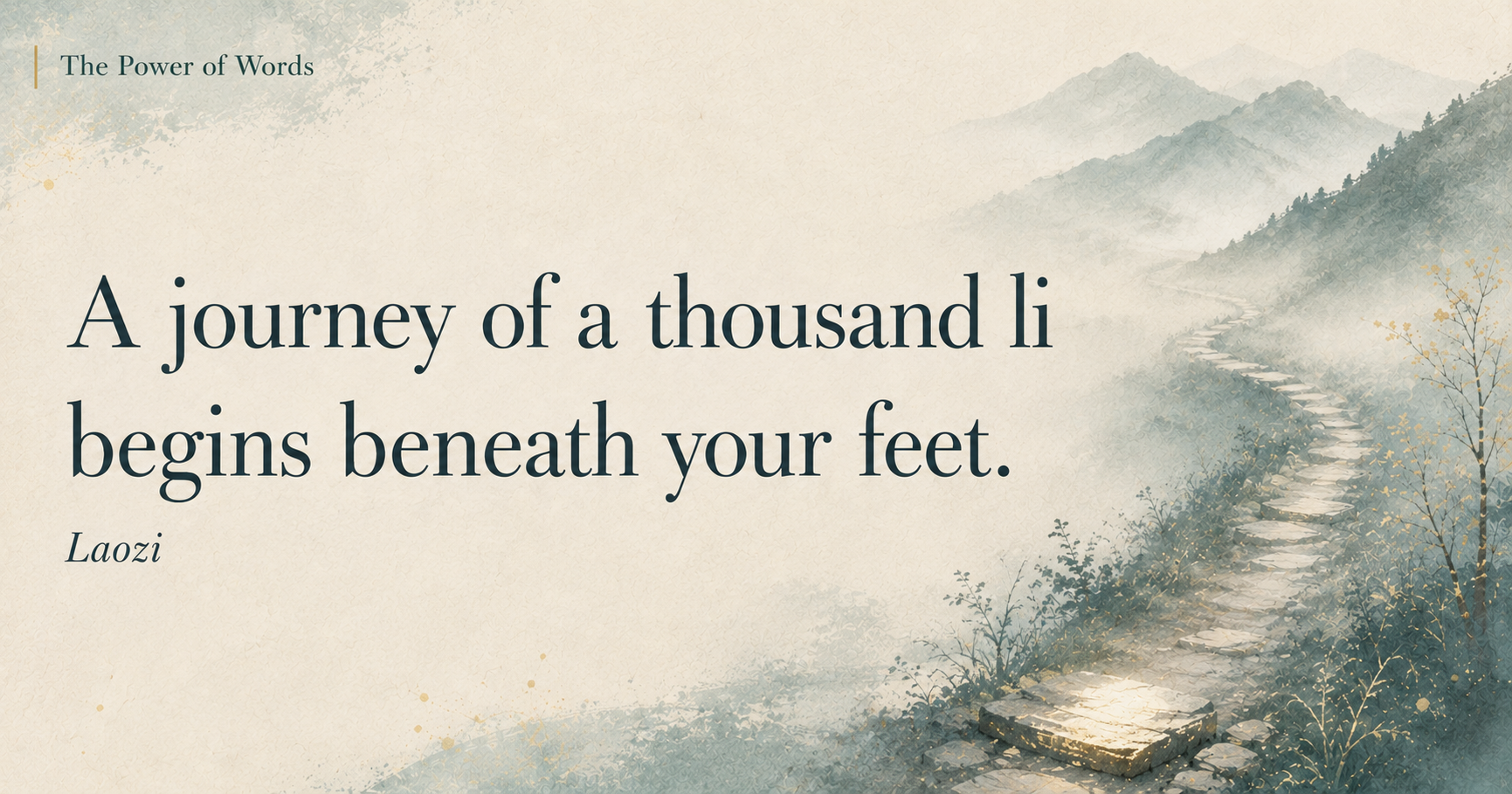
The Power of Words | Laozi: A Long Journey Begins Where You Stand

Words for today

千里之行、始於足下。

“A journey of a thousand li begins beneath your feet.” — Dao De Jing, Chapter 64, traditionally attributed to Laozi. Translation for this article. The original uses li, a Chinese unit of distance.

Reflection

Sometimes you know what you want to do, yet beginning feels difficult.

You want to study, organize your home, or try something new at work. Then you think about everything the goal requires—and find yourself carrying the weight of the entire journey before taking a step.

This passage invites us to bring our attention back to where we stand.

If your goal is to read a book, today’s task does not have to be finishing it. Open it and read a paragraph. If you want a tidier home, begin with one object on your desk. If you need to prepare a proposal, write down one question it must answer.

A small beginning may seem insignificant. Yet touching the task can reveal something that thinking alone cannot: what you understand, what you need, and what might come next.

There is no need to turn this into another demand to be productive every day.

Your starting point changes. Some days you have energy; other days you need rest. Preparing your tools, asking for help, or choosing a sensible time to begin may be the right step for you.

Someone else’s pace does not have to determine yours.

Today, instead of asking, “How will I accomplish all of this?” try asking, “What small part can I touch?”

Leave a note. Read a page. Gather one thing you need. Make it easier for tomorrow’s version of you to continue.

A distant hope becomes connected to daily life through something close enough to do now.

日本語版を読む

Source

Chinese Text Project: Dao De Jing, Chapter 64. The reflection above is original commentary, separate from the quotation.

Disclosure: This article includes affiliate links.

A little inspiration for everyday living

A few words can offer a fresh perspective. Sometimes, a thoughtful everyday item can bring a small moment of joy, too.

In my Rakuten ROOM, I share everyday essentials we might put off buying for ourselves but would be happy to receive as gifts. Feel free to take a look! (*^^*)

Shopping from outside Japan? Rakuten Global Express offers international forwarding from Japan. Please check supported destinations, shipping fees, and item restrictions before using the service.

Pre-publication checklist — editorial notes; remove before publishing

Check existing articles for duplicate figures and quotations. Verify and apply the three common tags and the English series tag. Suggested tags: Laozi / First Steps / Courage / en-power-of-words. Verify the English mood-category destination before adding a link; do not link to a Japanese-only collection as an English collection. Confirm that Japanese post 247 and this English post are published together, and add the reciprocal English link to post 247 after this post has an ID. No publication date is set. Intended slot: Day 1, 01:27 JST, subject to the owner’s review and existing schedule.

Featured image not created or assigned. Art direction: a misty mountain path at dawn, a softly lit stepping stone in the foreground, blue-green and ivory colors. Image quotation: “A journey of a thousand li begins beneath your feet.” Small text: “The Power of Words · Laozi · Article translation”. Verify spelling, rights, and mobile readability. Review the complete article and remove editorial notes before the owner decides whether to publish or schedule.

The Power of Words | Benjamin Franklin: Your Quiet Actions Still Count

Words for today

Well done is better than well said.

— Benjamin Franklin, Poor Richard, 1737.

Reflection

After a meeting, you may find yourself thinking, “I wish I had explained that better.”

Other people seem fluent and confident. You hesitate, lose your place, or struggle to find the right words. It becomes easy to overlook everything else you brought to the day.

For this reflection, Franklin’s words are an invitation to notice your actions—not a demand to compensate for imperfect speech by working harder.

You remembered to reply. You checked a detail rather than guessing. You returned a tool so the next person could find it.

These actions may attract little attention. Still, someone benefits from them. A task becomes easier. An uncertainty is resolved. A person has one less thing to worry about.

Quiet usefulness deserves recognition too.

This does not mean words are unnecessary. If you are running late, communicate. If you have caused harm, apologize. If someone has helped you, thank them. Nor should you silently accept more work than you can manage.

Words and actions can support each other.

A promise becomes clearer when you explain what you can do and when. Appreciation becomes tangible when you add a thoughtful gesture.

On your way home, try remembering one thing you did with care.

Perhaps you responded, checked, organized, or honestly said that you needed help. Does that really add up to a day in which you did nothing?

An awkward conversation does not erase the rest of your efforts.

Your words may not have been polished. Your care was still real.

日本語版を読む

Source

Founders Online, National Archives: Poor Richard, 1737. The reflection above is original commentary, separate from the quotation.

Disclosure: This article includes affiliate links.

A little inspiration for everyday living

A few words can offer a fresh perspective. Sometimes, a thoughtful everyday item can bring a small moment of joy, too.

In my Rakuten ROOM, I share everyday essentials we might put off buying for ourselves but would be happy to receive as gifts. Feel free to take a look! (*^^*)

Shopping from outside Japan? Rakuten Global Express offers international forwarding from Japan. Please check supported destinations, shipping fees, and item restrictions before using the service.

Pre-publication checklist — editorial notes; remove before publishing

Check existing articles for duplicate figures and quotations. Verify and apply the three common tags and the English series tag. Suggested tags: Benjamin Franklin / Integrity / Action / en-power-of-words. Verify the English mood-category destination for comparing yourself to others before adding a link; do not present a Japanese-only collection as an English collection. Confirm that Japanese post 249 and this English post are published together, and add the reciprocal English link to post 249 after this post has an ID. No publication date is set. Intended slot: Day 1, 12:07 JST, subject to the owner’s review and existing schedule.

Featured image not created or assigned. Art direction: a tidy wooden work desk, a closed notebook and a single pencil, amber and navy colors, quiet afternoon light. Image quotation: “Well done is better than well said.” Small text: “The Power of Words · Benjamin Franklin · 1737”. Verify spelling, rights, and mobile readability. Review the complete article and remove editorial notes before the owner decides whether to publish or schedule.

The Power of Words | Kenji Miyazawa: A Gentle Place to Return To

Disclosure: This article contains affiliate advertising.

“Always smiling quietly.”

Kenji Miyazawa

Translated for this article from “イツモシヅカニワラッテヰル” in Miyazawa’s “〔雨ニモマケズ〕.” This is not an official English translation.

You spoke a little sharply this morning.

You were busy. There were reasons. Still, your own voice keeps replaying in your mind: “I could have said that differently.”

Do not make smiling another obligation

The poem also expresses the wish to become such a person.

My own reading is not that we must smile regardless of how we feel.

Some days are difficult. Grading our smiles on those days would only add another burden.

Instead, I want to hold the image as somewhere to return when I have lost my patience.

One sharp moment does not have to define the day

We cannot remove what we said, but we can add something different.

“I sounded harsh earlier.”
“I was rushing. I’m sorry.”
“Could you tell me again?”

The other person may not respond warmly straight away. Even so, we can take responsibility for how we speak next.

Begin with gentleness, not cheerfulness

Answer carefully. Let someone finish. If you are tired, say so rather than forcing a conversation.

We do not need to be entertaining or endlessly upbeat to treat others—and ourselves—with care.

Today was not perfectly calm.

The next sentence is still yours to choose.

Quotation and poem source: Aozora Bunko: Kenji Miyazawa, “〔雨ニモマケズ〕” (Japanese).

How are you feeling today?

Struggling with relationships? Explore more words for connection.

Shopping from outside Japan? Rakuten Global Express offers international forwarding from Japan. Please check supported destinations, shipping fees, and item restrictions before using the service.

The Power of Words | Natsume Soseki: Different Opinions Do Not Have to Become Distance

Disclosure: This article contains affiliate advertising.

“I may face left, and you may face right.”

Natsume Soseki

Translated for this article from an excerpt of Soseki’s “私の個人主義.” This is not an official English translation. The surrounding passage discusses freedom for oneself and others, with a qualification concerning effects on others.

You recommend a film you loved. The other person was not impressed.

It is only a difference in taste. Yet it can feel as if they rejected a small part of you.

Soon, sharing your enjoyment becomes a presentation designed to change their mind.

Here is my own everyday reflection on Soseki’s words.

Agreement is not the only successful ending

It feels good when someone enjoys what we enjoy.

But a conversation can continue without matching conclusions.

“What didn’t work for you?”
“I hadn’t seen it that way.”

Ask to understand, rather than to win agreement.

Your enjoyment does not need endless defending

You can also say, “This is the part I love,” and leave it there.

Not demanding agreement does not mean withdrawing your own feelings.

There can be room for your enjoyment and their different response.

Respect still leaves room for boundaries

Respecting differences does not require accepting harmful behavior. Shared work needs agreements, and difficulties may need clear boundaries.

But a difference in taste does not always need a winner.

Next time opinions diverge, pause before persuading—or assuming you have been disliked.

You can face different directions and still remain in conversation.

Quotation and background source: Aozora Bunko: Natsume Soseki, “私の個人主義” (Japanese).

How are you feeling today?

Struggling with relationships? Explore more words for connection.