The Power of Words | Soichiro Honda: When Your Work Feels Hard to See

Disclosure: This article includes affiliate links.

You were busy all day. Yet when someone asks what you accomplished, it is surprisingly difficult to explain.

You answered a question, replenished supplies, and left a handover note so the next person would not get stuck.

No spectacular result. Nothing that earned applause in a meeting. On days like these, your own contribution can begin to look small.

Words for today

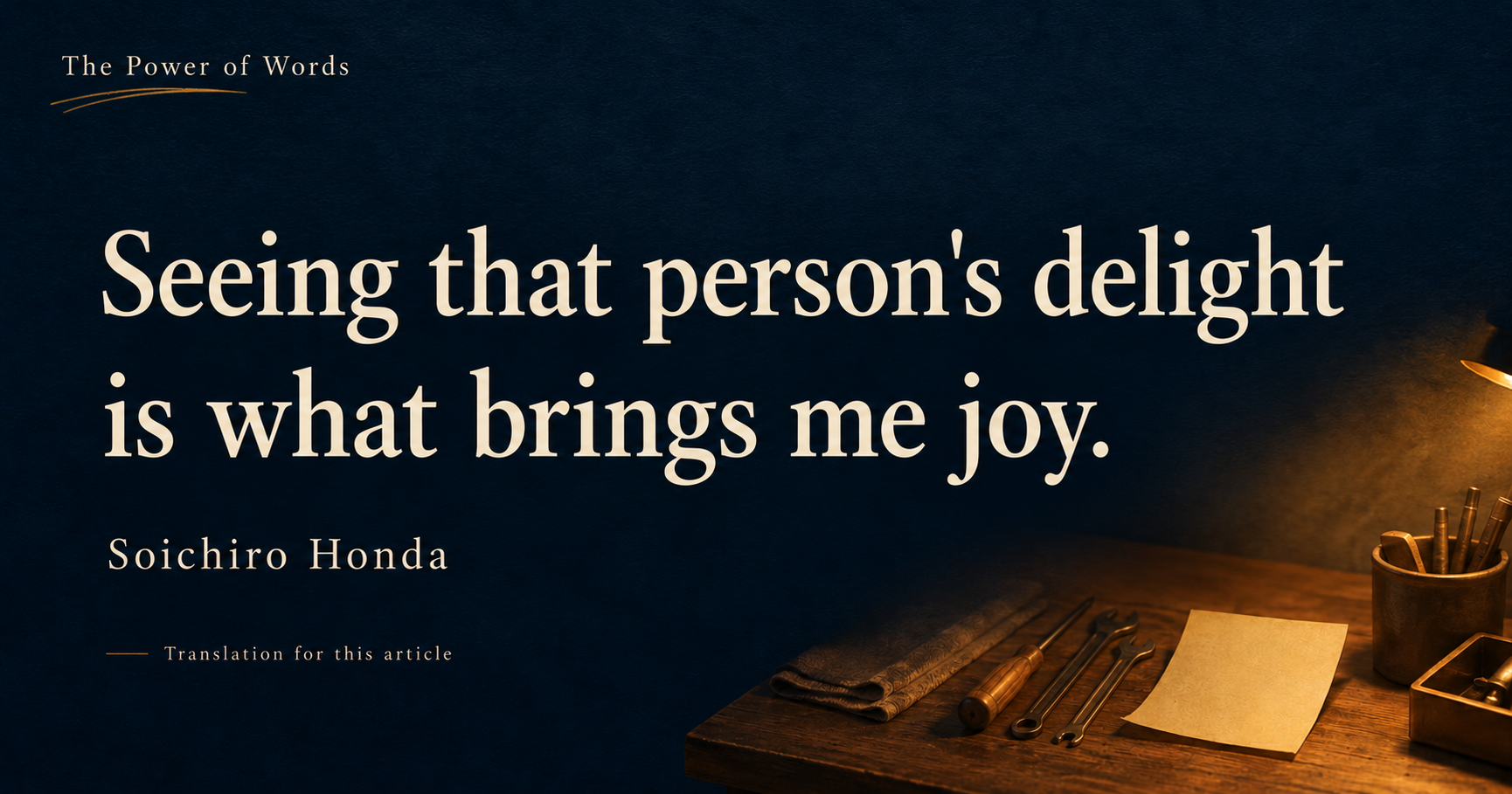
Seeing that person’s delight is what brings me joy.

Soichiro Honda — translated for this article

Original: その人の 喜んでくれた姿を見ることが 自分の喜びなんですね. Honda’s official Japanese page about its inherited philosophy presents these words alongside the story of a bicycle engine developed with his wife’s difficult shopping trips in mind. The English quotation above is this article’s translation, not an official Honda translation.

An everyday reflection on these words

Notice what changed for someone else

If you look for the value of your work only in sales figures or formal recognition, some days offer little evidence. But did something you did make another person’s task easier?

Consider a handover note. Instead of saying that something is in its usual place, you write: second shelf from the top, inside the blue box. That small detail may save the next person a search.

If they tell you it helped, you can accept that response as one sign of useful work. The following reflection applies the quotation to ordinary situations; it does not claim that Honda was speaking about these particular examples.

Care does not always mean taking on more

Thinking about others can easily turn into accepting another task. You could stay late. They might struggle if you refuse.

But this quotation need not become a reason to wear yourself down.

There are other ways to help: explain what you can finish today, connect a question to the right person instead of guessing, or turn a repeated explanation into a short guide.

Helping someone avoid the same difficulty next time is a form of consideration too.

A lack of thanks does not erase everything

Appreciation does not arrive every time. Someone may be too busy to notice. What you intended to help with may not be what they actually needed.

That does not make your worth depend on their reaction.

The point is not to turn other people’s gratitude into a scorecard. It is to picture the person on the other side of the task and ask what would genuinely help.

One thing for today: remove one point of confusion

Choose one piece of work and consider what the next person might have trouble finding or understanding: the file location, the section that needs checking, or the deadline for a reply.

If one extra sentence would clarify it, add that sentence and stop there.

It may not be a dramatic achievement. Still, someone may spend less time searching or understand what to do immediately.

When your contribution feels invisible, remember not only what you completed but whose day you made a little easier.

How are you feeling? Explore more words for connection.

Related reading

Benjamin Franklin: Your Quiet Actions Still Count
Kenji Miyazawa: A Gentle Place to Return To
日本語版を読む

Source

Honda’s official page: inherited philosophy (Japanese). The quotation, this article’s translation, and the original reflection are presented separately.

A little inspiration for everyday living

In my Rakuten ROOM, I share everyday items we might put off buying for ourselves but would be happy to receive as gifts. Feel free to browse when you need something. (*^^*)

Shopping from outside Japan? Rakuten Global Express offers international forwarding from Japan. Please check supported destinations, shipping fees, and item restrictions before using the service.

Pre-publication checklist — remove before publishing

Draft only; no publication date or schedule requested. Three common English tags, Connection and Integrity applied. The Soichiro Honda person tag remains to be created and assigned after confirmation. Check the category. Add the reciprocal English link to Japanese post 284 after this draft receives an ID. Verify related articles’ publication status, all links, quotation rights, translation, and mobile layout. The quotation’s original publication and date have not been established; do not invent them. Search demand has not been validated. Examples are illustrative, not claimed experiences of the site owner. Review and remove editorial notes before the owner decides to publish.

Featured image not generated or assigned. Prompt: landscape 1200×630; sophisticated, quietly playful adult editorial illustration matching the Japanese version; deep navy, warm ivory and amber; tidy workbench, tools and a handover note at lower right; no portrait or corporate logo. Largest quotation must be exactly: Seeing that person’s delight is what brings me joy. Smaller text: Soichiro Honda; The Power of Words; Translation for this article. Preserve wording and punctuation; adjust line breaks only. No article headline or invented slogan. Keep generous margins and readable text. Compare the generated image with this English quotation letter by letter before use; image verification has not yet been performed.
The Power of Words | Confucius: A Mistake Is Not the Whole of You

Words for today

過而不改、是謂過矣。

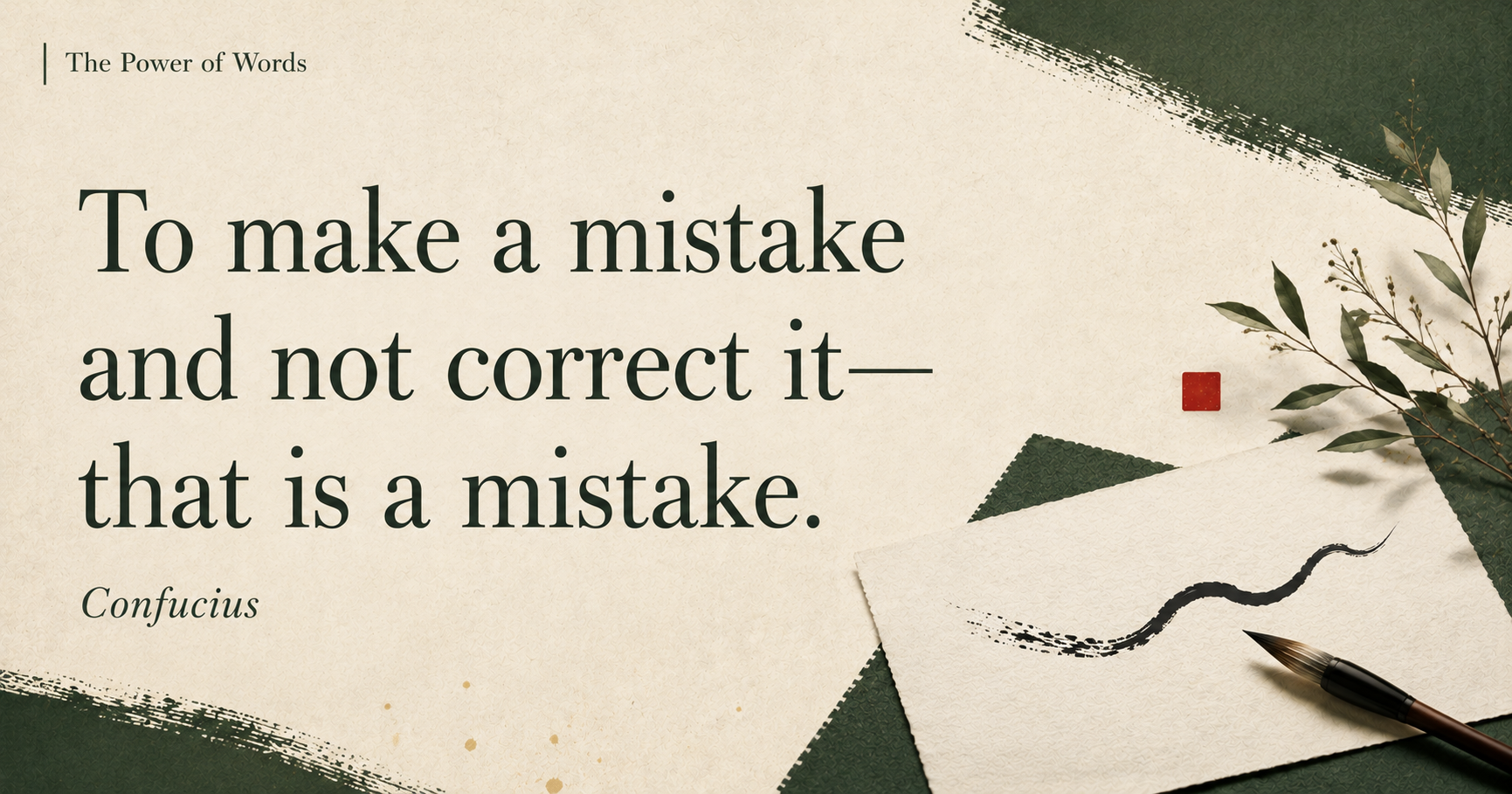
“To make a mistake and not correct it—that is a mistake.” — Confucius, Analects 15.30. Translation for this article.

Reflection

Sometimes a mistake returns long after the day has ended.

You missed a detail. Interrupted someone. Said something you wish you could take back. The scene repeats until “I made a mistake” becomes “There is something wrong with me.”

For this reflection, let us read the passage as a prompt toward correction, rather than a verdict on a person.

“I did not check carefully enough” leaves room for a different process. “I am useless” turns one event into a judgment about your entire self.

You do not have to make that leap.

What happened? Who was affected? What can you responsibly do now?

Perhaps you need to apologize, correct information, tell someone about an error, or add a check to your routine.

Correction does not erase what happened. An apology also does not require the other person to feel better immediately. Taking responsibility may involve continued attention and patience.

Still, responsibility and endless self-punishment are not the same thing. You can respond seriously without speaking cruelly to yourself.

Nor do you need to accept blame for things outside your responsibility.

Tonight, if the same scene keeps returning, write down one concrete response for tomorrow. If contacting someone now would be inappropriate, choose a suitable time.

Then allow the plan to wait until that time.

You cannot become someone who never made the mistake. But you can decide how to respond to it.

Instead of adding one more accusation, leave yourself one clear next step.

日本語版を読む

Source

Chinese Text Project: The Analects, Wei Ling Gong. The quotation, this article’s translation, and the original reflection are presented separately.

Disclosure: This article includes affiliate links.

A little inspiration for everyday living

A few words can offer a fresh perspective. Sometimes, a thoughtful everyday item can bring a small moment of joy, too.

In my Rakuten ROOM, I share everyday essentials we might put off buying for ourselves but would be happy to receive as gifts. Feel free to take a look! (*^^*)

Shopping from outside Japan? Rakuten Global Express offers international forwarding from Japan. Please check supported destinations, shipping fees, and item restrictions before using the service.

Pre-publication checklist — editorial notes; remove before publishing

Check existing articles for duplicate figures and quotations. Verify and apply the three common tags and the English series tag. Suggested tags: Confucius / Starting Again / Responsibility / en-power-of-words. Verify the English mood-category destination for relationship concerns before adding a link; do not present a Japanese-only collection as an English collection. Confirm that Japanese post 251 and this English post are published together, and add the reciprocal English link to post 251 after this post has an ID. No publication date is set. Intended slot: Day 2, 01:27 JST, subject to the owner’s review and existing schedule.

Featured image not created or assigned. Art direction: a notebook on a desk at night with one passage carefully corrected, soft lamplight, deep blue and pale coral, an atmosphere of beginning again rather than failure. Image quotation: “To make a mistake and not correct it—that is a mistake.” Small text: “The Power of Words · Confucius · Article translation”. Verify spelling, rights, and mobile readability. Review the complete article and remove editorial notes before the owner decides whether to publish or schedule.

The Power of Words | Kenji Miyazawa: A Gentle Place to Return To

Disclosure: This article contains affiliate advertising.

“Always smiling quietly.”

Kenji Miyazawa

Translated for this article from “イツモシヅカニワラッテヰル” in Miyazawa’s “〔雨ニモマケズ〕.” This is not an official English translation.

You spoke a little sharply this morning.

You were busy. There were reasons. Still, your own voice keeps replaying in your mind: “I could have said that differently.”

Do not make smiling another obligation

The poem also expresses the wish to become such a person.

My own reading is not that we must smile regardless of how we feel.

Some days are difficult. Grading our smiles on those days would only add another burden.

Instead, I want to hold the image as somewhere to return when I have lost my patience.

One sharp moment does not have to define the day

We cannot remove what we said, but we can add something different.

“I sounded harsh earlier.”
“I was rushing. I’m sorry.”
“Could you tell me again?”

The other person may not respond warmly straight away. Even so, we can take responsibility for how we speak next.

Begin with gentleness, not cheerfulness

Answer carefully. Let someone finish. If you are tired, say so rather than forcing a conversation.

We do not need to be entertaining or endlessly upbeat to treat others—and ourselves—with care.

Today was not perfectly calm.

The next sentence is still yours to choose.

Quotation and poem source: Aozora Bunko: Kenji Miyazawa, “〔雨ニモマケズ〕” (Japanese).

How are you feeling today?

Struggling with relationships? Explore more words for connection.

Shopping from outside Japan? Rakuten Global Express offers international forwarding from Japan. Please check supported destinations, shipping fees, and item restrictions before using the service.

The Power of Words | Natsume Soseki: Different Opinions Do Not Have to Become Distance

Disclosure: This article contains affiliate advertising.

“I may face left, and you may face right.”

Natsume Soseki

Translated for this article from an excerpt of Soseki’s “私の個人主義.” This is not an official English translation. The surrounding passage discusses freedom for oneself and others, with a qualification concerning effects on others.

You recommend a film you loved. The other person was not impressed.

It is only a difference in taste. Yet it can feel as if they rejected a small part of you.

Soon, sharing your enjoyment becomes a presentation designed to change their mind.

Here is my own everyday reflection on Soseki’s words.

Agreement is not the only successful ending

It feels good when someone enjoys what we enjoy.

But a conversation can continue without matching conclusions.

“What didn’t work for you?”
“I hadn’t seen it that way.”

Ask to understand, rather than to win agreement.

Your enjoyment does not need endless defending

You can also say, “This is the part I love,” and leave it there.

Not demanding agreement does not mean withdrawing your own feelings.

There can be room for your enjoyment and their different response.

Respect still leaves room for boundaries

Respecting differences does not require accepting harmful behavior. Shared work needs agreements, and difficulties may need clear boundaries.

But a difference in taste does not always need a winner.

Next time opinions diverge, pause before persuading—or assuming you have been disliked.

You can face different directions and still remain in conversation.

Quotation and background source: Aozora Bunko: Natsume Soseki, “私の個人主義” (Japanese).

How are you feeling today?

Struggling with relationships? Explore more words for connection.

The Power of Words | Misuzu Kaneko: Someone Else’s Strength Does Not Make You Smaller

Disclosure: This article contains affiliate advertising.

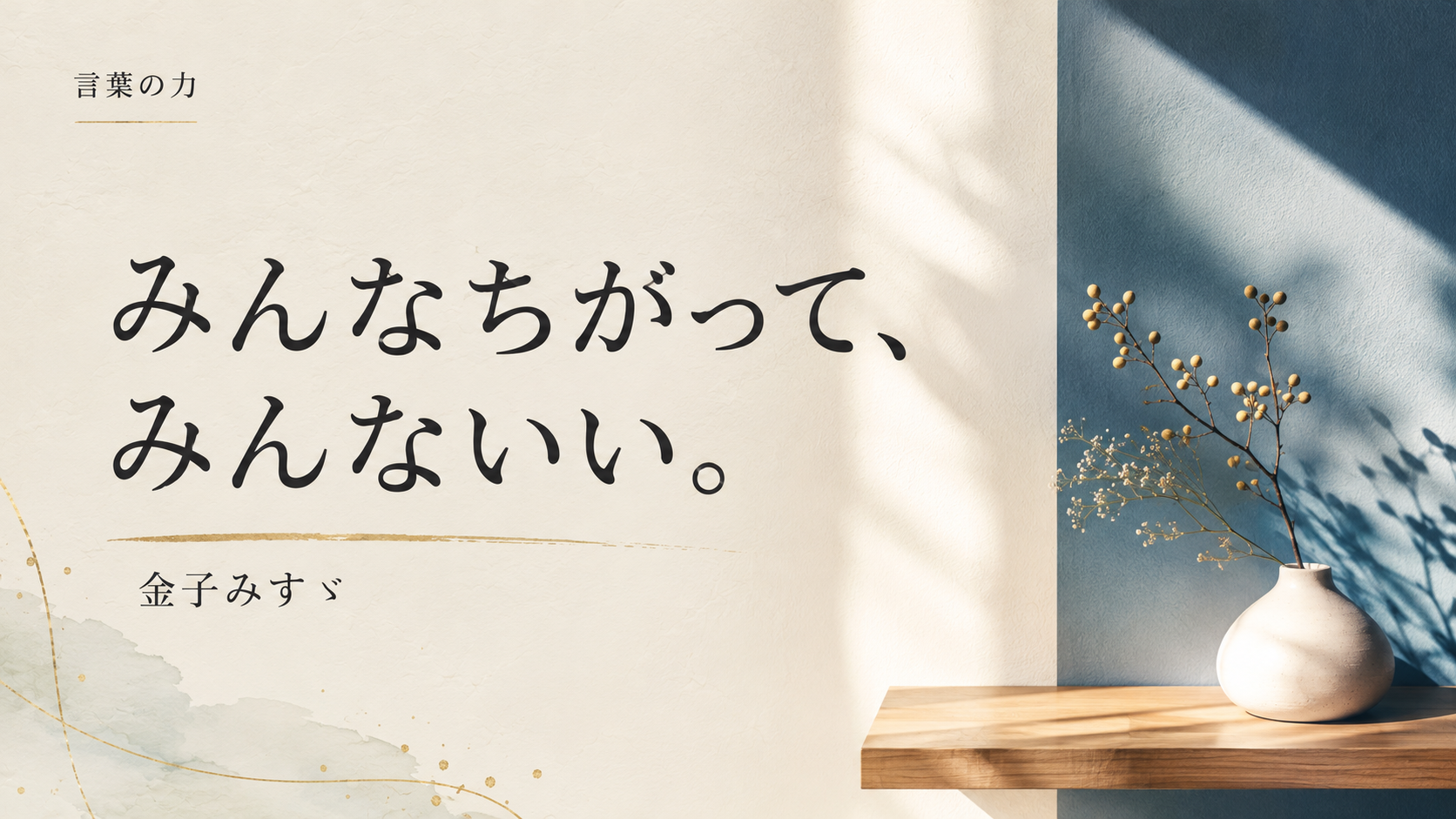
“We are all different, and each of us is good.”

Misuzu Kaneko, “私と小鳥と鈴と” (“Me, the Little Bird, and the Bell,” title translated for this article).

The quotation is translated here from the Japanese text published in the Kaneko Misuzu Memorial Museum director’s column on Nagato City’s website; this is not an official English translation.

Someone else’s strengths can make us suddenly notice everything we think we lack.

They speak confidently. Work quickly. Feel at ease with people they have just met.

Once we begin comparing, our own strengths seem remarkably good at hiding.

On days like that, I want to return to Misuzu Kaneko’s words.

Her poem brings together a little bird, a bell, and the speaker, describing things each can and cannot do.

What follows is my personal reflection on everyday life.

Do not turn someone’s strength into your shortcoming

We hear someone explain something well and immediately think, “I am too slow when I speak.”

But appreciating them and judging ourselves are separate acts.

We can stop at “That was clear.” We can think, “There is something I could learn from that.”

We do not have to lower ourselves every time we praise someone else.

Their strength does not reduce our worth.

Some contributions are quieter

One person offers an idea immediately. Another notices something missing after listening carefully.

One person gets a project moving. Another makes it easier to sustain.

Different situations make different contributions more visible.

When reflecting on your day, ask not only, “Did I stand out?” but also, “What did I help support?”

You checked a detail. Organized someone’s thoughts. Left a note so the next person would not struggle.

Those contributions do not have to disappear because they were quiet.

Being different and choosing to grow can coexist

I do not want to narrow this quotation into “Nothing ever needs to change.”

We can practice a difficult skill or reconsider a troublesome habit.

But we do not have to begin with the belief that our present selves are worthless.

We can change without rejecting ourselves. Respecting differences also does not mean ignoring someone’s needs or accepting harmful behavior.

If someone seems especially impressive today, acknowledge one good thing about them.

Then notice one thing you did, too.

Being different does not automatically mean being deficient. I would like to keep that thought close, like a small note at the corner of a desk.

Quotation and poem source: Nagato City: Kaneko Misuzu Memorial Museum director Setsuo Yazaki’s column, “私と小鳥と鈴と” (Japanese).

The Power of Words | Anne Frank: Something to Give, Even on an Ordinary Day

日本語で読む | English

Disclosure: This article contains affiliate advertising.

“And you can always, always give something, even if it is only kindness!”

Anne Frank, “Give.” The wording and its attribution are documented in Snopes’ examination of the quotation.

We may want to help someone and still feel that we do not have enough to offer.

Not enough time. Not much money to spare. No special knowledge.

While we wait to have something more impressive, the day passes.

Anne Frank’s words bring the idea of giving closer to ordinary life. What follows is my own reflection.

Help does not have to solve everything

We may not be able to resolve someone’s entire problem, but there may still be something we can do.

Listen without interrupting. Thank someone for a specific thing they did. Ask how they are doing without assuming that we already know.

A small gesture can give someone a little room to breathe. Kindness does not always require a grand act.

Let the other person help define kindness

What we intend as helpful may not be what someone needs.

They may want to be heard rather than advised. They may need quiet rather than repeated questions.

Instead of rushing to do something for them, we can ask, “What would be helpful right now?”

Offering help and giving someone space can both be ways of respecting them.

Kindness does not require exhausting yourself

We do not have to accept every request.

We can explain that today is difficult, offer what we can manage, or suggest another person or approach.

This article is not an invitation to give until nothing remains for yourself.

What could you offer someone today?

“Thank you—that helped.”
“Thank you for telling me.”
“I cannot do all of it, but I can help with this part.”

Kindness need not be a gift reserved for special occasions. There may be a place for it in an ordinary day.

The Power of Words | Tamori: What We Miss When We Try Too Hard

日本語で読む | English

Disclosure: This article contains affiliate advertising.

“Those full of motivation should leave.”

Tamori. Source: a Diamond Online article (Japanese) introducing the book Datsuryoku Meigen. English translations of quoted words are prepared for this article, not official translations.

“I need to try harder.”

When we think this, we usually have a particular goal in mind.

We want results.
We want recognition.
We want to meet expectations.

So we keep preparing, remain on edge, and try to anticipate problems before we make mistakes.

Yet sometimes, the harder we try, the less we hear the voices around us.

At such moments, Tamori’s words, “Those full of motivation should leave,” can come as a surprise.

Why tell motivated people to leave?

The Diamond Online article connects this remark with Tamori’s observation that motivated people “look only at the center.” In comedy, interesting things begin at the edges, but these people overlook them.

What follows is my own interpretation.

I feel these words are not rejecting people who make an effort, but questioning how narrow our vision can become when we tense up too much.

The moment we decide, “It has to be done this way,” everything else disappears from view.

We try to speak as planned and miss the other person’s expression.
We try to explain our ideas and stop listening before the other person finishes.
We try to be helpful and take on things nobody asked us to do.

None of this comes from bad intentions.

On the contrary, we want to make things better.

Even so, our eagerness can sometimes pull us away from the person or situation right in front of us.

Relaxing is not the same as being careless

When we hear “relax,” it may sound like cutting corners.

But I want to distinguish between the two.

Cutting corners means leaving out what needs to be done.

Relaxing means not making ourselves more rigid than necessary.

Prepare.
Keep promises.
Check what you do not understand.

Then ease, just a little, the feeling that you absolutely must get everything right.

This leaves room to hear something unexpected, or to admit a mistake and try again.

You can listen carefully without trying to look impressive.

You can say, “I didn’t know that,” even when you cannot give a perfect answer.

That kind of room is something I want to value when connecting with others.

Look at what is in front of you, not just your own effort

When something goes wrong, I can imagine myself thinking only about increasing my effort.

Prepare more.
Explain more.
Do more myself.

But before that, there are things worth reconsidering.

How is the other person responding right now?
What is actually needed?
Am I moving the conversation forward on my own?

Instead of increasing our effort, broaden the area we are looking at.

What makes these words interesting, I think, is how they invite us to question “motivation,” something that usually sounds entirely positive.

If you feel a little tense in your interactions today, do not rush to an answer. Listen to one more thing the other person has to say.

Before trying to prove something, look at what is happening in front of you.

Leave room for someone else in the space that was filled with your own effort.

Perhaps there are things we can receive precisely because we have relaxed.