The Power of Words | Uesugi Yozan: Give That Postponed Task a Small Beginning

Disclosure: This article includes affiliate links.

Why does a difficult task suddenly make tidying your desk feel so urgent?

Before starting the report, you check your email. Before answering the email, you check your calendar. Somehow it is lunchtime. You tell yourself you were preparing—which is technically a kind of activity.

A task can look largest before you have touched it.

Words for today

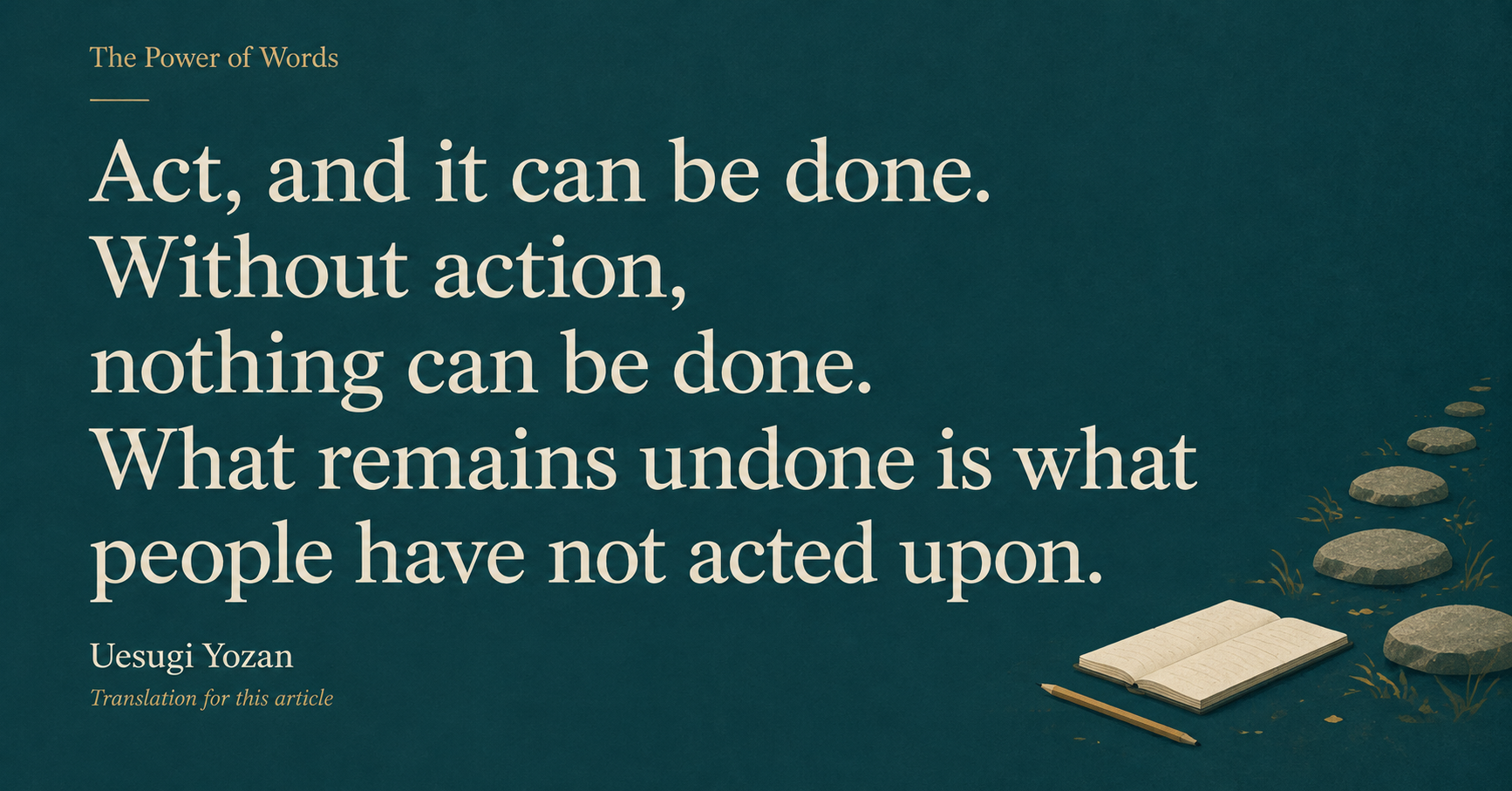
Act, and it can be done. Without action, nothing can be done. What remains undone is what people have not acted upon.

Uesugi Yozan — translated for this article

Original: なせば成る なさねば成らぬ 何事も 成らぬは人のなさぬなりけり. Yonezawa City’s account identifies these words in written guidance Yozan gave to retainers serving his heir, Akitaka, when Yozan moved to his retirement residence. The English wording above is this article’s translation, not an official English version.

An everyday reflection on these words

Touch the task before deciding it is impossible

The quotation places strong emphasis on action. Here, however, we will not use it to claim that effort guarantees success or that every unsuccessful person simply failed to try. The following is our own everyday application, not a complete account of Yozan’s intentions.

Instead, ask whether you have already declared something impossible without beginning it.

Consider a report due next week. Finishing it feels heavy. Opening the file and writing three headings is more concrete.

You might discover a section you can write immediately. Or you might find that essential information is missing. Either discovery gives you something that thinking alone did not.

Give beginning the name of an action

Get serious is difficult to put into a calendar. How would you know when you had done it?

Try naming a visible action instead. For a report, write its purpose at the top of the first page. For tidying, remove one empty box. For studying, read one question.

Small does not mean pointless.

If beginning reveals that you need help, you also gain a clearer question. Instead of saying only that you cannot do it, you can explain what you understand and which condition needs checking.

One thing for today: name your first move

Choose one postponed task and write its first physical action. Thinking about a new job becomes opening one listing. Reviewing your budget becomes opening this month’s statement.

You do not have to reach a final decision today. Let these words prompt a beginning rather than promise a result.

The desk can probably wait until afterward.

How are you feeling? Explore more words for courage.

Related reading

Laozi: A Long Journey Begins Where You Stand
Shinjiro Torii: Before Preparation Becomes a Place to Hide
日本語版を読む

Source

Yonezawa City: Uesugi Yozan’s history (Japanese). The quotation, this article’s translation, and the original reflection are presented separately.

A little inspiration for everyday living

In my Rakuten ROOM, I share everyday items we might put off buying for ourselves but would be happy to receive as gifts. Feel free to browse when you need something. (*^^*)

Shopping from outside Japan? Rakuten Global Express offers international forwarding from Japan. Please check supported destinations, shipping fees, and item restrictions before using the service.

Pre-publication checklist — remove before publishing

Draft only; no publication or schedule requested. Three common English tags and relevant existing tags applied. The Uesugi Yozan person tag remains to be created and assigned after confirmation. Check the category. Add the reciprocal English link to Japanese post 282 after this draft receives an ID. Verify related articles’ publication status, all links, quotation rights, translation, and mobile layout. Search demand has not been validated. Everyday scenes are illustrative, not the site owner’s claimed experiences. Review and remove these editorial notes before the owner decides to publish.

Featured image not generated or assigned. Prompt: landscape 1200×630; sophisticated, quietly playful adult editorial illustration, deep teal, warm ivory, muted gold; notebook, pencil and a small stepping stone at lower right; no portrait. Largest text must be exactly: Act, and it can be done. Without action, nothing can be done. What remains undone is what people have not acted upon. Smaller text: Uesugi Yozan; The Power of Words; Translation for this article. Change line breaks only; no shortening, paraphrasing or punctuation changes. Prioritize quotation readability and generous margins. The image quotation must match the English article, not the Japanese original or headline. Inspect the generated image letter by letter before use; image verification is not yet performed.

The Power of Words | Marcus Aurelius: You Can Change the Way Forward

Words for today

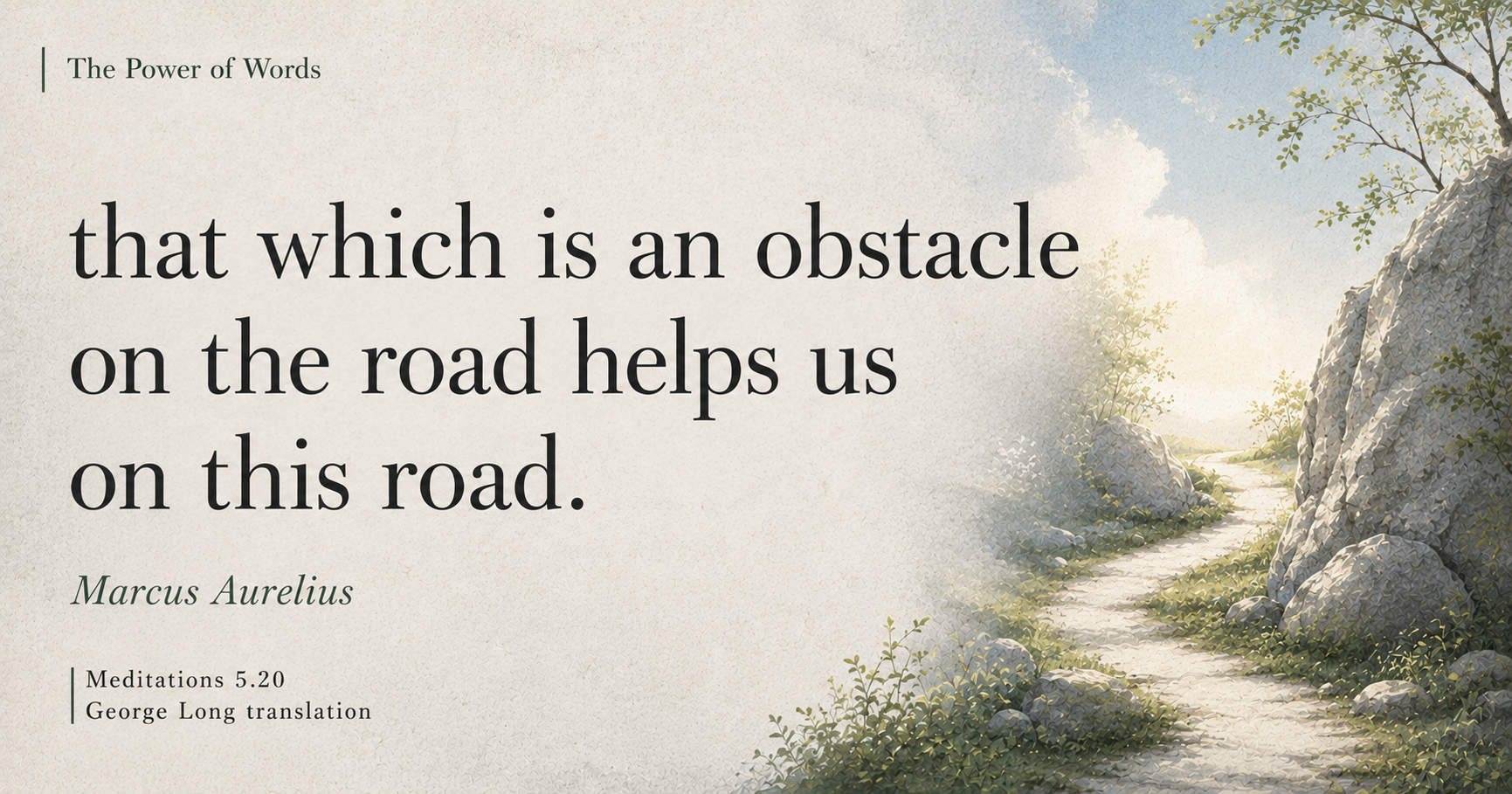
that which is an obstacle on the road helps us on this road.

— Marcus Aurelius, Meditations 5.20, translated by George Long; excerpt.

Reflection

You have a plan, but something keeps stopping it.

A reply does not arrive. A tool fails. Another attempt ends at the same point. Soon, a problem with the process begins to feel like a judgment about you.

Yet an obstacle is not a measure of your worth.

In this passage, Marcus describes the mind’s capacity to adapt its response to what blocks its activity. For everyday life, that offers a useful question: must the goal and the original method always stay together?

When a door will not open, pushing harder is not your only option.

You can investigate the conditions, look for another entrance, ask someone with relevant knowledge, or reconsider the order of your tasks.

Learning that an approach does not work under certain conditions is information. It need not become an accusation.

This does not mean every painful experience must be called a blessing. You do not have to endure danger or mistreatment to turn it into personal growth. Leaving, seeking support, and choosing not to continue can be responsible decisions.

Nor can every external problem be solved by adjusting your attitude.

Still, where a choice remains, you may be able to change the next move.

Instead of asking only, “Why can’t I do this?” try, “What would help me make the next decision?”

Clarify what is missing. Discuss the deadline. Consult someone else. Rest before reconsidering.

You can care about a destination without remaining loyal to the first route you chose.

Changing direction does not have to mean giving up.

日本語版を読む

Source

MIT Internet Classics Archive: The Meditations, Book Five, translated by George Long, section 20. The reflection above is original commentary, separate from the quotation.

Disclosure: This article includes affiliate links.

A little inspiration for everyday living

A few words can offer a fresh perspective. Sometimes, a thoughtful everyday item can bring a small moment of joy, too.

In my Rakuten ROOM, I share everyday essentials we might put off buying for ourselves but would be happy to receive as gifts. Feel free to take a look! (*^^*)

Shopping from outside Japan? Rakuten Global Express offers international forwarding from Japan. Please check supported destinations, shipping fees, and item restrictions before using the service.

Pre-publication checklist — editorial notes; remove before publishing

Check existing articles for duplicate figures and quotations. Verify and apply the three common tags and the English series tag. Suggested tags: Marcus Aurelius / Adaptability / Obstacles / en-power-of-words. Verify the English mood-category destination for feeling that your efforts are not paying off before adding a link; do not present a Japanese-only collection as an English collection. Confirm that Japanese post 254 and this English post are published together, and add the reciprocal English link to post 254 after this post has an ID. No publication date is set. Intended slot: Day 2, 12:07 JST, subject to the owner’s review and existing schedule.

Featured image not created or assigned. Art direction: a path gently curving around a rock toward an open, bright space, limestone gray, pale blue and natural greens; do not depict the obstacle as threatening. Image quotation: “that which is an obstacle on the road helps us on this road.” Small text: “The Power of Words · Marcus Aurelius · Translated by George Long”. Verify spelling, rights, and mobile readability. Review the complete article and remove editorial notes before the owner decides whether to publish or schedule.

The Power of Words | Laozi: A Long Journey Begins Where You Stand

Words for today

千里之行、始於足下。

“A journey of a thousand li begins beneath your feet.” — Dao De Jing, Chapter 64, traditionally attributed to Laozi. Translation for this article. The original uses li, a Chinese unit of distance.

Reflection

Sometimes you know what you want to do, yet beginning feels difficult.

You want to study, organize your home, or try something new at work. Then you think about everything the goal requires—and find yourself carrying the weight of the entire journey before taking a step.

This passage invites us to bring our attention back to where we stand.

If your goal is to read a book, today’s task does not have to be finishing it. Open it and read a paragraph. If you want a tidier home, begin with one object on your desk. If you need to prepare a proposal, write down one question it must answer.

A small beginning may seem insignificant. Yet touching the task can reveal something that thinking alone cannot: what you understand, what you need, and what might come next.

There is no need to turn this into another demand to be productive every day.

Your starting point changes. Some days you have energy; other days you need rest. Preparing your tools, asking for help, or choosing a sensible time to begin may be the right step for you.

Someone else’s pace does not have to determine yours.

Today, instead of asking, “How will I accomplish all of this?” try asking, “What small part can I touch?”

Leave a note. Read a page. Gather one thing you need. Make it easier for tomorrow’s version of you to continue.

A distant hope becomes connected to daily life through something close enough to do now.

日本語版を読む

Source

Chinese Text Project: Dao De Jing, Chapter 64. The reflection above is original commentary, separate from the quotation.

Disclosure: This article includes affiliate links.

A little inspiration for everyday living

A few words can offer a fresh perspective. Sometimes, a thoughtful everyday item can bring a small moment of joy, too.

In my Rakuten ROOM, I share everyday essentials we might put off buying for ourselves but would be happy to receive as gifts. Feel free to take a look! (*^^*)

Shopping from outside Japan? Rakuten Global Express offers international forwarding from Japan. Please check supported destinations, shipping fees, and item restrictions before using the service.

Pre-publication checklist — editorial notes; remove before publishing

Check existing articles for duplicate figures and quotations. Verify and apply the three common tags and the English series tag. Suggested tags: Laozi / First Steps / Courage / en-power-of-words. Verify the English mood-category destination before adding a link; do not link to a Japanese-only collection as an English collection. Confirm that Japanese post 247 and this English post are published together, and add the reciprocal English link to post 247 after this post has an ID. No publication date is set. Intended slot: Day 1, 01:27 JST, subject to the owner’s review and existing schedule.

Featured image not created or assigned. Art direction: a misty mountain path at dawn, a softly lit stepping stone in the foreground, blue-green and ivory colors. Image quotation: “A journey of a thousand li begins beneath your feet.” Small text: “The Power of Words · Laozi · Article translation”. Verify spelling, rights, and mobile readability. Review the complete article and remove editorial notes before the owner decides whether to publish or schedule.

The Power of Words | Shinjiro Torii: Before Preparation Becomes a Place to Hide

Disclosure: This article contains affiliate advertising.

“Give it a try.”

Shinjiro Torii — translated for this article from “やってみなはれ”; not an official translation.

Suntory’s official history presents the phrase as an expression of its founder’s pioneering spirit.

We decide to begin something—and first, we research.

We check what we need, read reviews, and search for ways to avoid mistakes. Before long, the time we set aside for beginning has disappeared into the phone in our hands.

The preparation has advanced.
The comparison chart is ready.
But we have not tried it once.

That is when I want to remember these words: “Give it a try.”

What follows is my personal reflection on applying them to everyday life.

Are we gathering information—or waiting for certainty?

Checking things before we begin matters.

But collecting the information we need is different from researching until every uneasy feeling disappears.

We want to write, yet keep reading about writing. We want to take walks, yet keep comparing equipment. We want to tidy a room, yet keep saving pictures of storage ideas.

At some point, we can give that preparation somewhere to go by trying the activity itself.

Make the first attempt smaller

Trying something does not have to mean making a grand commitment.

Before writing an article, write three opening lines. Before tidying a room, clear one corner of the desk. Before promising to exercise every day, walk around the neighborhood for five minutes.

A smaller beginning leaves room to reconsider after the attempt.

This is my own everyday application of the quotation, not a claim about its original meaning.

Let the result become information, not just a verdict

Once we try, something may be harder than expected.

But stopping at “I knew I was no good at this” seems to lose part of what we learned.

Where did we get stuck? What was missing? What was unexpectedly enjoyable?

The attempt gives us something more concrete to work with.

Of course, decisions involving safety, health, or significant spending should not be made on enthusiasm alone. Some situations call for careful checks and advice.

Today, instead of preparing to become someone who never fails, choose one small thing you can safely test.

Give five minutes to something that has been waiting in preparation.

Let “Give it a try” make the first attempt lighter, rather than make you feel hurried.

Quotation and background source: Suntory’s history of “Yatte Minahare” (Japanese).

The Power of Words | Coach Anzai: One Difficult Day Does Not Have to Be the End

日本語で読む | English

Disclosure: This article contains affiliate advertising.

“If you give up, that is where the game ends.”

Coach Anzai in Takehiko Inoue’s SLAM DUNK. English translation prepared for this article from the Japanese wording; not an official English translation. Japanese wording checked against a quotation commentary (Japanese); the original manga wording and scene still require final verification before publication.

Sometimes one disappointing result makes everything we have done feel uncertain.

A piece of writing receives no response. We cannot remember what we studied. A proposal we worked hard on is turned down.

“Perhaps I am simply not suited to this.”

At such moments, I think of Coach Anzai’s words. What follows is my personal reflection on everyday life, not an explanation of the scene in the story.

Separate today’s result from tomorrow’s possibilities

Something did go wrong today. We do not have to erase our disappointment or pretend it was not a setback.

But one result does not have to decide everything that comes next.

“This did not get through this time” is different from “My words will never reach anyone.” “I could not do it today” is different from “I will never be able to do it.”

When we feel discouraged, we can cross that distance too quickly. First, let today’s experience remain the size of one day.

Continuing can mean changing your approach

Trying again does not require repeating the same method.

Make a long piece of writing more focused. Reduce the scope of a study session. Ask someone to help with a problem you could not solve alone.

Changing how you continue is not necessarily giving up. Sometimes it is how you protect something you still care about.

Rest is not the final whistle

I do not want to turn this quotation into a demand that tired people keep pushing.

We do not have to sacrifice our health or safety. Leaving an unsuitable situation or choosing another goal can also be a thoughtful decision.

For me, these words are a reminder not to close off every possibility in a moment of disappointment.

Rest today. Reconsider tomorrow. Leave yourself one line about what you might try next.

One difficult day does not have to be the end. You can decide whether to continue, change direction, or pause when you have a little more room to think.