The Power of Words | Kirin Kiki: When Someone Else’s Good News Makes You Feel Behind

Disclosure: This article includes affiliate links.

A classmate gets promoted. A friend shares holiday photos. Another family looks wonderfully happy.

You are pleased for them. That part is real. Yet after putting down your phone, your own ordinary day suddenly seems less impressive.

A moment ago, life felt reasonably normal. Now you are conducting an unexpected performance review of yourself.

Words for today

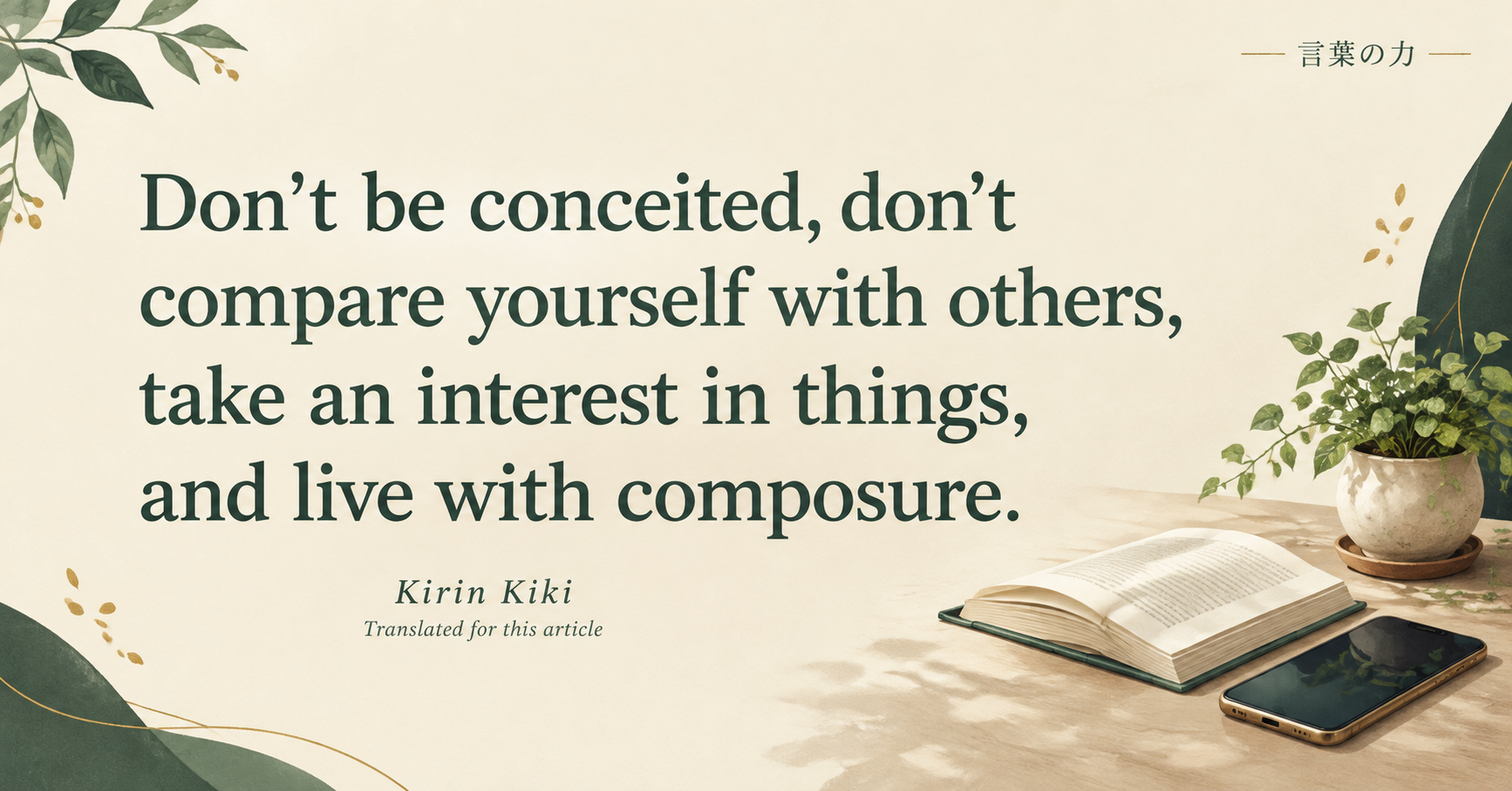
Don’t be conceited, don’t compare yourself with others, take an interest in things, and live with composure.

Kirin Kiki — translated for this article

Original: おごらず、人と比べず、面白がって、平気に生きればいい. According to Shukan Josei PRIME’s report of Kiki’s farewell ceremony, her daughter Yayako Uchida recalled these words as something her mother had told her. We present them as words passed on by her daughter, not as a direct transcript of a lecture by Kiki. The English above is this article’s translation, not an official translation.

An everyday reflection on these words

Their good news is not an instruction for you

A friend starting a new job is an event in your friend’s life. It is not a notification telling you to change yours immediately.

Still, while looking at the screen, you may begin grading your own days. What am I doing with my life?

You do not need to criticize yourself for comparing, either. First, notice what happened: you turned someone else’s news into your own score. Celebrating them and diminishing yourself do not have to come together.

Interest does not mean pretending everything is funny

For this reflection, taking an interest in things does not mean laughing away painful experiences. The following is our own everyday reading, not a claim to explain all of Kiki’s intentions.

It can mean returning your attention to something that quietly caught your interest: a shop on your way home, a neatly written line, or a pitch in a baseball game that made you look up.

These moments may not look as glamorous as someone else’s holiday. But something moved in your own day. Not posting it or receiving praise does not erase the enjoyment.

You can step back when composure feels out of reach

We need not read composure as a command to become someone who never gets hurt.

If scrolling is making you miserable, close the screen for now. Give yourself time before replying. Talk to someone you trust. Taking some distance is an option too.

One thing for today: return to a private pleasure

Think of one small thing you have wanted to enjoy. Open a book for one page, listen to a song, or look at the plant by your window. It need not cost money or become another appointment.

After visiting someone else’s life on a screen, come back to your own. Even without impressive news to share, your day may still contain something worth noticing.

How are you feeling? Explore more words for being yourself.

Related reading

Misuzu Kaneko: Someone Else’s Strength Does Not Make You Smaller
Shigeru Mizuki: You Do Not Have to Earn Your Day Off
日本語版を読む

Source

Shukan Josei PRIME: report of Kirin Kiki’s farewell ceremony (Japanese). The quotation is attributed through her daughter’s recollection. The translation and reflection are this article’s own.

A little inspiration for everyday living

In my Rakuten ROOM, I share everyday items we might put off buying for ourselves but would be happy to receive as gifts. Browse when you need something. (*^^*) Buying something is not the conclusion of this reflection.

Shopping from outside Japan? Rakuten Global Express offers international forwarding from Japan. Please check supported destinations, shipping fees, and item restrictions before using the service.

Pre-publication checklist — remove before publishing

Second of ten drafts for five selected themes. Draft only, no publication date or schedule requested. Three common English tags, Be Yourself and Discovery applied. Person tag and category still need review and assignment. Add the reciprocal English link to Japanese post 295 after creation. Verify source wording, quotation, translation and image-use rights, related articles’ publication status, links and mobile layout. Attribution is through the daughter’s recollection in a secondary report, not a direct recording of Kiki. Search demand unverified. Scenes are illustrative, not the owner’s experiences. Image not generated or assigned. Remove editorial notes after review; the owner decides publication.

Featured-image brief: 1200×630 landscape, refined adult editorial illustration with quiet playfulness, ivory, muted forest green and restrained gold. A face-down phone, open book and small plant at lower right; no portrait or logo. The largest text must exactly match the article quotation: Don’t be conceited, don’t compare yourself with others, take an interest in things, and live with composure. Smaller text: Kirin Kiki; The Power of Words; Translation for this article. Adjust line breaks only; do not shorten or change punctuation. Keep generous margins and readable serif typography. Do not generate or publish before reviewing image-use rights. Compare the generated image letter by letter against the English quotation; image verification has not been performed.

The Power of Words | Benjamin Franklin: Your Quiet Actions Still Count

Words for today

Well done is better than well said.

— Benjamin Franklin, Poor Richard, 1737.

Reflection

After a meeting, you may find yourself thinking, “I wish I had explained that better.”

Other people seem fluent and confident. You hesitate, lose your place, or struggle to find the right words. It becomes easy to overlook everything else you brought to the day.

For this reflection, Franklin’s words are an invitation to notice your actions—not a demand to compensate for imperfect speech by working harder.

You remembered to reply. You checked a detail rather than guessing. You returned a tool so the next person could find it.

These actions may attract little attention. Still, someone benefits from them. A task becomes easier. An uncertainty is resolved. A person has one less thing to worry about.

Quiet usefulness deserves recognition too.

This does not mean words are unnecessary. If you are running late, communicate. If you have caused harm, apologize. If someone has helped you, thank them. Nor should you silently accept more work than you can manage.

Words and actions can support each other.

A promise becomes clearer when you explain what you can do and when. Appreciation becomes tangible when you add a thoughtful gesture.

On your way home, try remembering one thing you did with care.

Perhaps you responded, checked, organized, or honestly said that you needed help. Does that really add up to a day in which you did nothing?

An awkward conversation does not erase the rest of your efforts.

Your words may not have been polished. Your care was still real.

日本語版を読む

Source

Founders Online, National Archives: Poor Richard, 1737. The reflection above is original commentary, separate from the quotation.

Disclosure: This article includes affiliate links.

A little inspiration for everyday living

A few words can offer a fresh perspective. Sometimes, a thoughtful everyday item can bring a small moment of joy, too.

In my Rakuten ROOM, I share everyday essentials we might put off buying for ourselves but would be happy to receive as gifts. Feel free to take a look! (*^^*)

Shopping from outside Japan? Rakuten Global Express offers international forwarding from Japan. Please check supported destinations, shipping fees, and item restrictions before using the service.

Pre-publication checklist — editorial notes; remove before publishing

Check existing articles for duplicate figures and quotations. Verify and apply the three common tags and the English series tag. Suggested tags: Benjamin Franklin / Integrity / Action / en-power-of-words. Verify the English mood-category destination for comparing yourself to others before adding a link; do not present a Japanese-only collection as an English collection. Confirm that Japanese post 249 and this English post are published together, and add the reciprocal English link to post 249 after this post has an ID. No publication date is set. Intended slot: Day 1, 12:07 JST, subject to the owner’s review and existing schedule.

Featured image not created or assigned. Art direction: a tidy wooden work desk, a closed notebook and a single pencil, amber and navy colors, quiet afternoon light. Image quotation: “Well done is better than well said.” Small text: “The Power of Words · Benjamin Franklin · 1737”. Verify spelling, rights, and mobile readability. Review the complete article and remove editorial notes before the owner decides whether to publish or schedule.

The Power of Words | Shinjiro Torii: Before Preparation Becomes a Place to Hide

Disclosure: This article contains affiliate advertising.

“Give it a try.”

Shinjiro Torii — translated for this article from “やってみなはれ”; not an official translation.

Suntory’s official history presents the phrase as an expression of its founder’s pioneering spirit.

We decide to begin something—and first, we research.

We check what we need, read reviews, and search for ways to avoid mistakes. Before long, the time we set aside for beginning has disappeared into the phone in our hands.

The preparation has advanced.
The comparison chart is ready.
But we have not tried it once.

That is when I want to remember these words: “Give it a try.”

What follows is my personal reflection on applying them to everyday life.

Are we gathering information—or waiting for certainty?

Checking things before we begin matters.

But collecting the information we need is different from researching until every uneasy feeling disappears.

We want to write, yet keep reading about writing. We want to take walks, yet keep comparing equipment. We want to tidy a room, yet keep saving pictures of storage ideas.

At some point, we can give that preparation somewhere to go by trying the activity itself.

Make the first attempt smaller

Trying something does not have to mean making a grand commitment.

Before writing an article, write three opening lines. Before tidying a room, clear one corner of the desk. Before promising to exercise every day, walk around the neighborhood for five minutes.

A smaller beginning leaves room to reconsider after the attempt.

This is my own everyday application of the quotation, not a claim about its original meaning.

Let the result become information, not just a verdict

Once we try, something may be harder than expected.

But stopping at “I knew I was no good at this” seems to lose part of what we learned.

Where did we get stuck? What was missing? What was unexpectedly enjoyable?

The attempt gives us something more concrete to work with.

Of course, decisions involving safety, health, or significant spending should not be made on enthusiasm alone. Some situations call for careful checks and advice.

Today, instead of preparing to become someone who never fails, choose one small thing you can safely test.

Give five minutes to something that has been waiting in preparation.

Let “Give it a try” make the first attempt lighter, rather than make you feel hurried.

Quotation and background source: Suntory’s history of “Yatte Minahare” (Japanese).