The Power of Words | Natsume Soseki: Different Opinions Do Not Have to Become Distance

Disclosure: This article contains affiliate advertising.

“I may face left, and you may face right.”

Natsume Soseki

Translated for this article from an excerpt of Soseki’s “私の個人主義.” This is not an official English translation. The surrounding passage discusses freedom for oneself and others, with a qualification concerning effects on others.

You recommend a film you loved. The other person was not impressed.

It is only a difference in taste. Yet it can feel as if they rejected a small part of you.

Soon, sharing your enjoyment becomes a presentation designed to change their mind.

Here is my own everyday reflection on Soseki’s words.

Agreement is not the only successful ending

It feels good when someone enjoys what we enjoy.

But a conversation can continue without matching conclusions.

“What didn’t work for you?”
“I hadn’t seen it that way.”

Ask to understand, rather than to win agreement.

Your enjoyment does not need endless defending

You can also say, “This is the part I love,” and leave it there.

Not demanding agreement does not mean withdrawing your own feelings.

There can be room for your enjoyment and their different response.

Respect still leaves room for boundaries

Respecting differences does not require accepting harmful behavior. Shared work needs agreements, and difficulties may need clear boundaries.

But a difference in taste does not always need a winner.

Next time opinions diverge, pause before persuading—or assuming you have been disliked.

You can face different directions and still remain in conversation.

Quotation and background source: Aozora Bunko: Natsume Soseki, “私の個人主義” (Japanese).

How are you feeling today?

Struggling with relationships? Explore more words for connection.
The Power of Words | Konosuke Matsushita: Do Not Measure Your Journey by Someone Else’s Speed

Disclosure: This article contains affiliate advertising.

“I have a path of my own.”

Konosuke Matsushita

Translated for this article from “自分には自分に与えられた道がある。,” the opening of “The Path” in Michi o Hiraku. This is not an official translation.

Someone who began around the same time seems far ahead.

Yesterday, you felt you were making progress. Today, after seeing their achievement, you feel as though you have been standing still.

You have not actually moved backward. Yet your confidence has.

You see only part of their path

Matsushita describes a path with wide and narrow stretches, uphill and downhill sections.

Here is my own everyday application of that image.

We can see someone’s result without seeing all their preparation or support. We also have our own responsibilities, circumstances, and available energy.

Comparing destinations alone can hide how different the journeys have been.

Changing your pace does not erase your effort

Something you once did daily may now happen once a week.

That does not necessarily mean it has stopped mattering.

You can make an activity smaller, adapt it to your circumstances, or leave yourself a way back after a pause. This is my reflection, not a claim about the quotation’s original meaning.

Return to what is within reach

Write one unfinished paragraph. Look up one unanswered question. Put your tools in order for next time.

These may not look impressive, but they belong to your journey.

Today, notice one place where you have moved from yesterday.

A small footprint is still a footprint.

Quotation and background source: PHP Institute: Michi o Hiraku (Japanese).

How are you feeling today?

Feel like your efforts aren’t paying off? Explore more words for small steps.

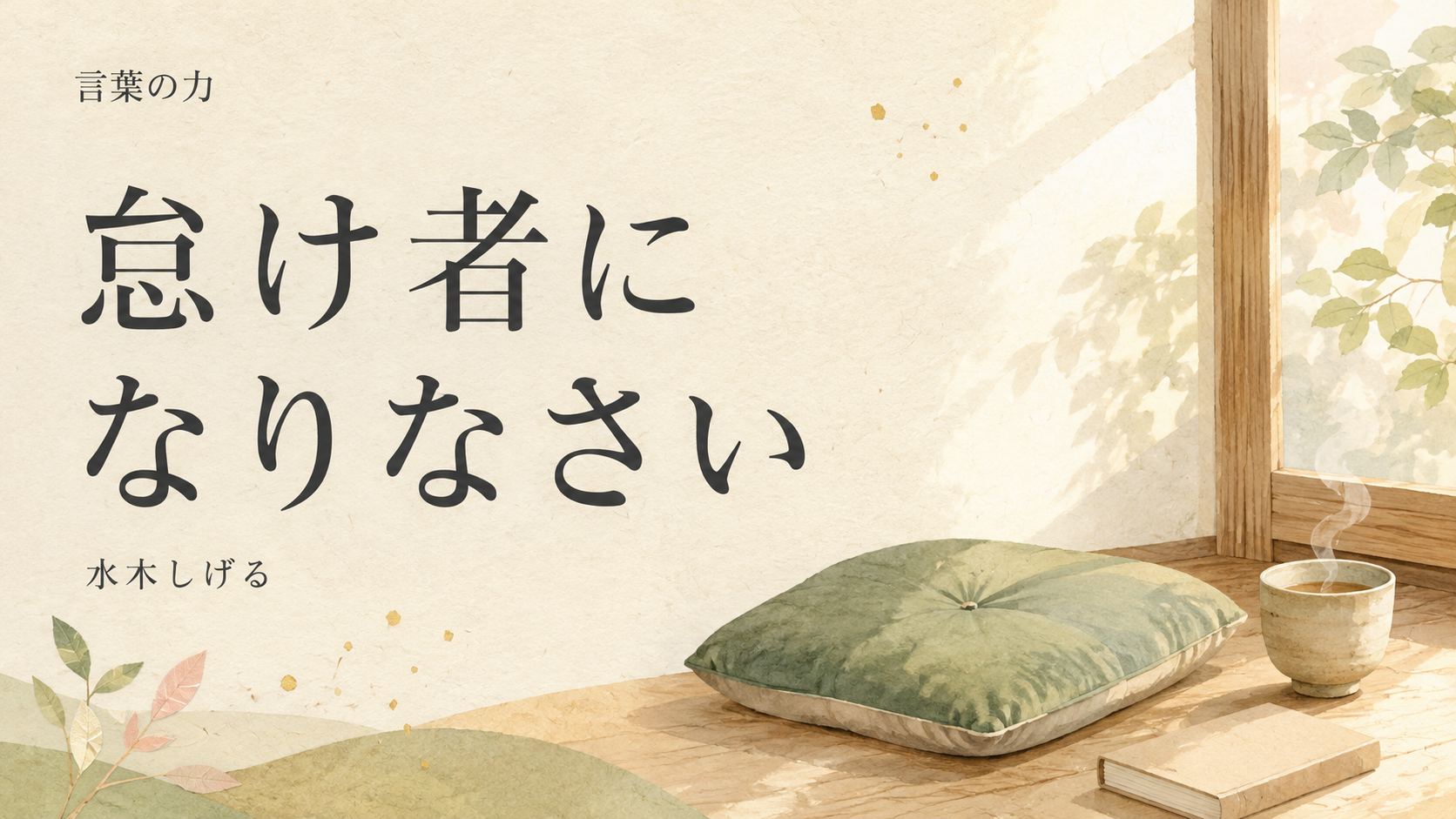
The Power of Words | Shigeru Mizuki: You Do Not Have to Earn Your Day Off

Disclosure: This article contains affiliate advertising.

“Be lazy.”

Shigeru Mizuki

Translated for this article from “怠け者になりなさい,” one of Shigeru Mizuki’s seven principles of happiness. This is not an official English translation.

You planned to take it easy. Then the laundry became cleaning, cleaning became shopping, and sitting down brought a new question: “Have I forgotten something?”

Even on a day off, there seems to be a very diligent manager inside your head.

Here is my own everyday reflection on Mizuki’s words.

Rest does not need a performance review

A fulfilling day off can quietly turn into a list of assignments: finish a book, exercise, tidy the room, prepare for next week.

None of these is wrong. But not completing them does not make your day a failure.

An unproductive hour does not automatically deserve the name “wasted.”

Stop supervising your quiet moments

Drink tea. Watch the view from a window. Listen to music without planning what comes next.

You do not have to justify every pause as preparation for working harder later.

“I feel tired” or “I want some quiet” can be enough reason to remove one thing from your schedule.

Choose one thing not to do

Responsibilities do not disappear. Still, something can often wait.

Choose one nonurgent task to postpone—and resist immediately filling the space with another.

That is how I would like to carry these words into today.

Offer your hardworking self a chair.

“Come on. Sit down for a while.”

You do not have to earn every moment of your day off.

Quotation source: J-CAST News: Shigeru Mizuki’s seven principles of happiness (Japanese).

How are you feeling today?

Feeling a little worn out? Explore more words for rest.

The Power of Words | Misuzu Kaneko: Someone Else’s Strength Does Not Make You Smaller

Disclosure: This article contains affiliate advertising.

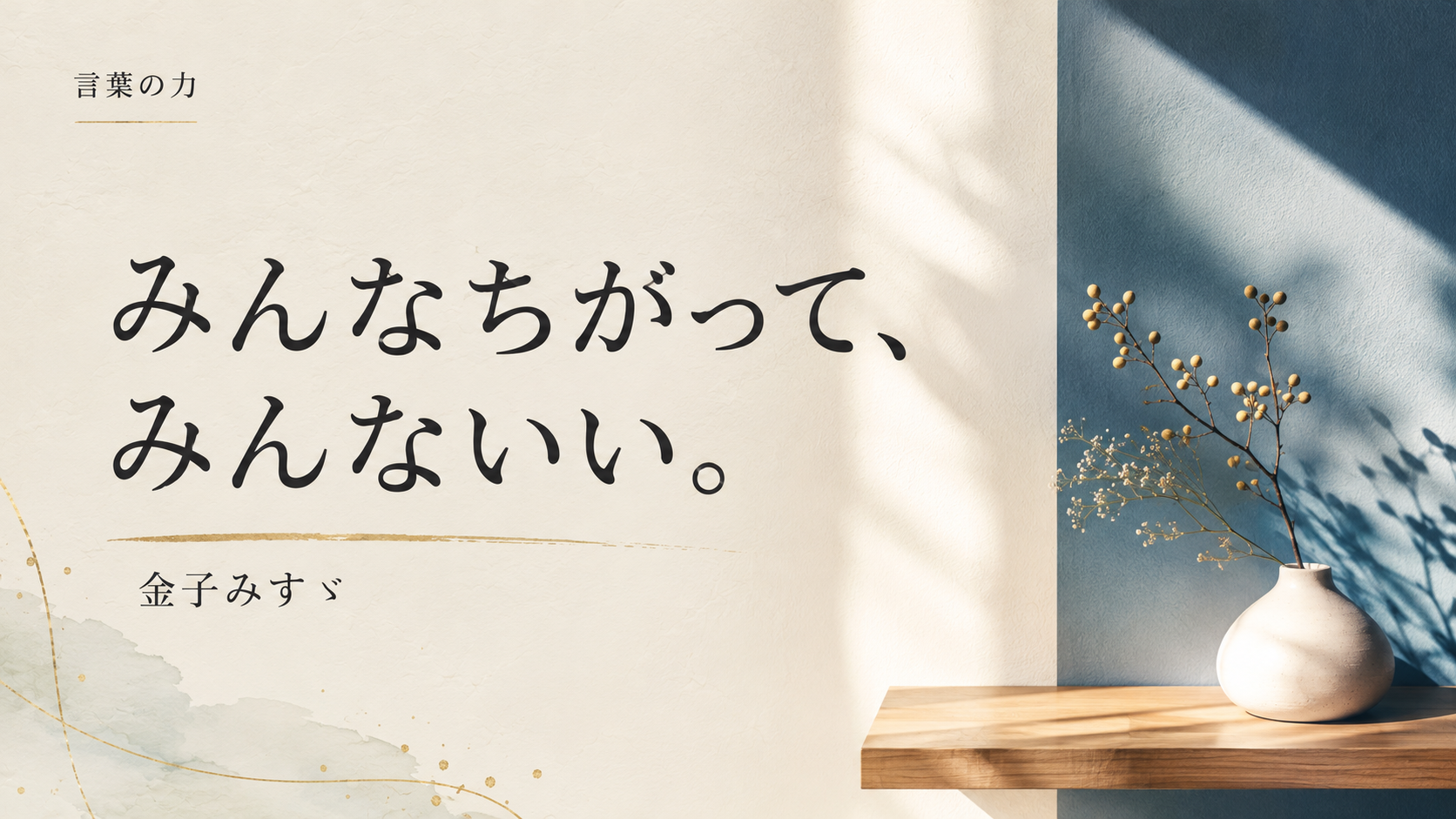
“We are all different, and each of us is good.”

Misuzu Kaneko, “私と小鳥と鈴と” (“Me, the Little Bird, and the Bell,” title translated for this article).

The quotation is translated here from the Japanese text published in the Kaneko Misuzu Memorial Museum director’s column on Nagato City’s website; this is not an official English translation.

Someone else’s strengths can make us suddenly notice everything we think we lack.

They speak confidently. Work quickly. Feel at ease with people they have just met.

Once we begin comparing, our own strengths seem remarkably good at hiding.

On days like that, I want to return to Misuzu Kaneko’s words.

Her poem brings together a little bird, a bell, and the speaker, describing things each can and cannot do.

What follows is my personal reflection on everyday life.

Do not turn someone’s strength into your shortcoming

We hear someone explain something well and immediately think, “I am too slow when I speak.”

But appreciating them and judging ourselves are separate acts.

We can stop at “That was clear.” We can think, “There is something I could learn from that.”

We do not have to lower ourselves every time we praise someone else.

Their strength does not reduce our worth.

Some contributions are quieter

One person offers an idea immediately. Another notices something missing after listening carefully.

One person gets a project moving. Another makes it easier to sustain.

Different situations make different contributions more visible.

When reflecting on your day, ask not only, “Did I stand out?” but also, “What did I help support?”

You checked a detail. Organized someone’s thoughts. Left a note so the next person would not struggle.

Those contributions do not have to disappear because they were quiet.

Being different and choosing to grow can coexist

I do not want to narrow this quotation into “Nothing ever needs to change.”

We can practice a difficult skill or reconsider a troublesome habit.

But we do not have to begin with the belief that our present selves are worthless.

We can change without rejecting ourselves. Respecting differences also does not mean ignoring someone’s needs or accepting harmful behavior.

If someone seems especially impressive today, acknowledge one good thing about them.

Then notice one thing you did, too.

Being different does not automatically mean being deficient. I would like to keep that thought close, like a small note at the corner of a desk.

Quotation and poem source: Nagato City: Kaneko Misuzu Memorial Museum director Setsuo Yazaki’s column, “私と小鳥と鈴と” (Japanese).

The Power of Words | The Little Prince: A Day Is More Than What You Can Count

日本語で読む | English

Disclosure: This article contains affiliate advertising.

“What is essential is invisible to the eye.”

Antoine de Saint-Exupéry, The Little Prince. English wording as presented on the work’s official website.

At the end of a day, we sometimes want to count what we accomplished.

How many tasks did we finish? How many pages did we read? Did anyone respond to what we shared?

Numbers can help us notice things. But when the numbers are small, calling the whole day empty may be too quick.

These words from The Little Prince invite me to look beyond what is easiest to measure. What follows is my personal reflection.

Some meaningful time comes before a visible result

Not everything immediately takes shape.

The time spent listening to someone. The care taken to rewrite a message before sending it. The decision to remove a plan because you needed rest.

None of these may appear in a completed-task count. Yet they can support our relationships and daily lives.

A day with few visible results does not have to erase everything that happened before those results.

What is invisible may still need to be expressed

I do not want to read this quotation as “If you care, you never need to say so.”

Tell someone they matter. Thank them for helping. Ask when you think something has been misunderstood.

Valuing what is invisible is different from assuming we know what another person feels.

Sometimes a small sentence matters more than leaving something unspoken.

Remember one thing you cared for today

Tonight, ask not only, “What did I add?” but also, “What did I take care of?”

You kept a promise. Noticed your tiredness. Waited without rushing someone. Paused before saying too much.

These may not be impressive achievements, but they reveal choices you made.

Numbers are useful. They do not have to define the entire meaning of a day.

This is not a reason to ignore practical problems. It is a way to acknowledge that meaningful time can exist outside visible accomplishments.

Even if today moved more slowly than you hoped, it does not have to become a day in which nothing mattered.

The Power of Words | Anne Frank: Something to Give, Even on an Ordinary Day

日本語で読む | English

Disclosure: This article contains affiliate advertising.

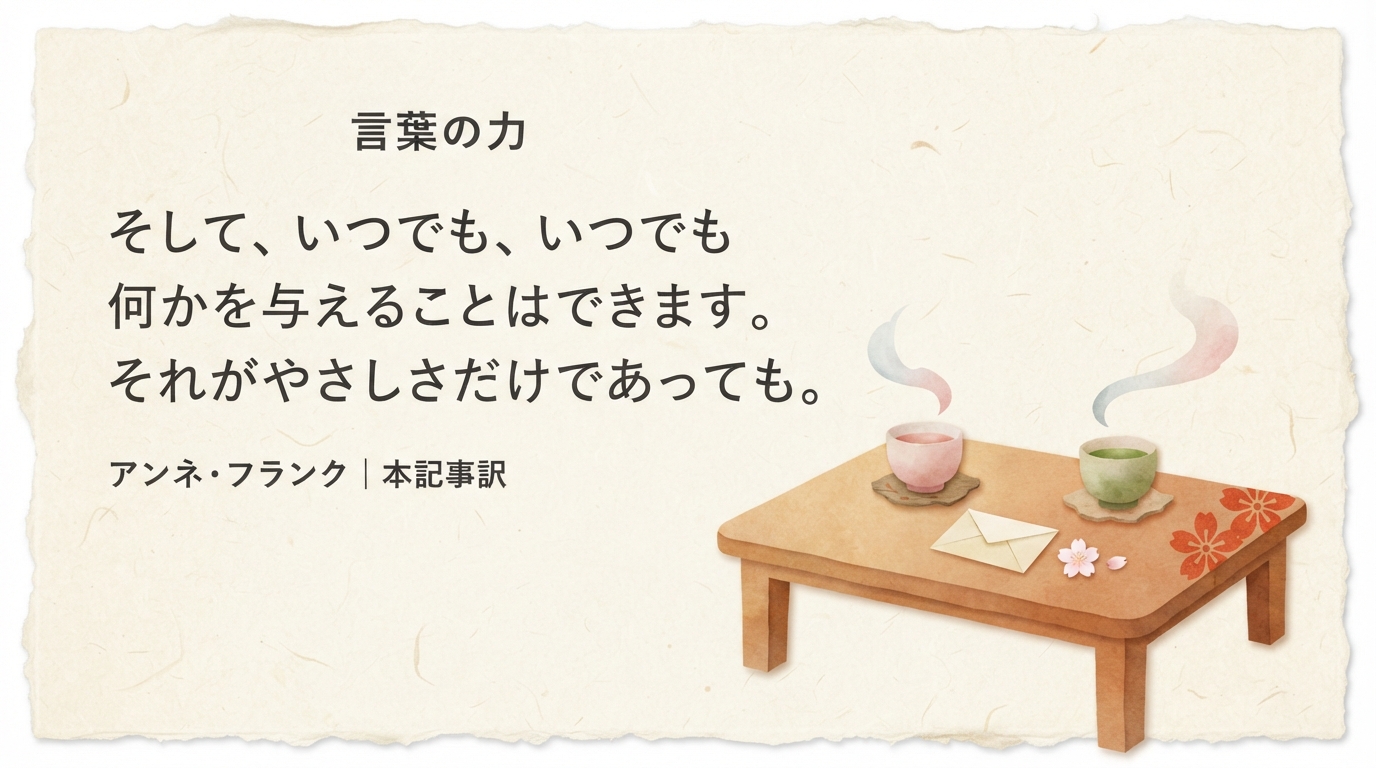
“And you can always, always give something, even if it is only kindness!”

Anne Frank, “Give.” The wording and its attribution are documented in Snopes’ examination of the quotation.

We may want to help someone and still feel that we do not have enough to offer.

Not enough time. Not much money to spare. No special knowledge.

While we wait to have something more impressive, the day passes.

Anne Frank’s words bring the idea of giving closer to ordinary life. What follows is my own reflection.

Help does not have to solve everything

We may not be able to resolve someone’s entire problem, but there may still be something we can do.

Listen without interrupting. Thank someone for a specific thing they did. Ask how they are doing without assuming that we already know.

A small gesture can give someone a little room to breathe. Kindness does not always require a grand act.

Let the other person help define kindness

What we intend as helpful may not be what someone needs.

They may want to be heard rather than advised. They may need quiet rather than repeated questions.

Instead of rushing to do something for them, we can ask, “What would be helpful right now?”

Offering help and giving someone space can both be ways of respecting them.

Kindness does not require exhausting yourself

We do not have to accept every request.

We can explain that today is difficult, offer what we can manage, or suggest another person or approach.

This article is not an invitation to give until nothing remains for yourself.

What could you offer someone today?

“Thank you—that helped.”
“Thank you for telling me.”
“I cannot do all of it, but I can help with this part.”

Kindness need not be a gift reserved for special occasions. There may be a place for it in an ordinary day.

The Power of Words | Coach Anzai: One Difficult Day Does Not Have to Be the End

日本語で読む | English

Disclosure: This article contains affiliate advertising.

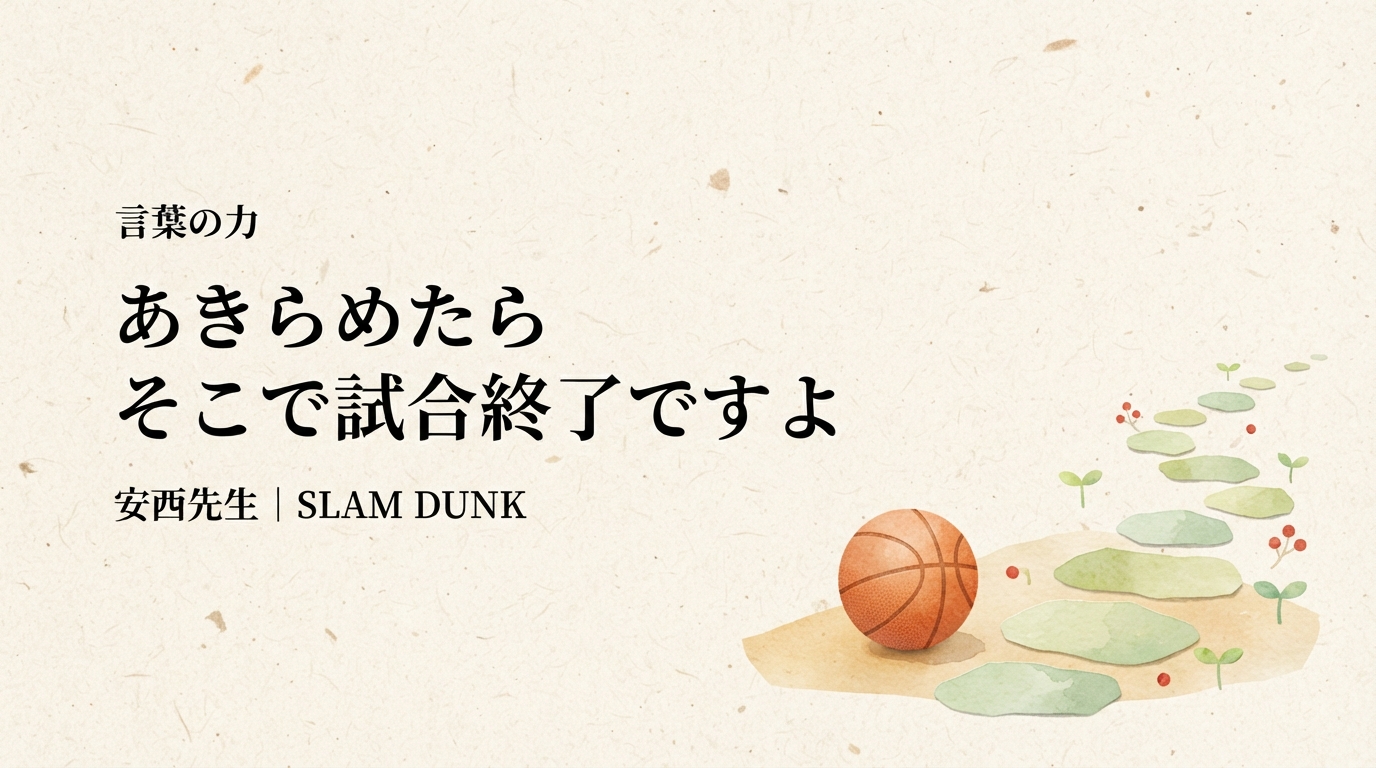
“If you give up, that is where the game ends.”

Coach Anzai in Takehiko Inoue’s SLAM DUNK. English translation prepared for this article from the Japanese wording; not an official English translation. Japanese wording checked against a quotation commentary (Japanese); the original manga wording and scene still require final verification before publication.

Sometimes one disappointing result makes everything we have done feel uncertain.

A piece of writing receives no response. We cannot remember what we studied. A proposal we worked hard on is turned down.

“Perhaps I am simply not suited to this.”

At such moments, I think of Coach Anzai’s words. What follows is my personal reflection on everyday life, not an explanation of the scene in the story.

Separate today’s result from tomorrow’s possibilities

Something did go wrong today. We do not have to erase our disappointment or pretend it was not a setback.

But one result does not have to decide everything that comes next.

“This did not get through this time” is different from “My words will never reach anyone.” “I could not do it today” is different from “I will never be able to do it.”

When we feel discouraged, we can cross that distance too quickly. First, let today’s experience remain the size of one day.

Continuing can mean changing your approach

Trying again does not require repeating the same method.

Make a long piece of writing more focused. Reduce the scope of a study session. Ask someone to help with a problem you could not solve alone.

Changing how you continue is not necessarily giving up. Sometimes it is how you protect something you still care about.

Rest is not the final whistle

I do not want to turn this quotation into a demand that tired people keep pushing.

We do not have to sacrifice our health or safety. Leaving an unsuitable situation or choosing another goal can also be a thoughtful decision.

For me, these words are a reminder not to close off every possibility in a moment of disappointment.

Rest today. Reconsider tomorrow. Leave yourself one line about what you might try next.

One difficult day does not have to be the end. You can decide whether to continue, change direction, or pause when you have a little more room to think.

The Power of Words | Takashi Yanase: You Are Alive, Even on Days You Do Not Feel Cheerful

日本語で読む | English

Disclosure: This article contains affiliate advertising.

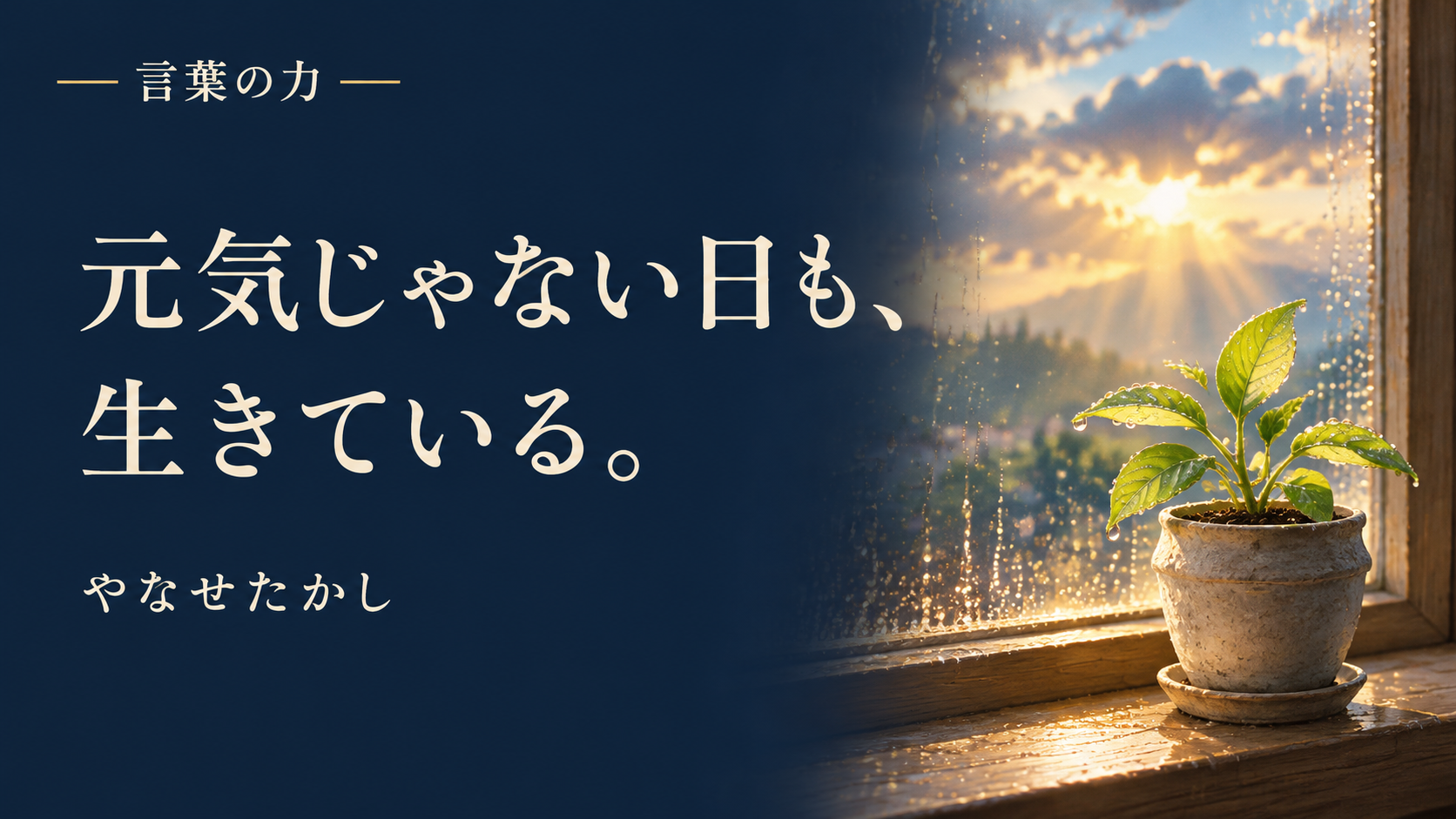
“It is because we are alive that we feel sad.”

From Te no Hira o Taiyo ni, lyrics by Takashi Yanase (lyrics published on Uta-Net, in Japanese). English translation prepared for this article; not an official translation.

“Keep smiling today.” “Stay positive and do your best.”

Some days, words like these encourage us. On others, they feel a little too bright.

We know they are well meant. But we do not have that energy right now. The more cheerful words we encounter, the more we may feel left behind because we cannot be cheerful ourselves.

On such a day, today’s words reach us from a different angle.

A cheerful song has room for sadness

Te no Hira o Taiyo ni is a song with lyrics by Takashi Yanase and music by Taku Izumi. It first aired on NHK’s Minna no Uta in 1962.

Although it feels like a lively song, its lyrics include sadness.

Being alive brings enjoyment and happiness. But that is not all. For me, the depth of these words lies in making room for more than those feelings.

In an article from PHP (Japanese), Yanase explains that hardship and pain are also signs of being alive, and discusses why he placed sadness before joy.

Sadness is not treated as a wrong emotion. I find a quiet kindness in that.

Even your feelings do not have to behave perfectly

You made a mistake at work. You could not communicate well with someone important to you. Plans you were looking forward to were canceled.

At such times, we sometimes find another reason to blame ourselves, on top of the event itself.

“I am weak for still worrying about this.” “I need to be more positive.”

Sadness is hard enough, yet we also scold ourselves for being sad. We seem to keep a very demanding boss inside our minds.

But considering today’s words allows a slightly different perspective.

You are sad because it mattered. You are disappointed because you had hopes. You feel frustrated because you wanted to do well.

Behind those feelings may lie something you deeply valued.

Words can stay beside us without rushing us

Of course, we do not have to find meaning in every sadness. Nor do we need to force a painful experience into the conclusion that it was a good experience.

I want to receive today’s words not as an instruction to endure sadness, but as a reminder that we do not have to reject ourselves for remaining sad.

The power of words is not limited to stirring people into action. Words can also sit beside someone who has stopped and say, “You do not have to feel better right away.”

You could not smile today. Even so, it is all right to drink something warm, rest a little, and bring the day to a close.

A day without a smile is still a day you lived.

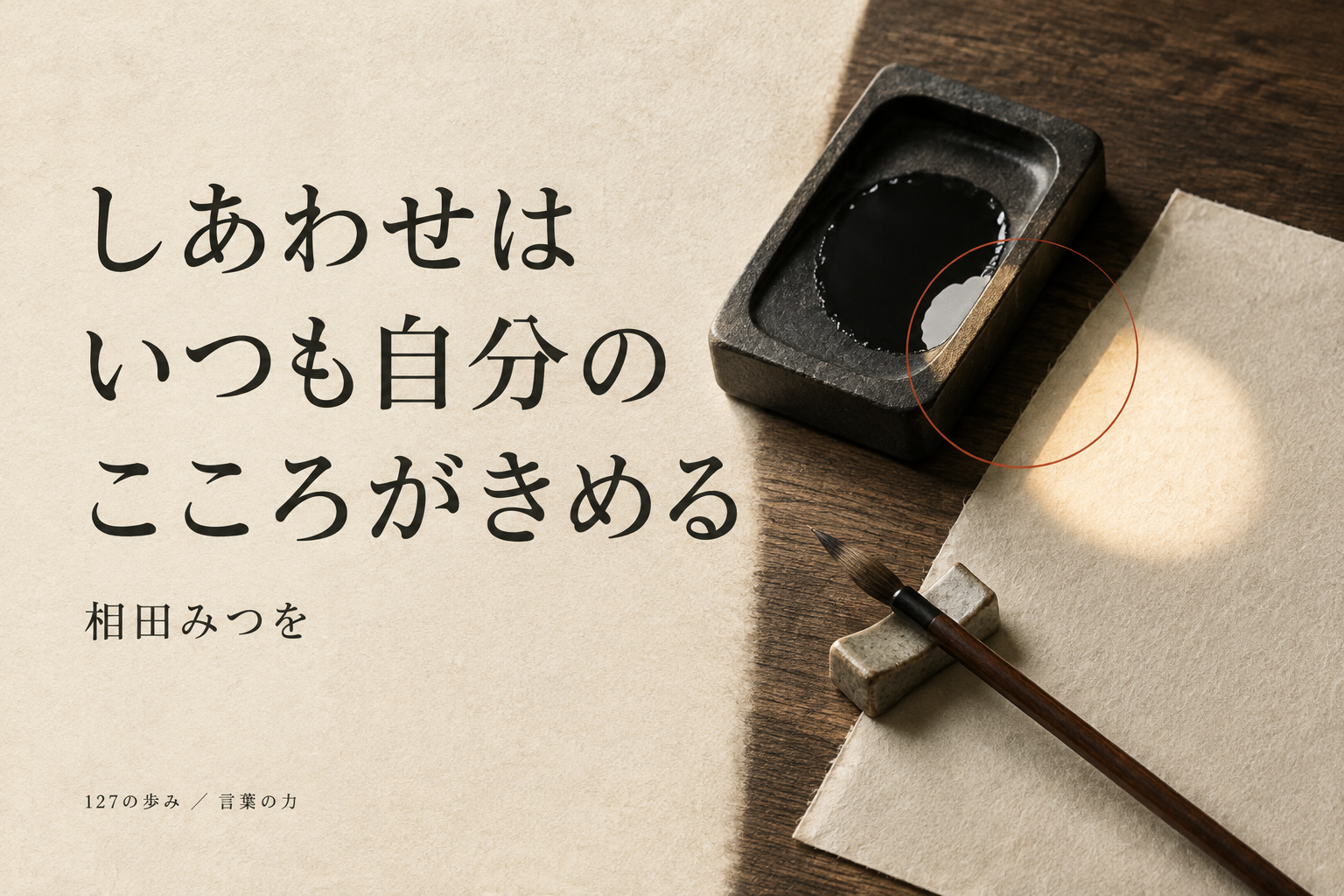
The Power of Words | Mitsuo Aida: Happiness Is Always Decided by Your Own Heart

日本語で読む | English

Disclosure: This article contains affiliate advertising.

“Happiness is always decided by your own heart.”

Mitsuo Aida. Wording quoted in an article from Koka Gakuen (Japanese). English translation prepared for this article; not an official translation.

Some days, as the day draws to a close, we remember only what we could not do.

The message we never answered.
The tidying we made no progress on.
The work that did not go as planned.

In the morning, we had meant to get a little more done.

Looking back this way can leave us feeling as though nothing remained of the day.

For me, these words from Mitsuo Aida offer a chance to look at today from a slightly different angle.

Do not pressure yourself to feel happy

“Happiness is decided by your own heart.”

I do not want to use these words to dismiss painful experiences as merely a matter of attitude.

A sad day is sad.
When you are tired, you are tired.

I do not think we have to force difficult feelings into cheerful words.

What follows is my own interpretation.

I want to hold on to these words not as a reason to blame myself for being unable to feel happy, but as a reminder not to leave it entirely to others to decide what feels good to me.

A fulfilling day for someone else is not necessarily the same for us.

On some days, eating a quiet meal brings more relief than getting through a packed schedule.

On others, spending time slowly at home feels better than traveling somewhere far away.

I think we are allowed to discover what is good for us within our own lives.

Was there a moment today that felt a little easier?

When we look for great happiness, sometimes nothing comes to mind.

At those times, I would like to make the question smaller.

“Was there a moment today when I felt a little relieved?”

When I drank something warm.
When I finished one task.
When I exchanged a few words with someone.

Having that moment does not erase the difficulties of the day.

Still, it may keep unpleasant experiences from coloring everything about today.

Some things did not go well.
But there were also moments that felt a little easier.

I think both can be true.

On days when you find nothing, begin with rest

Of course, there may be days when we cannot remember even a moment of relief.

We do not have to force ourselves to count good things on those days, either.

“Today was hard.”

Acknowledging that and bringing the day to an end can also be a way of caring for ourselves.

If there is something you can do tonight, let it be just one thing that makes tomorrow a little easier.

Leave a nonurgent task until tomorrow.
Write down what has been worrying you and set it aside for now.
Draw a line and say, “That is enough for today.”

If the word happiness feels distant, it is enough to begin by choosing something that feels a little easier.

Even if today was not ideal, do not reject the self who lived through it.

Even when a day does not look impressive by someone else’s standards, I want to keep moments of relief within everyday life.

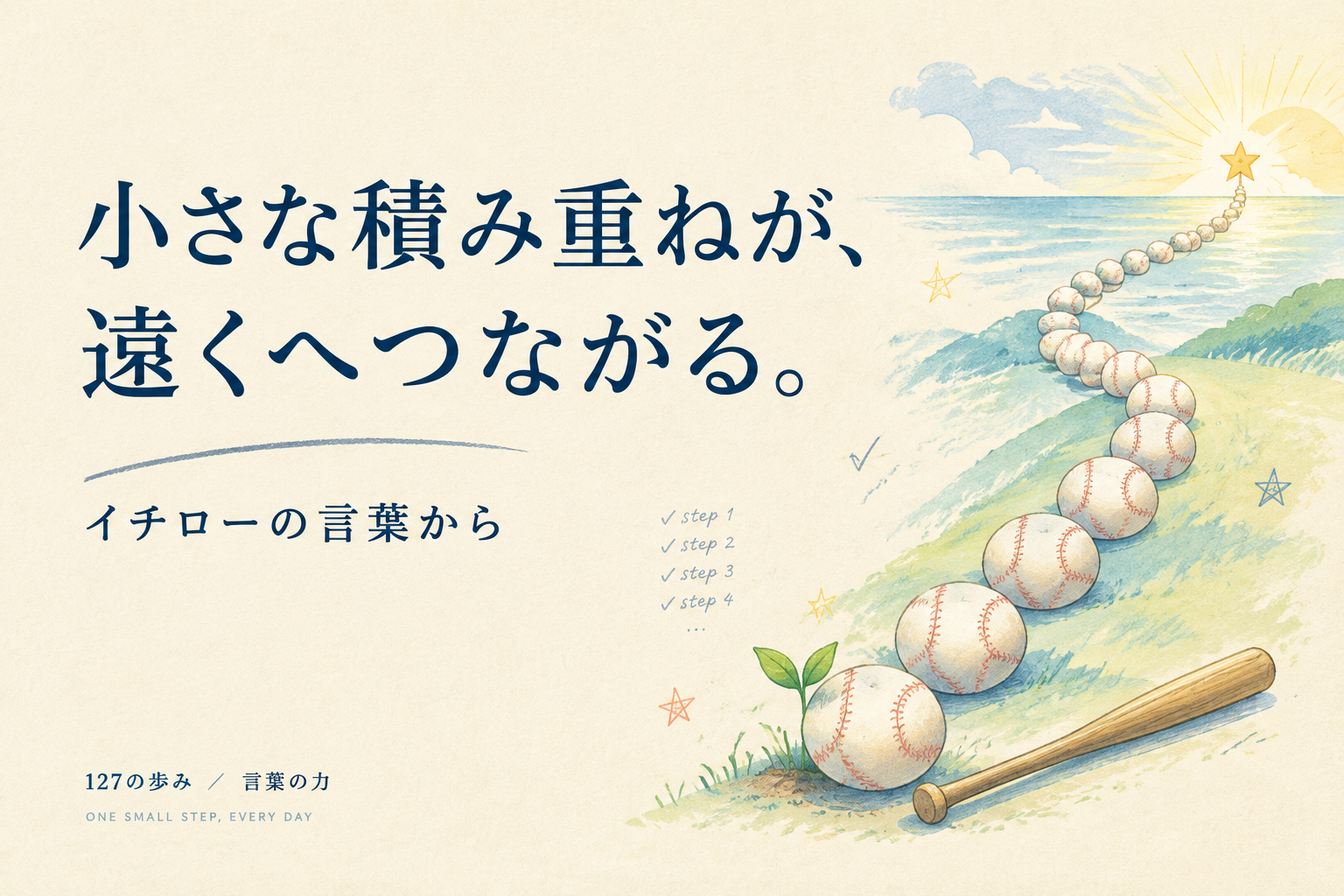
The Power of Words | Ichiro: Small Steps Take Us Somewhere Extraordinary

日本語で読む | English

Disclosure: This article contains affiliate advertising.

“Building up small things is the only way to reach somewhere extraordinary.”

Ichiro, wording quoted on the official Yunker website (Japanese). English translation prepared for this article; not an official translation.

When we set a big goal, our feelings grow bigger, too.

Exercise every day starting tomorrow. Begin studying something new. Produce different results at work.

Yet what we can actually do today is smaller than we imagined. Read a few pages. Finish one preparation. Revise a little of what we have written.

“Can something like this really make a difference?” When facing that question, I want to remember Ichiro’s words.

Think about big results through small actions

Toshin’s introduction to this quotation (Japanese) also presents these words about building up small things as a remark from the press conference after Ichiro broke the Major League Baseball single-season hits record in 2004.

What I want to notice is that, when speaking about a great result, his words begin with “small things.”

It is not a shortcut where one extraordinary act takes us somewhere extraordinary. It is about building on the small things right in front of us.

I find encouragement here: even someone overwhelmed by the size of a goal has a place to begin.

Building on experience is more than repetition

Suppose you write an article every day.

Instead of simply writing as you did yesterday, shorten today’s opening. Fix a sentence that was hard to read. Check the source of a quotation.

From the outside, each looks like a small task. But checking and changing things one by one gives you more to notice as you write.

What follows is my own interpretation of these words. Perhaps building things up means not only doing something more often, but also carrying yesterday’s experience into today’s actions.

Even if something did not go well, thinking “Next time, I will try this” means the day does not simply disappear.

Do not judge today’s step only by its size

Of course, continuing small actions does not mean everyone will reach the same result. Circumstances, health, and the methods we choose also affect how we move forward.

So I do not want these words to become a guarantee of success or an instruction never to rest.

Instead, I want to keep them as a reminder not to dismiss what we managed today as worthless simply because results are not immediately visible.

You read one page. Checked one thing. Started writing one line.

On some days, that may be enough. When your energy returns, you can build on it again.

The power of words lies not in erasing what we cannot do, but also in helping us turn our attention back to what we can.

Change “I can only do something this small” into “I can begin with this small thing.”

You do not have to produce an extraordinary result today.

Add one small thing that connects to the future. Let us try not to undervalue that one thing ourselves.