The Power of Words | Marcus Aurelius: You Can Change the Way Forward

Words for today

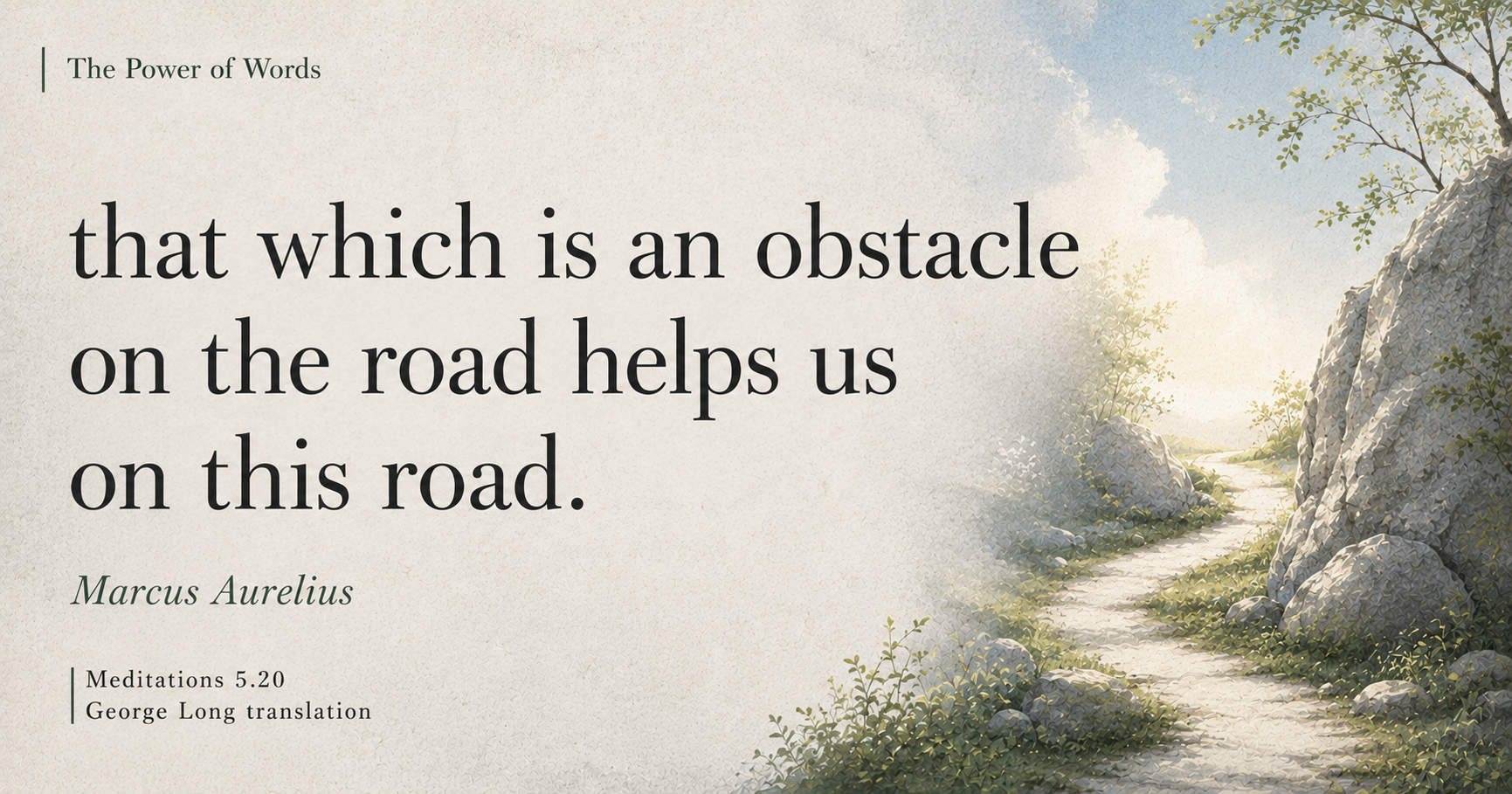
that which is an obstacle on the road helps us on this road.

— Marcus Aurelius, Meditations 5.20, translated by George Long; excerpt.

Reflection

You have a plan, but something keeps stopping it.

A reply does not arrive. A tool fails. Another attempt ends at the same point. Soon, a problem with the process begins to feel like a judgment about you.

Yet an obstacle is not a measure of your worth.

In this passage, Marcus describes the mind’s capacity to adapt its response to what blocks its activity. For everyday life, that offers a useful question: must the goal and the original method always stay together?

When a door will not open, pushing harder is not your only option.

You can investigate the conditions, look for another entrance, ask someone with relevant knowledge, or reconsider the order of your tasks.

Learning that an approach does not work under certain conditions is information. It need not become an accusation.

This does not mean every painful experience must be called a blessing. You do not have to endure danger or mistreatment to turn it into personal growth. Leaving, seeking support, and choosing not to continue can be responsible decisions.

Nor can every external problem be solved by adjusting your attitude.

Still, where a choice remains, you may be able to change the next move.

Instead of asking only, “Why can’t I do this?” try, “What would help me make the next decision?”

Clarify what is missing. Discuss the deadline. Consult someone else. Rest before reconsidering.

You can care about a destination without remaining loyal to the first route you chose.

Changing direction does not have to mean giving up.

日本語版を読む

Source

MIT Internet Classics Archive: The Meditations, Book Five, translated by George Long, section 20. The reflection above is original commentary, separate from the quotation.

Disclosure: This article includes affiliate links.

A little inspiration for everyday living

A few words can offer a fresh perspective. Sometimes, a thoughtful everyday item can bring a small moment of joy, too.

In my Rakuten ROOM, I share everyday essentials we might put off buying for ourselves but would be happy to receive as gifts. Feel free to take a look! (*^^*)

Shopping from outside Japan? Rakuten Global Express offers international forwarding from Japan. Please check supported destinations, shipping fees, and item restrictions before using the service.

Pre-publication checklist — editorial notes; remove before publishing

Check existing articles for duplicate figures and quotations. Verify and apply the three common tags and the English series tag. Suggested tags: Marcus Aurelius / Adaptability / Obstacles / en-power-of-words. Verify the English mood-category destination for feeling that your efforts are not paying off before adding a link; do not present a Japanese-only collection as an English collection. Confirm that Japanese post 254 and this English post are published together, and add the reciprocal English link to post 254 after this post has an ID. No publication date is set. Intended slot: Day 2, 12:07 JST, subject to the owner’s review and existing schedule.

Featured image not created or assigned. Art direction: a path gently curving around a rock toward an open, bright space, limestone gray, pale blue and natural greens; do not depict the obstacle as threatening. Image quotation: “that which is an obstacle on the road helps us on this road.” Small text: “The Power of Words · Marcus Aurelius · Translated by George Long”. Verify spelling, rights, and mobile readability. Review the complete article and remove editorial notes before the owner decides whether to publish or schedule.
The Power of Words | Konosuke Matsushita: Do Not Measure Your Journey by Someone Else’s Speed

Disclosure: This article contains affiliate advertising.

“I have a path of my own.”

Konosuke Matsushita

Translated for this article from “自分には自分に与えられた道がある。,” the opening of “The Path” in Michi o Hiraku. This is not an official translation.

Someone who began around the same time seems far ahead.

Yesterday, you felt you were making progress. Today, after seeing their achievement, you feel as though you have been standing still.

You have not actually moved backward. Yet your confidence has.

You see only part of their path

Matsushita describes a path with wide and narrow stretches, uphill and downhill sections.

Here is my own everyday application of that image.

We can see someone’s result without seeing all their preparation or support. We also have our own responsibilities, circumstances, and available energy.

Comparing destinations alone can hide how different the journeys have been.

Changing your pace does not erase your effort

Something you once did daily may now happen once a week.

That does not necessarily mean it has stopped mattering.

You can make an activity smaller, adapt it to your circumstances, or leave yourself a way back after a pause. This is my reflection, not a claim about the quotation’s original meaning.

Return to what is within reach

Write one unfinished paragraph. Look up one unanswered question. Put your tools in order for next time.

These may not look impressive, but they belong to your journey.

Today, notice one place where you have moved from yesterday.

A small footprint is still a footprint.

Quotation and background source: PHP Institute: Michi o Hiraku (Japanese).

How are you feeling today?

Feel like your efforts aren’t paying off? Explore more words for small steps.

The Power of Words | Ichiro: Small Steps Take Us Somewhere Extraordinary

日本語で読む | English

Disclosure: This article contains affiliate advertising.

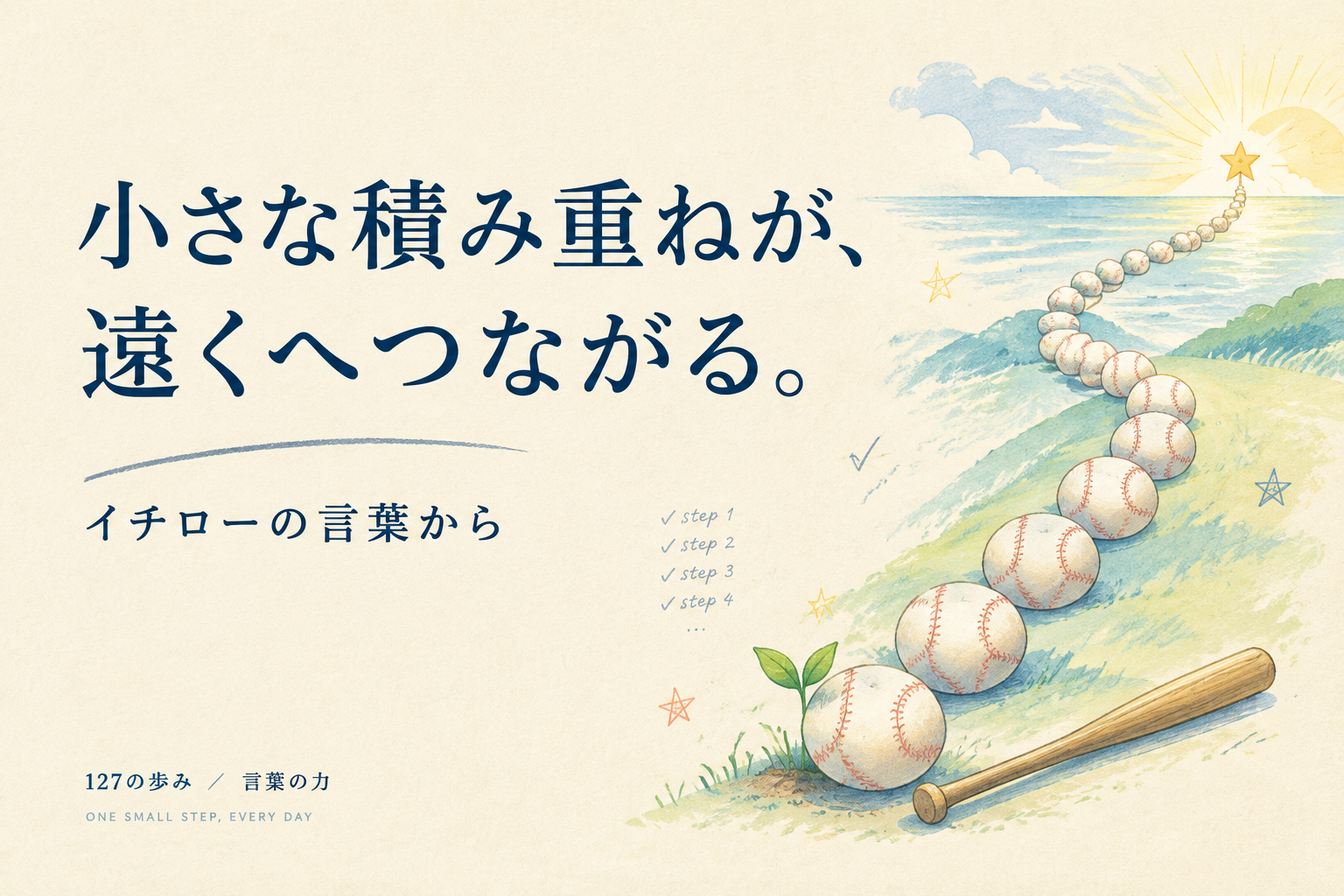
“Building up small things is the only way to reach somewhere extraordinary.”

Ichiro, wording quoted on the official Yunker website (Japanese). English translation prepared for this article; not an official translation.

When we set a big goal, our feelings grow bigger, too.

Exercise every day starting tomorrow. Begin studying something new. Produce different results at work.

Yet what we can actually do today is smaller than we imagined. Read a few pages. Finish one preparation. Revise a little of what we have written.

“Can something like this really make a difference?” When facing that question, I want to remember Ichiro’s words.

Think about big results through small actions

Toshin’s introduction to this quotation (Japanese) also presents these words about building up small things as a remark from the press conference after Ichiro broke the Major League Baseball single-season hits record in 2004.

What I want to notice is that, when speaking about a great result, his words begin with “small things.”

It is not a shortcut where one extraordinary act takes us somewhere extraordinary. It is about building on the small things right in front of us.

I find encouragement here: even someone overwhelmed by the size of a goal has a place to begin.

Building on experience is more than repetition

Suppose you write an article every day.

Instead of simply writing as you did yesterday, shorten today’s opening. Fix a sentence that was hard to read. Check the source of a quotation.

From the outside, each looks like a small task. But checking and changing things one by one gives you more to notice as you write.

What follows is my own interpretation of these words. Perhaps building things up means not only doing something more often, but also carrying yesterday’s experience into today’s actions.

Even if something did not go well, thinking “Next time, I will try this” means the day does not simply disappear.

Do not judge today’s step only by its size

Of course, continuing small actions does not mean everyone will reach the same result. Circumstances, health, and the methods we choose also affect how we move forward.

So I do not want these words to become a guarantee of success or an instruction never to rest.

Instead, I want to keep them as a reminder not to dismiss what we managed today as worthless simply because results are not immediately visible.

You read one page. Checked one thing. Started writing one line.

On some days, that may be enough. When your energy returns, you can build on it again.

The power of words lies not in erasing what we cannot do, but also in helping us turn our attention back to what we can.

Change “I can only do something this small” into “I can begin with this small thing.”

You do not have to produce an extraordinary result today.

Add one small thing that connects to the future. Let us try not to undervalue that one thing ourselves.

The Power of Words | Natsume Soseki: The Seeds You Sow Today

日本語で読む | English

Disclosure: This article contains affiliate advertising.

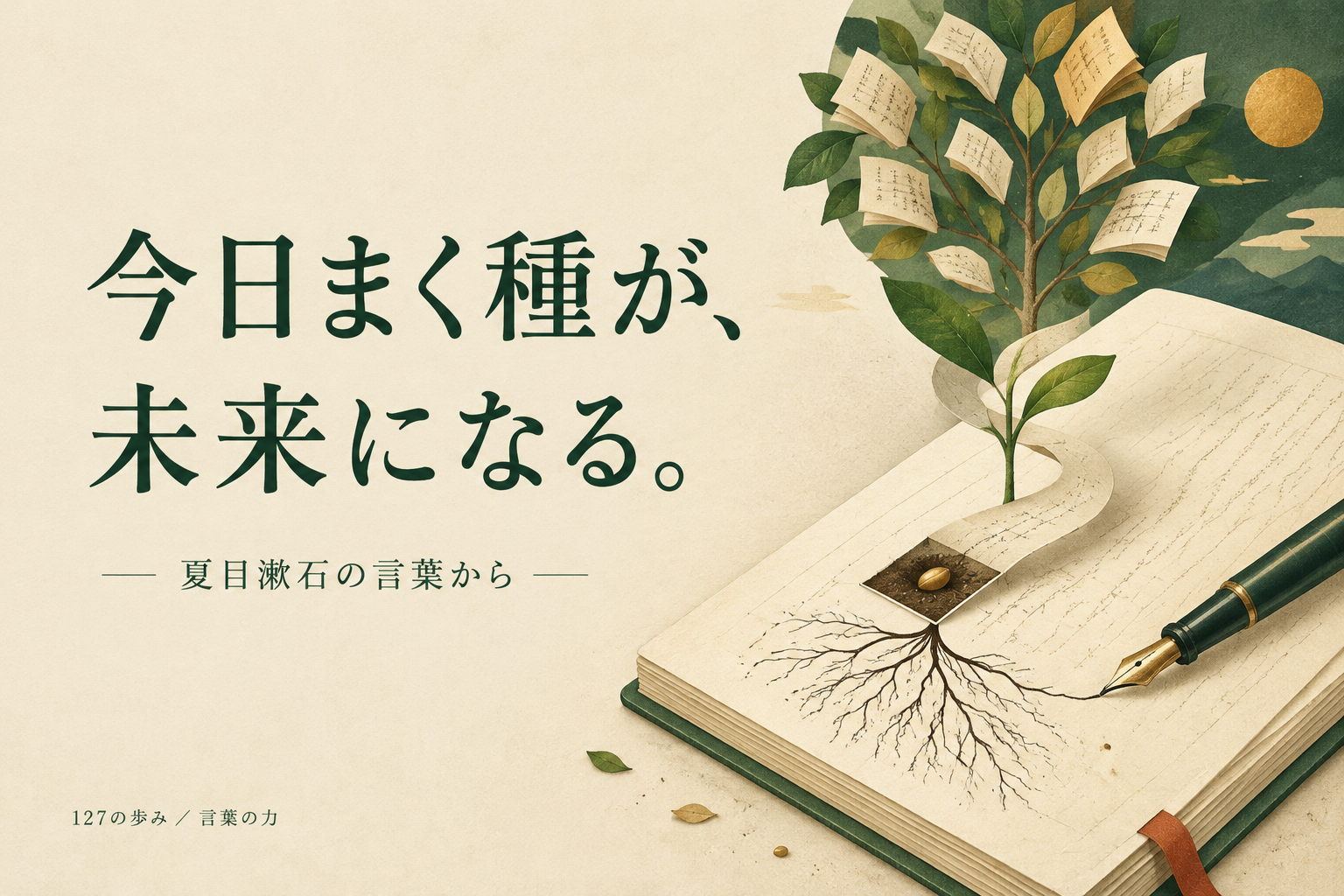
“The seeds you sow in the present will eventually appear as the future you are to reap.”

Natsume Soseki, diary entry dated March 21, 1901, as quoted in Sarai (Japanese). English translation prepared for this article; not an official translation.

When we think about the future, it is easy to place our hopes in “someday.”

Someday, when I have more time. Someday, when life feels less demanding. Someday, when I feel more confident.

We imagine we will do better then. Yet what our future selves receive is not unrelated to what we do today.

These words from Natsume Soseki connect the distant future with the day right in front of us.

What are the seeds we sow today?

The Sarai article presents this sentence as a passage from Soseki’s diary entry of March 21, 1901.

The seeds we sow now eventually emerge as the future we receive. I want to apply this metaphor not only to great efforts, but also to the small choices we make every day.

Look up one thing you do not understand. Keep a promise. Listen until someone has finished speaking. Start a task that has been on your mind.

Even if these actions seem unremarkable at the time, they may grow into knowledge we can use later or relationships with other people.

Acting for the future is not something reserved for special days. An ordinary day may offer opportunities to sow seeds, too.

Not seeing a sprout does not mean nothing is happening

When we begin something, we often want to see results straight away.

We study, but still struggle to answer. We write an article, but fewer people read it than we hoped. We take care with our work, but receive no response.

Then we start to wonder whether our efforts mean anything.

But expecting a harvest on the very day we sow a seed may be asking too much, too soon. Before results become visible, there may be time needed to learn, grow accustomed to something, or reach another person.

This is my own reflection on how these words might relate to daily life, not a claim about the circumstances or intentions behind Soseki’s original statement.

We do not have to judge the entire value of today’s actions by today’s results. Leaving that room may help us think more calmly about how to continue.

Do not make the future entirely your own responsibility

At the same time, I would avoid reading these words as saying that everything happening now is the fault of our past selves.

Life includes circumstances we cannot choose and events we cannot foresee. The same effort does not always produce the same result.

I prefer to receive these words as an invitation to consider the actions available to us, rather than a guarantee that we will harvest exactly the future we want.

What will we sow? How will we tend it? If a method does not suit us, how might we change it?

Even when we cannot control everything, there may still be a small part of today’s choices we can influence.

The seeds we sow today need not be large. Read one page of a book you have wanted to open. Thank someone. Prepare one thing for your future self tomorrow.

The power of words lies not only in describing distant goals, but also in restoring meaning to the small things we do today.

Rather than simply waiting for the future, prepare one thing to pass on to it.

Let us quietly begin sowing seeds with what we can do right now.