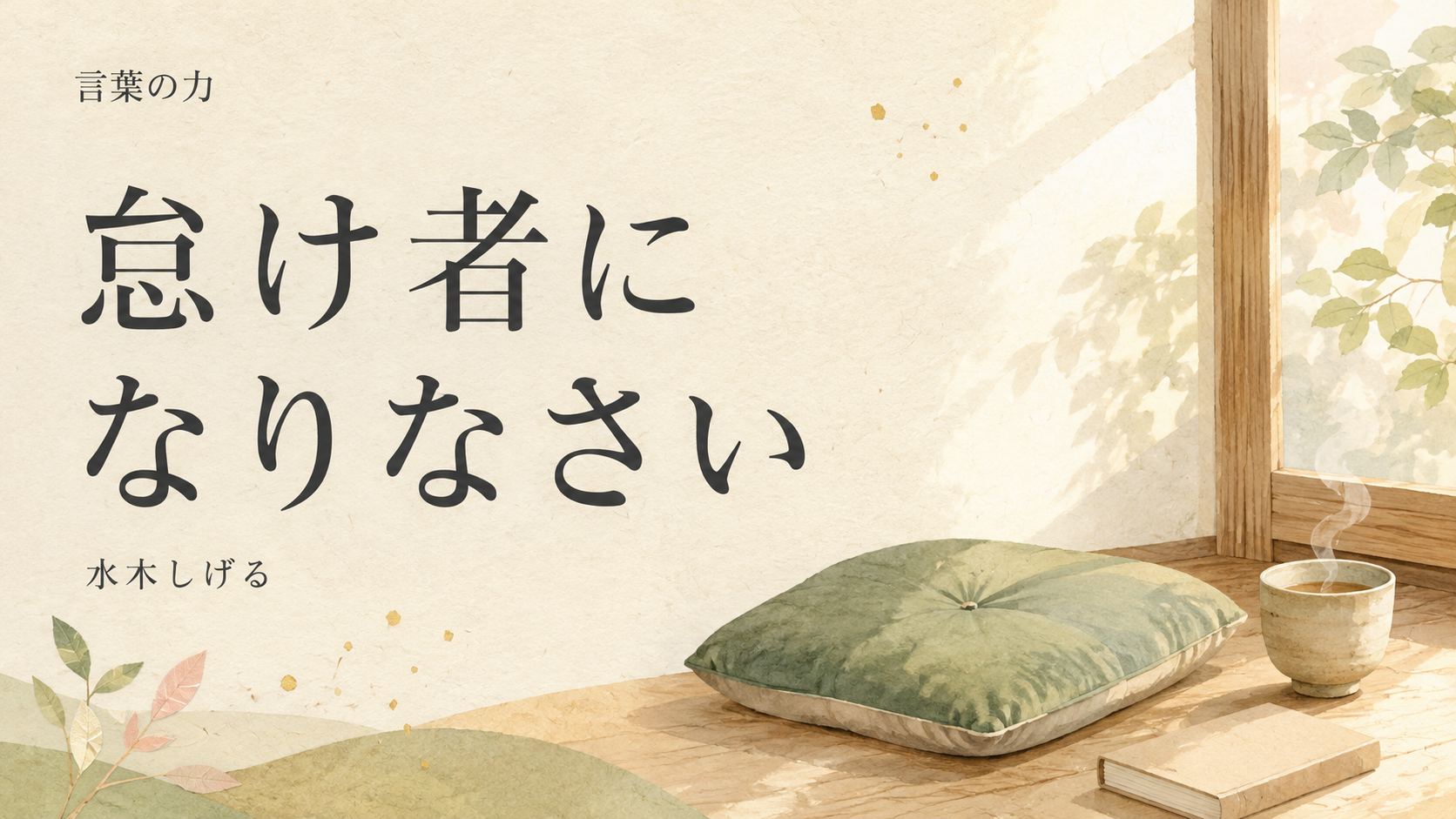
The Power of Words | Shigeru Mizuki: You Do Not Have to Earn Your Day Off

Disclosure: This article contains affiliate advertising.

“Be lazy.”

Shigeru Mizuki

Translated for this article from “怠け者になりなさい,” one of Shigeru Mizuki’s seven principles of happiness. This is not an official English translation.

You planned to take it easy. Then the laundry became cleaning, cleaning became shopping, and sitting down brought a new question: “Have I forgotten something?”

Even on a day off, there seems to be a very diligent manager inside your head.

Here is my own everyday reflection on Mizuki’s words.

Rest does not need a performance review

A fulfilling day off can quietly turn into a list of assignments: finish a book, exercise, tidy the room, prepare for next week.

None of these is wrong. But not completing them does not make your day a failure.

An unproductive hour does not automatically deserve the name “wasted.”

Stop supervising your quiet moments

Drink tea. Watch the view from a window. Listen to music without planning what comes next.

You do not have to justify every pause as preparation for working harder later.

“I feel tired” or “I want some quiet” can be enough reason to remove one thing from your schedule.

Choose one thing not to do

Responsibilities do not disappear. Still, something can often wait.

Choose one nonurgent task to postpone—and resist immediately filling the space with another.

That is how I would like to carry these words into today.

Offer your hardworking self a chair.

“Come on. Sit down for a while.”

You do not have to earn every moment of your day off.

Quotation source: J-CAST News: Shigeru Mizuki’s seven principles of happiness (Japanese).
How are you feeling today?

Feeling a little worn out? Explore more words for rest.

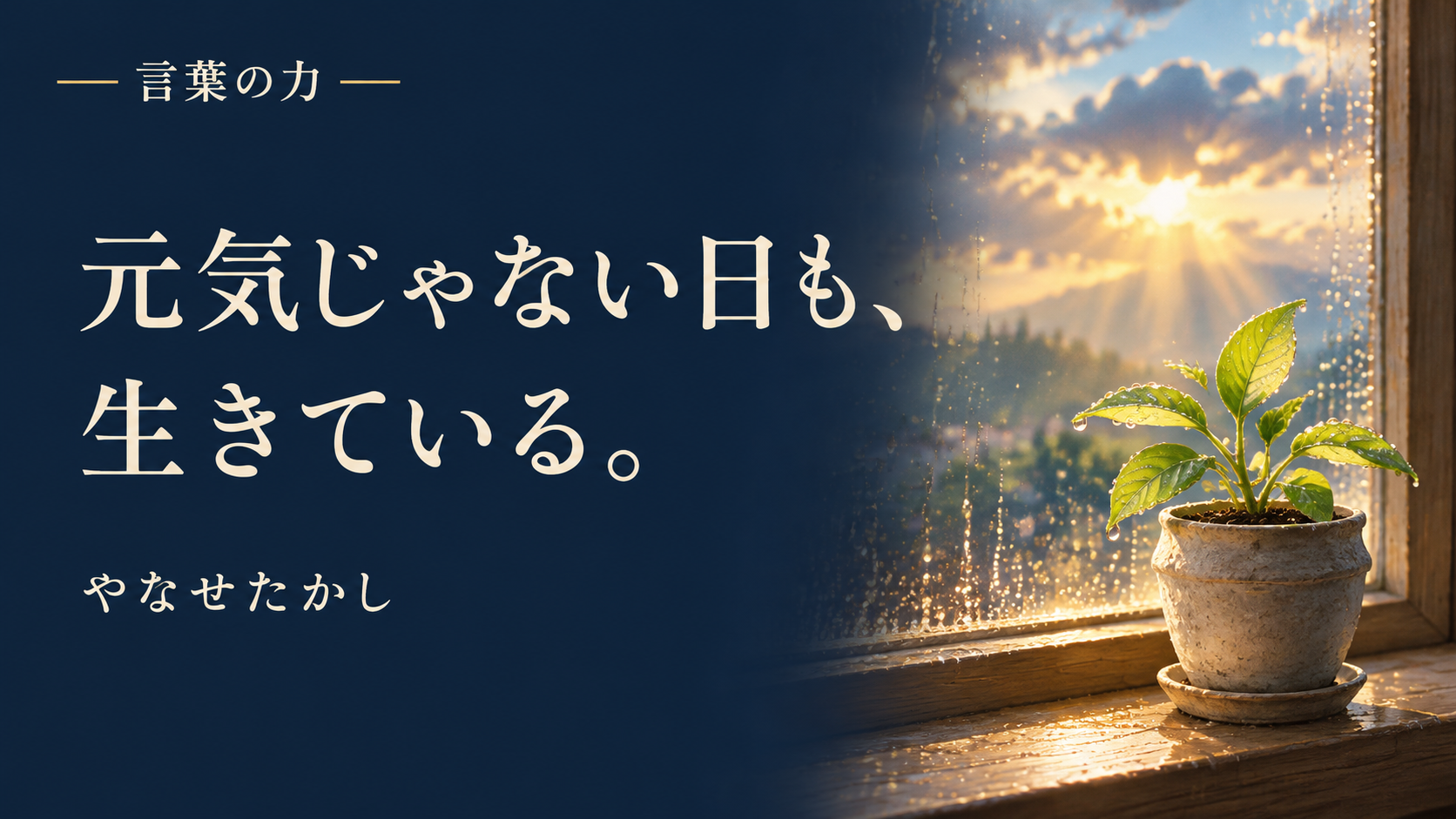
The Power of Words | Takashi Yanase: You Are Alive, Even on Days You Do Not Feel Cheerful

日本語で読む | English

Disclosure: This article contains affiliate advertising.

“It is because we are alive that we feel sad.”

From Te no Hira o Taiyo ni, lyrics by Takashi Yanase (lyrics published on Uta-Net, in Japanese). English translation prepared for this article; not an official translation.

“Keep smiling today.” “Stay positive and do your best.”

Some days, words like these encourage us. On others, they feel a little too bright.

We know they are well meant. But we do not have that energy right now. The more cheerful words we encounter, the more we may feel left behind because we cannot be cheerful ourselves.

On such a day, today’s words reach us from a different angle.

A cheerful song has room for sadness

Te no Hira o Taiyo ni is a song with lyrics by Takashi Yanase and music by Taku Izumi. It first aired on NHK’s Minna no Uta in 1962.

Although it feels like a lively song, its lyrics include sadness.

Being alive brings enjoyment and happiness. But that is not all. For me, the depth of these words lies in making room for more than those feelings.

In an article from PHP (Japanese), Yanase explains that hardship and pain are also signs of being alive, and discusses why he placed sadness before joy.

Sadness is not treated as a wrong emotion. I find a quiet kindness in that.

Even your feelings do not have to behave perfectly

You made a mistake at work. You could not communicate well with someone important to you. Plans you were looking forward to were canceled.

At such times, we sometimes find another reason to blame ourselves, on top of the event itself.

“I am weak for still worrying about this.” “I need to be more positive.”

Sadness is hard enough, yet we also scold ourselves for being sad. We seem to keep a very demanding boss inside our minds.

But considering today’s words allows a slightly different perspective.

You are sad because it mattered. You are disappointed because you had hopes. You feel frustrated because you wanted to do well.

Behind those feelings may lie something you deeply valued.

Words can stay beside us without rushing us

Of course, we do not have to find meaning in every sadness. Nor do we need to force a painful experience into the conclusion that it was a good experience.

I want to receive today’s words not as an instruction to endure sadness, but as a reminder that we do not have to reject ourselves for remaining sad.

The power of words is not limited to stirring people into action. Words can also sit beside someone who has stopped and say, “You do not have to feel better right away.”

You could not smile today. Even so, it is all right to drink something warm, rest a little, and bring the day to a close.

A day without a smile is still a day you lived.

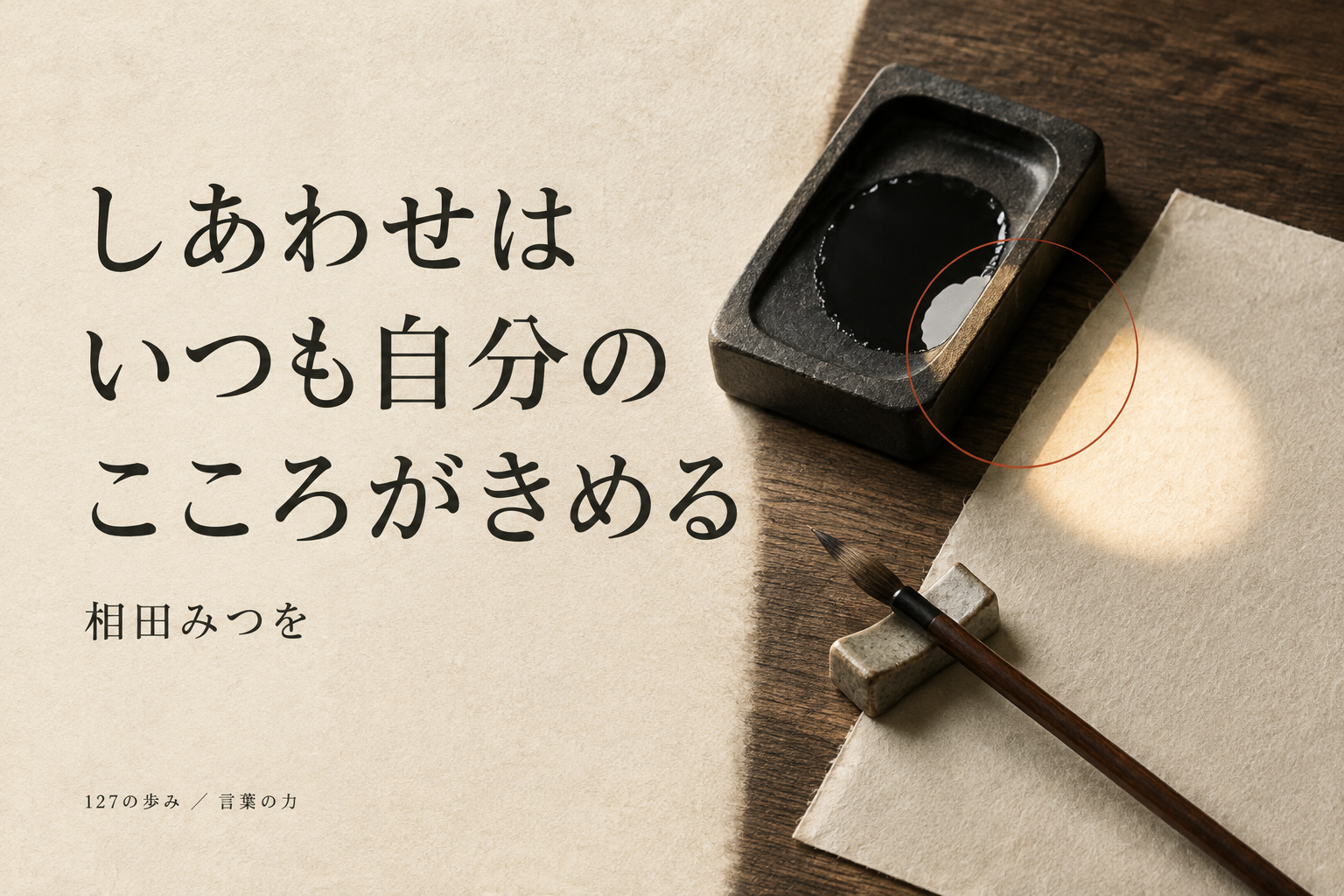
The Power of Words | Mitsuo Aida: Happiness Is Always Decided by Your Own Heart

日本語で読む | English

Disclosure: This article contains affiliate advertising.

“Happiness is always decided by your own heart.”

Mitsuo Aida. Wording quoted in an article from Koka Gakuen (Japanese). English translation prepared for this article; not an official translation.

Some days, as the day draws to a close, we remember only what we could not do.

The message we never answered.
The tidying we made no progress on.
The work that did not go as planned.

In the morning, we had meant to get a little more done.

Looking back this way can leave us feeling as though nothing remained of the day.

For me, these words from Mitsuo Aida offer a chance to look at today from a slightly different angle.

Do not pressure yourself to feel happy

“Happiness is decided by your own heart.”

I do not want to use these words to dismiss painful experiences as merely a matter of attitude.

A sad day is sad.
When you are tired, you are tired.

I do not think we have to force difficult feelings into cheerful words.

What follows is my own interpretation.

I want to hold on to these words not as a reason to blame myself for being unable to feel happy, but as a reminder not to leave it entirely to others to decide what feels good to me.

A fulfilling day for someone else is not necessarily the same for us.

On some days, eating a quiet meal brings more relief than getting through a packed schedule.

On others, spending time slowly at home feels better than traveling somewhere far away.

I think we are allowed to discover what is good for us within our own lives.

Was there a moment today that felt a little easier?

When we look for great happiness, sometimes nothing comes to mind.

At those times, I would like to make the question smaller.

“Was there a moment today when I felt a little relieved?”

When I drank something warm.
When I finished one task.
When I exchanged a few words with someone.

Having that moment does not erase the difficulties of the day.

Still, it may keep unpleasant experiences from coloring everything about today.

Some things did not go well.
But there were also moments that felt a little easier.

I think both can be true.

On days when you find nothing, begin with rest

Of course, there may be days when we cannot remember even a moment of relief.

We do not have to force ourselves to count good things on those days, either.

“Today was hard.”

Acknowledging that and bringing the day to an end can also be a way of caring for ourselves.

If there is something you can do tonight, let it be just one thing that makes tomorrow a little easier.

Leave a nonurgent task until tomorrow.
Write down what has been worrying you and set it aside for now.
Draw a line and say, “That is enough for today.”

If the word happiness feels distant, it is enough to begin by choosing something that feels a little easier.

Even if today was not ideal, do not reject the self who lived through it.

Even when a day does not look impressive by someone else’s standards, I want to keep moments of relief within everyday life.