
What should you bring to a dinner with friends?
Imagine looking through recipes. There is something you have been wanting to make, but bringing a dish you have never tried feels risky. You decide on the familiar recipe instead.
That can be a perfectly good choice. It makes the day easier, and someone may already be looking forward to it.
Still, what happens when “I probably won’t get it wrong” becomes the reason behind most of your choices—not just what you cook?
It can become harder to remember what you wanted to try.
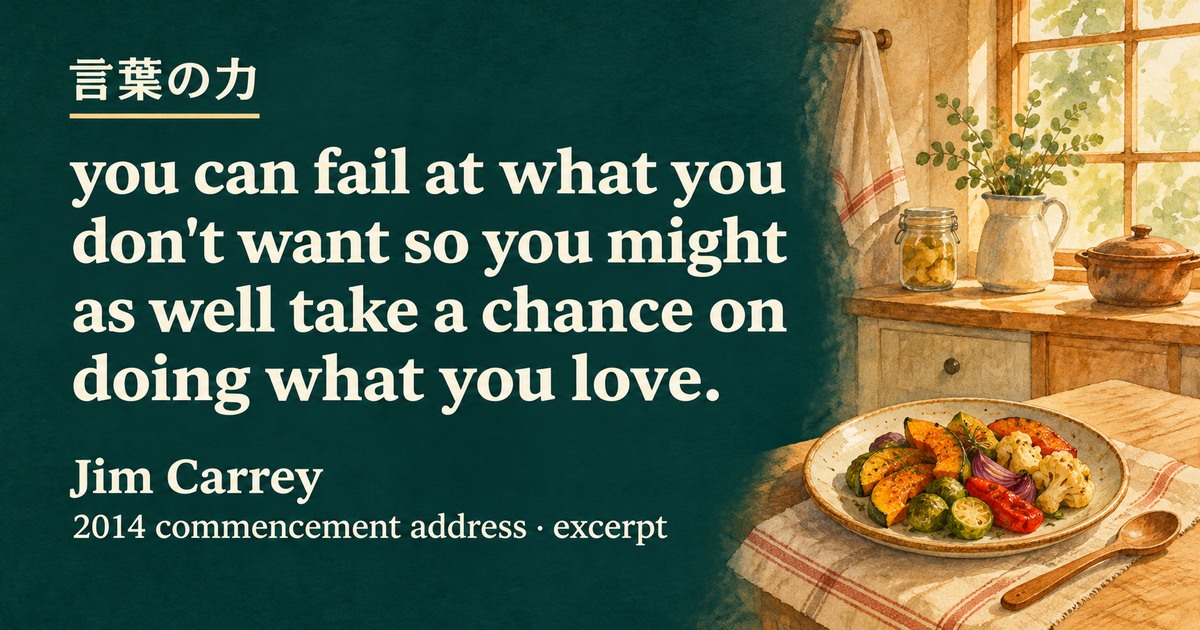
Today’s Quote
you can fail at what you don't want so you might as well take a chance on doing what you love.
— Jim Carrey
An excerpt from his 2014 commencement address; the lowercase opening follows the transcript
A Comedian Reflects on His Father’s Choice
Jim Carrey shared these words during his 2014 commencement address at Maharishi University of Management.
He described his father as someone who could have been a great comedian but did not believe that possibility was within reach. Instead, his father made what Carrey called a conservative choice and became an accountant.
His father later lost that job. Carrey offered today’s quotation as one of the lessons he learned from that experience.
He was not promising that doing what you love guarantees success. His point was more uncomfortable: choosing something you do not want does not remove the possibility of failure.
Nor did his account end with criticism of his father. Carrey went on to describe the influence of his father’s love and humor.
“Not Now” Is Different From “Not for Me”
The reflections that follow are our interpretation of the quotation in everyday life.
There are many good reasons to put something aside.
You cannot afford another expense this month. Your family needs your time. You do not want to fill every free afternoon.
Those considerations matter. Wanting to do something does not mean you must do it immediately.
At other times, though, we may end the discussion before giving ourselves a chance: “I’m probably not the sort of person who could do that.”
Perhaps we fear getting it wrong. Perhaps it also feels embarrassing to let other people know that we wanted to try.
From the outside, both decisions look the same: we do not do the thing.
But there is a difference between deciding that something does not fit your circumstances and pretending that it never interested you because failure would feel uncomfortable.
You do not have to change your decision to notice which explanation is closer to the truth.
Something You Love Need Not Become Your Life’s Work
“Taking a chance on what you love” can sound enormous: leaving a job, starting a business, stepping onto a stage.
Applied to ordinary life, it can also mean trying that recipe for your own dinner rather than serving it to a room full of friends.
If it does not turn out well, you can lower the heat next time. Nobody needs to score its appearance. It might taste better than it looks. Or you might discover that you prefer ordering the dish to cooking it.
Trying something does not oblige you to keep doing it—or to become good at it.
That is the kind of room we would like to leave for Carrey’s words in everyday life.
The Familiar Dish and the One You Want to Try
You can still bring your usual dish to the next dinner.
The comfort of something familiar and the pleasure of experimenting do not have to cancel each other out.
Make the reliable recipe for your friends. On an ordinary Tuesday beforehand, perhaps open the other one.
You do not yet know whether it will work.
But at least that evening’s meal will include something you wanted to taste.
Source and Translation Note
Source: Jim Carrey’s 2014 commencement address at Maharishi University of Management, as transcribed by Rev. The quotation appears in the paragraph beginning at 11:19.
The quotation is an excerpt from within a longer sentence. Its wording and lowercase opening follow the transcript. The Japanese edition uses our own translation of this same excerpt.
The dinner and cooking scenarios are illustrative, not accounts of Carrey’s life or a particular reader’s experience. The everyday applications are the article’s own interpretations.
Related article: The Power of Words | Sakana-kun: Enjoying Something Without Getting Better at It
Advertisement / Affiliate disclosure: The link below leads to our Rakuten ROOM. Product links within the ROOM are affiliate links, and we may earn a commission from purchases.