The Power of Words | Emma Thompson: A Birthday Without a Checklist of “Shoulds”

言葉の力|Emma Thompson|I think what I feel principally now is free.

As a birthday approaches, the number itself may not be the difficult part.

It can be the expectations attached to it.

At this age, I should be more settled. At this age, I should have outgrown that.

Imagine finding yourself adding conditions that nobody has actually asked you to meet.

Reflecting on turning 60, Emma Thompson offered a rather different description.

Today’s quote

I think what I feel principally now is free.

— Emma Thompson
From her 2021 interview with British Vogue.

Less posing, more playing

In Giles Hattersley’s interview, published in May 2021, Thompson described turning 60 as a watershed.

The article also recounts her approach to the accompanying fashion shoot. She had expressed discomfort with trying to look slim and fashionable. Rather than simply pose, she wanted to perform and enjoy herself.

Yet the interview is not an uninterrupted celebration. She also speaks about the sadness of her daughter leaving home. Feeling freer does not mean that uncertainty or grief has vanished. The presence of both makes the quoted sentence more interesting.

Allowing your preferences to change

What follows is this article’s reflection.

A gathering you once enjoyed now leaves you tired.

A colour you would never have chosen catches your eye.

A quiet afternoon that once sounded boring begins to sound appealing.

When preferences change, it can be tempting to ask which version of you is the real one.

But enjoying something different now need not be treated as a betrayal of your earlier self.

Age does not automatically bring freedom. It can bring additional constraints, too. Thompson’s sentence describes her own experience at that moment; it is not a rule about what everyone should feel after a particular birthday.

Still, it offers an alternative to treating each birthday only as an inspection of what has been lost.

Something besides the number of candles

Another candle does not make every feeling neatly appropriate to your age.

You may still hesitate. Your tastes may keep changing.

Perhaps there is also something you now choose with less concern about how it looks to other people.

That, too, can be part of the story you tell about getting older.

Source note

Giles Hattersley, “Emma Thompson On ‘Cruella’, Life After 60, & Her Many Decades Of Activism,” British Vogue, May 7, 2021.

The quotation uses Thompson’s English wording, not a back-translation from this article’s Japanese edition. It is her interview statement, not dialogue spoken by a film character. The birthday scenario and everyday examples are original to this article.


Advertisement / Affiliate disclosure: The link below leads to our Rakuten ROOM. Product links within the ROOM are affiliate links, and we may earn a commission from purchases.

You can also browse our Rakuten ROOM for everyday items.
言葉の力|エマ・トンプソン——誕生日に「この年なら」を数えるより

言葉の力|エマ・トンプソン|今、いちばん強く感じているのは、自由だということだと思います。|本記事独自訳

誕生日が近づくと、年齢そのものより、「この年なら」という言葉が気になることがあります。

この年なら、もっと落ち着いているはず。この年なら、こういうことは卒業しているはず。

そんなふうに、まだ誰にも言われていない条件まで、自分で付け足してしまう場面を想像してみてください。

俳優のエマ・トンプソンさんは、60歳を節目として語ったインタビューで、こんな言葉を残しています。

今日の名言

今、いちばん強く感じているのは、自由だということだと思います。

— エマ・トンプソン
英語原文からの本記事独自訳。

格好よく決めるより、面白がりたい

原文は、次の一文です。

“I think what I feel principally now is free.”

2021年の『British Vogue』のインタビューで、トンプソンさんは60歳を一つの転機として振り返っています。

その記事には、雑誌の撮影をめぐるやり取りも登場します。細く流行に合った姿に見せることには居心地の悪さがあり、ただ格好よくポーズを取るより、演じて楽しみたいという意向を伝えていました。

一方で、記事全体が明るい話だけでできているわけではありません。娘が家を出た寂しさも語っています。自由を感じることと、寂しさや揺らぎがなくなることは、同じではない。その両方が書かれているところに、この言葉の実感があります。

好みが変わったことに、いちいち説明を付けなくても

ここからは、記事独自の考察です。

昔は好きだった集まりに、今は少し疲れる。

以前なら選ばなかった色に、目が留まる。

若いころには退屈だった過ごし方が、今は案外楽しい。

変わった自分に気づくと、「前はこうだったのに」と、どちらが本当なのか決めたくなることがあります。

でも、今の好みを、昔の自分への裏切りにしなくてもいいのかもしれません。

もちろん、年齢を重ねれば自然に自由になれる、とは言えません。年齢とともに増える事情もあります。トンプソンさんの言葉も、誰にでも同じ変化が訪れるという法則ではなく、一人の人がその時点で感じていたことです。

それでも、誕生日を「できなくなったこと」の点検だけで終えない見方は、借りてみたくなります。

ろうそくの数とは別の話

ケーキのろうそくが増えたからといって、気持ちまで年相応に整うわけではない。

まだ迷うし、好きなものも変わる。

そのなかに、前より人目を気にせず選べることが一つあったなら。今年の自分については、そんな話をしてもいいのでしょう。

出典・参照

Giles Hattersley, “Emma Thompson On ‘Cruella’, Life After 60, & Her Many Decades Of Activism,” British Vogue, May 7, 2021.

日本語引用は本記事独自訳です。映画の登場人物の台詞ではなく、インタビューにおける本人の発言です。誕生日や好みの変化の例は本記事独自の考察であり、本人の体験として記述したものではありません。


【広告】この先は楽天ROOMへのご案内です。ROOM内の商品リンクにはアフィリエイト広告が含まれ、購入により運営者に報酬が発生する場合があります。

暮らしのものを探すときは、こちらもどうぞ。

The Power of Words | Yuzuru Hanyu: Nervous, Even Though You Have Done This Before

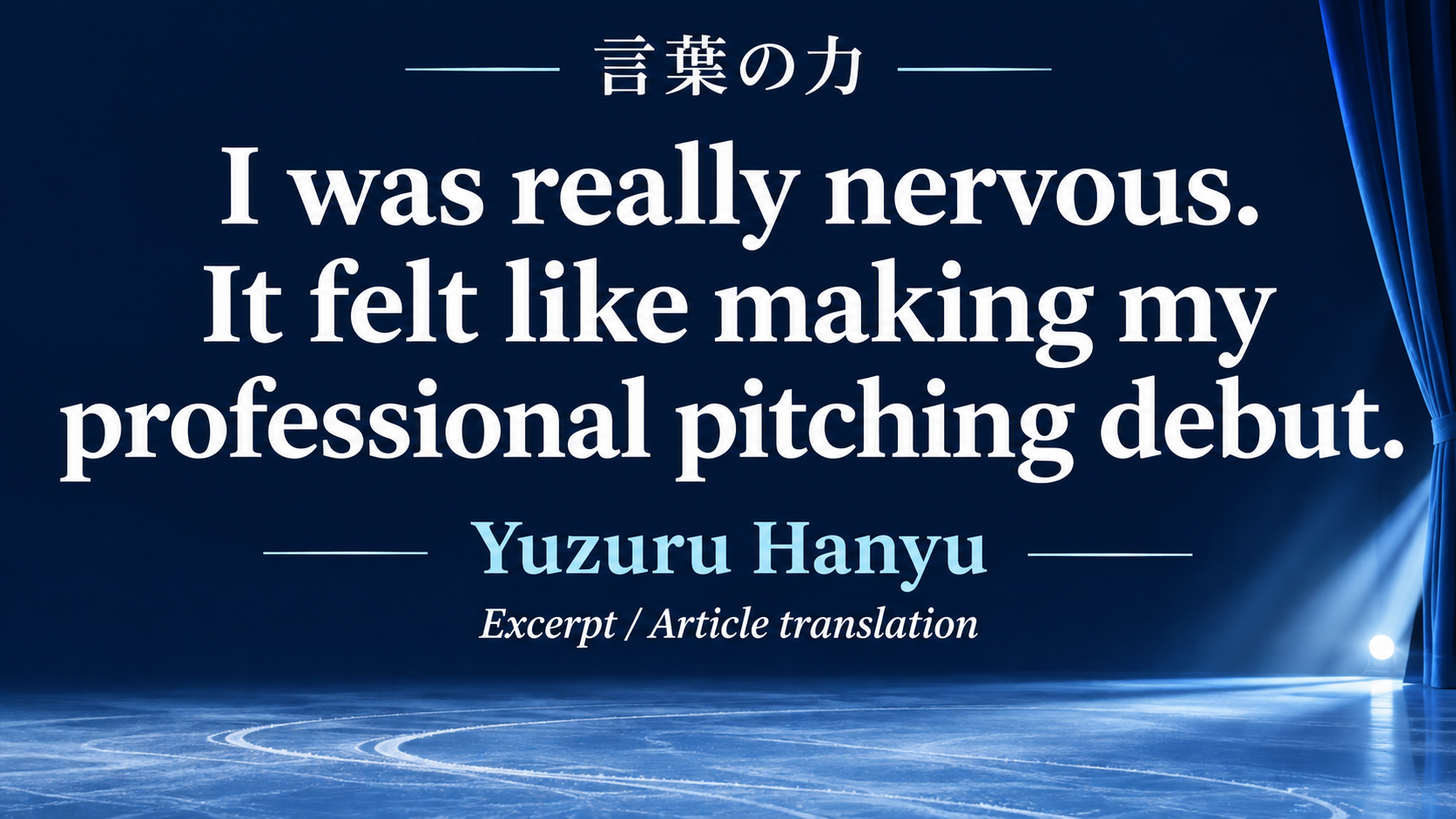
言葉の力|Yuzuru Hanyu|I was really nervous. It felt like making my professional pitching debut.|Excerpt / Article translation

Imagine being asked to give a short welcome at a community gathering.

You know what you want to say. It is not your first time. Yet as your turn approaches, you keep checking the sheet of paper in your hand.

Then comes another thought: surely something this small should not make you nervous.

Yuzuru Hanyu’s words offer a different place to pause.

Today’s quote

I was really nervous. It felt like making my professional pitching debut.

— Yuzuru Hanyu
An excerpt from an interview about his solo show, REALIVE. This article’s translation from Japanese.

A baseball comparison from the ice

In a solo interview with khb East Japan Broadcasting, Hanyu was asked to compare the first and second days of REALIVE.

His interviewer was former professional baseball player Shintaro Ejiri. Hanyu said the second day had been better, then compared his nerves to making a professional pitching debut.

He also explained that, after a maintenance period, he was rediscovering the demands of pacing himself through a solo show. His reflections included a specific observation: he had started too fast on the first day.

The appeal of the exchange is partly its directness. Someone accustomed to major performances simply says he was nervous. And he describes that feeling in the language of his interviewer’s sport.

Not adding self-criticism to the nerves

What follows is this article’s reflection.

You speak in front of a group after a long break. You return to a class you have missed. You cook a familiar dish, but this time for guests.

The task may look the same while the circumstances feel different.

When nerves arrive, it is easy to add a second difficulty: the belief that you should be beyond this by now.

Hanyu’s words do not promise that nerves lead to a good performance. They do show an experienced performer speaking openly about being nervous.

That leaves room for a gentler interpretation of your own uneasiness. It does not have to be immediate proof that you lack experience.

Waiting with the paper in your hand

You check your notes once more while waiting to speak.

Perhaps your hands are not completely steady. That need not become a verdict on how far you have come.

This is today’s turn. Feeling unsettled before it does not erase the turns you have taken before.

Source and translation note

khb East Japan Broadcasting, “羽生結弦~限界無き挑戦~ インタビューフル動画,” published May 18, 2026, presenting an interview from a program broadcast on May 10, 2026.

Japanese original: 「本当に緊張しましたよ。プロ初登板みたいな感じでしたよ。」

The English quotation is this article’s translation. The pitching debut is Hanyu’s comparison, not a claim that he played professional baseball. The community gathering and other everyday examples are original to this article.


Advertisement / Affiliate disclosure: The link below leads to our Rakuten ROOM. Product links within the ROOM are affiliate links, and we may earn a commission from purchases.

You can also browse our Rakuten ROOM for everyday items.
言葉の力|羽生結弦——慣れているはずなのに、出番の前は落ち着かない

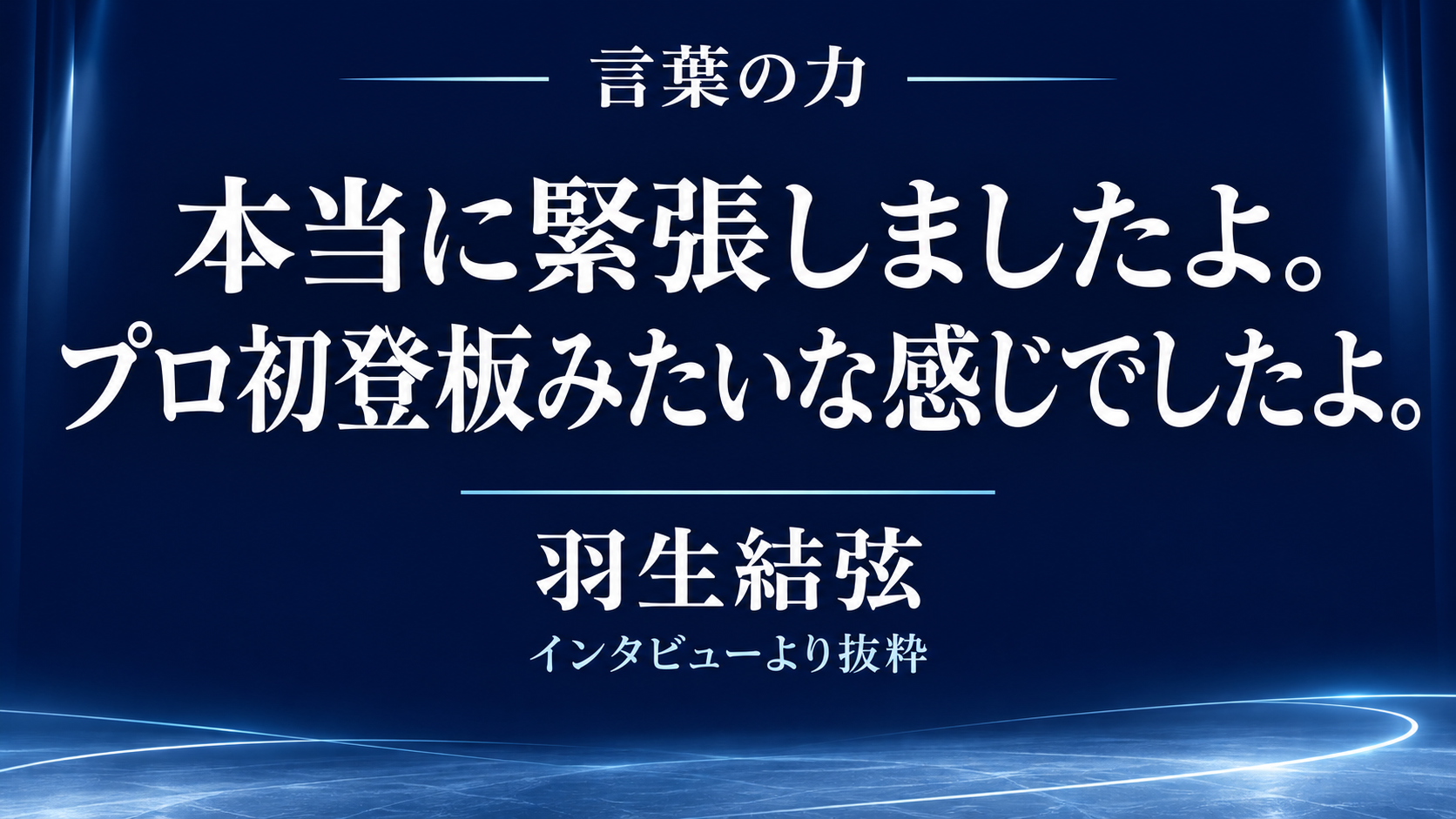
言葉の力|羽生結弦|本当に緊張しましたよ。プロ初登板みたいな感じでしたよ。|インタビューより抜粋

地域の集まりで、短い挨拶を頼まれた。

話すことは決まっているし、初めてでもない。それなのに、自分の番が近づくと、何度も紙を確かめてしまう。

「このくらいで緊張するなんて」と思う場面を想像してみてください。

そんなとき、羽生結弦さんのこの言葉を読むと、少し違う気持ちになるかもしれません。

今日の名言

本当に緊張しましたよ。プロ初登板みたいな感じでしたよ。

— 羽生結弦
単独公演「REALIVE」を振り返ったインタビューから抜粋。

氷の上の話に、野球のたとえ

khb東日本放送の単独インタビューで、羽生さんは、単独公演「REALIVE」の初日と2日目について聞かれました。

聞き手は元プロ野球選手の江尻慎太郎さん。羽生さんは2日目のほうが良かったと答え、初日の緊張を「プロ初登板」にたとえています。

このインタビューでは、メンテナンス期間を挟み、単独公演での体力やペースの配分を改めて経験したことも説明しています。初日は最初から飛ばしすぎた、という具体的な振り返りもありました。

大きな舞台に立ってきた人の言葉なのに、緊張を隠すための飾りがありません。しかも、野球経験のある聞き手に、野球のたとえで伝える。その会話の感じにも、少し親しみを覚えます。

緊張の上に、反省まで重ねない

ここからは、記事独自の考察です。

久しぶりに人前で話す。しばらく休んでいた習い事に戻る。何度も作った料理を、今日はお客さんに出す。

同じことをしているつもりでも、間が空いたり、相手が変わったりすると、勝手が違うことがあります。

そこで緊張すると、「前にもできたのに」と、自分を責める材料まで増やしてしまう。

けれど、羽生さんの発言は、経験のある人が緊張を口にすることを、そのまま見せてくれます。これを、緊張すればうまくいくという保証にする必要はありません。ただ、緊張している自分を、すぐに経験不足と決めつけなくてもよさそうです。

紙を持った手を見つめながら

挨拶の順番を待つ間、原稿をもう一度見る。

少し手が落ち着かなくても、「まだ慣れていない自分はだめだ」という話にまで広げなくていい。

今日は今日の出番。その前にそわそわしている自分がいても、不思議ではないのでしょう。

出典・参照

khb東日本放送「羽生結弦~限界無き挑戦~ インタビューフル動画」、2026年5月18日掲載。2026年5月10日放送の番組における単独インタビューを掲載したもの。

引用は掲載された回答の一部です。「プロ初登板」は羽生さんによるたとえであり、野球選手として登板したという意味ではありません。挨拶や料理の例は、本記事独自のものです。


【広告】この先は楽天ROOMへのご案内です。ROOM内の商品リンクにはアフィリエイト広告が含まれ、購入により運営者に報酬が発生する場合があります。

暮らしのものを探すときは、こちらもどうぞ。

The Power of Words | Matsuko Deluxe: A Good Day Without a Photo to Prove It

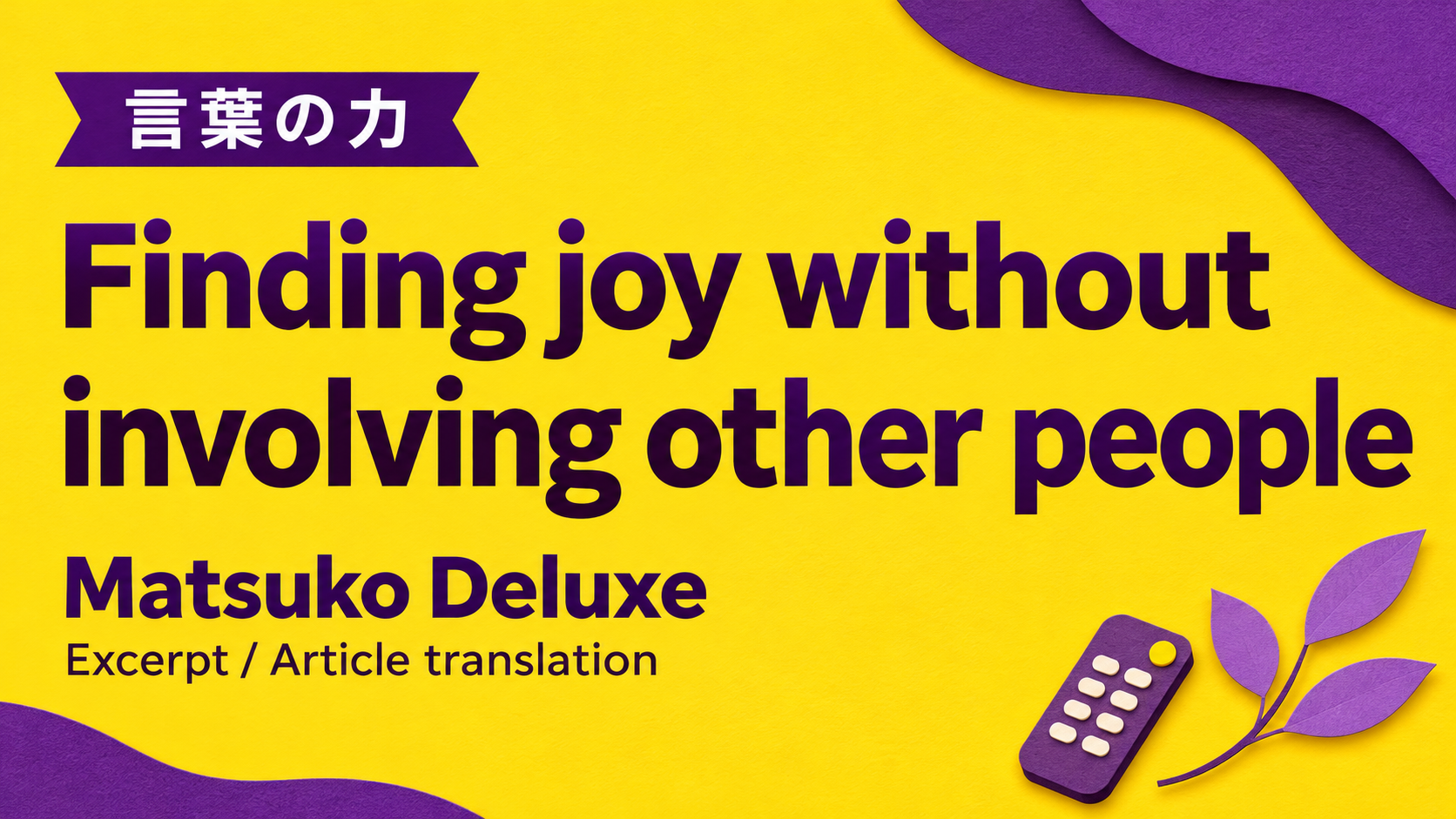
言葉の力|Matsuko Deluxe|Finding joy without involving other people|Excerpt / Article translation

Imagine looking through your phone at the end of a day off.

Your friends have posted beautiful meals and views from their travels. You took a walk nearby, watched an old television drama, and made lunch with what was in the fridge.

It was a pleasant day. Yet with nothing much to post, it suddenly begins to look a little ordinary.

Today’s quote

Finding joy without involving other people

— Matsuko Deluxe
An excerpt from a discussion of happiness on Matsuko Kaigi. This article’s translation from Japanese.

Looking happy and feeling happy

On the May 7, 2022 episode of Matsuko Kaigi, musician Chanmina and Matsuko discussed the different shapes happiness can take.

Their conversation touched on how familiar models of a good life, including marriage and parenthood, do not necessarily describe everyone’s choices. Matsuko offered the quoted phrase while considering what happiness means.

An account of the broadcast also describes a discussion of socially recognizable signs of happiness and the reactions people receive on social media. It reports Matsuko speaking about having something that is not measured against other people—not about cutting off human relationships.

This article reads the phrase as making room for enjoyment that does not need someone else’s assessment, rather than as a demand to become completely self-sufficient.

Pleasures that sound small when explained

What follows is this article’s reflection.

You laughed at the same scene in a drama you have watched before.

You noticed that a plant on your usual walking route had grown.

The leftovers turned into a surprisingly good lunch.

These pleasures can be difficult to turn into a story. If someone asks what happened next, there may be nothing more to tell. But the pleasure you felt does not disappear because the explanation is short.

Sharing a photograph can be enjoyable. So can telling a friend and laughing together.

Still, a moment need not become disappointing afterward simply because nobody else saw it.

An unchanged camera roll

Perhaps you finish the day with no new photographs.

You still remember laughing. You remember enjoying the walk.

When someone asks what you did, you may have no impressive answer. That does not mean the day was missing something.

Sources and translation note

Japanese original: 「他者を介在させずに喜びを得ること」

The quotation is an excerpt, translated for this article. Matsuko did not deliver it in English. The day-off scenario and everyday examples are original to this article.


Advertisement / Affiliate disclosure: The link below leads to our Rakuten ROOM. Product links within the ROOM are affiliate links, and we may earn a commission from purchases.

You can also browse our Rakuten ROOM for everyday items.
言葉の力|マツコ・デラックス——写真に残さなかった休日も、楽しかった

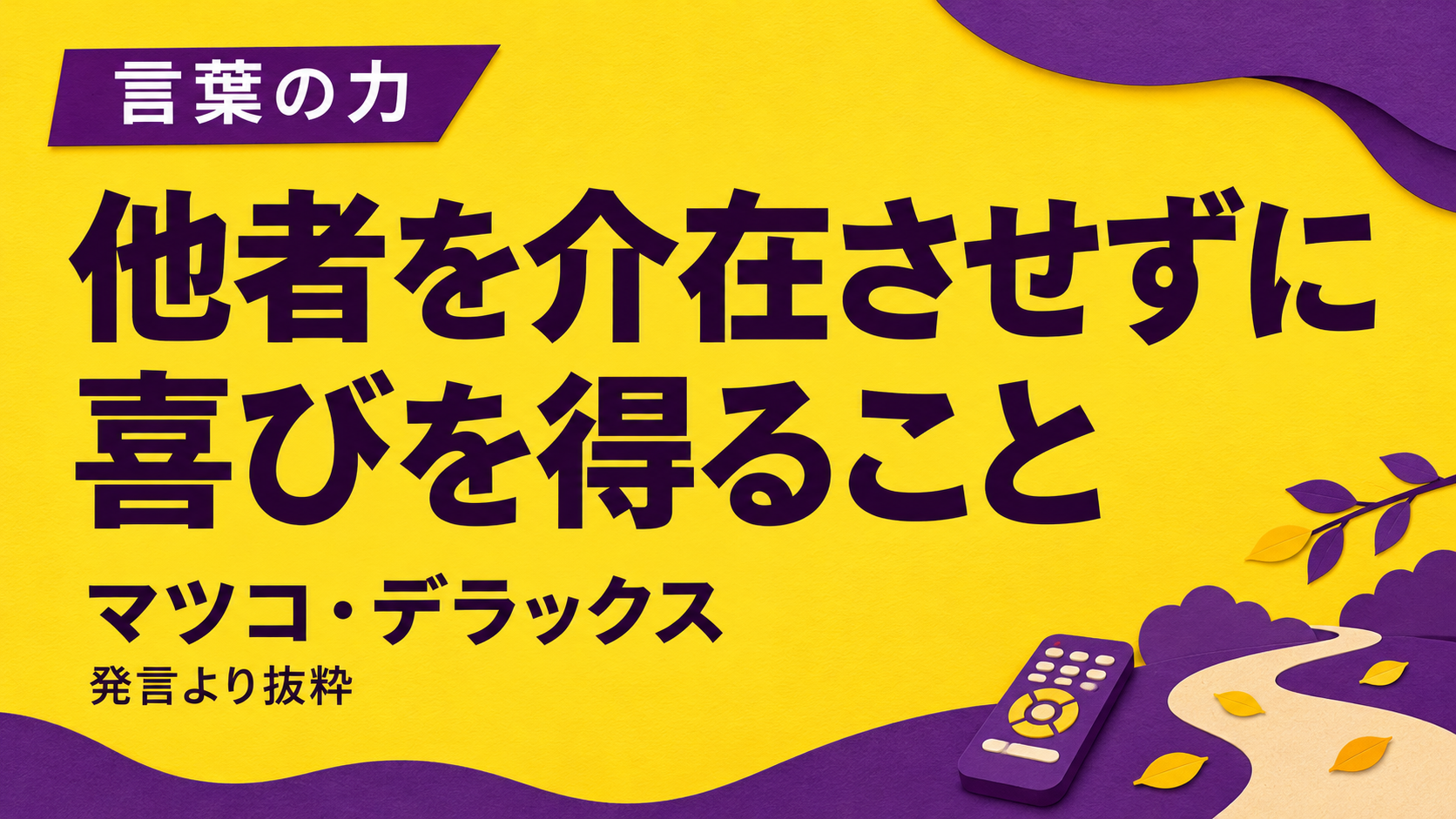
言葉の力。マツコ・デラックス:他者を介在させずに喜びを得ること。発言より抜粋。

休日の夕方、スマートフォンの写真を見返す。

友人の投稿には、きれいな料理や旅先の景色が並んでいる。自分はというと、近所を歩いて、昔のドラマを見て、冷蔵庫にあったものでごはんを食べたくらい。

悪くない一日だったはずなのに、投稿できる写真がないと、少し地味に思えてしまう。そんな場面を想像してみてください。

今日の名言

他者を介在させずに喜びを得ること

— マツコ・デラックス
『マツコ会議』で、幸福について述べた発言から抜粋。

「幸せに見える」と「うれしい」の間

2022年5月7日の『マツコ会議』では、ちゃんみなさんとマツコさんが、幸せの形について話しています。

結婚や出産など、分かりやすい暮らしの形だけでは、自分の選びたい人生を表せない。その話題のなかで、マツコさんが幸福について語ったのが、今回の言葉です。

放送内容を紹介した記事では、他人から見て分かりやすい幸福や、SNSで反応をもらうことにも話が及んでいます。一方で、人との関係を断つという話ではなく、他人と比較しないものを持つことにも触れています。

「誰にも頼らず生きなさい」という強い言葉としてではなく、自分の喜びのなかに、他人の採点が入らない場所もあっていい。この記事では、そんなふうに受け止めてみたいと思います。

説明すると、少し地味になる楽しみ

ここからは、記事独自の考察です。

同じドラマの同じ場面で、また笑った。

散歩の途中、よその家の植木が少し大きくなっているのを見つけた。

残り物を組み合わせたら、思ったよりおいしい昼ごはんになった。

こういう楽しさは、人に話そうとすると少し困ります。「それで?」と聞かれたら、その先がない。でも、そのとき自分が楽しかったことまで、なくなるわけではありません。

もちろん、誰かに話して一緒に笑うのも楽しい。写真を撮って残すのもいい。

ただ、見せる相手がいなかった時間を、あとから残念な時間に変えなくてもよさそうです。

カメラロールは静かなままでも

一日を振り返ったとき、写真は一枚も増えていない。

それでも、あの場面で笑ったことや、散歩が気持ちよかったことは覚えている。

「何をしたの」と聞かれて、立派な答えは浮かばなくてもいい。休日の手応えが、いつも画面に残るとは限らないのです。

出典・参照

引用は、幸福について述べた発言の一部です。冒頭の休日と日常例は、本記事が説明のために設けたもので、本人の体験談ではありません。


【広告】この先は楽天ROOMへのご案内です。ROOM内の商品リンクにはアフィリエイト広告が含まれ、購入により運営者に報酬が発生する場合があります。

暮らしのものを探すときは、こちらもどうぞ。

The Power of Words | Fred Rogers: When You Cannot Find the Right Reply

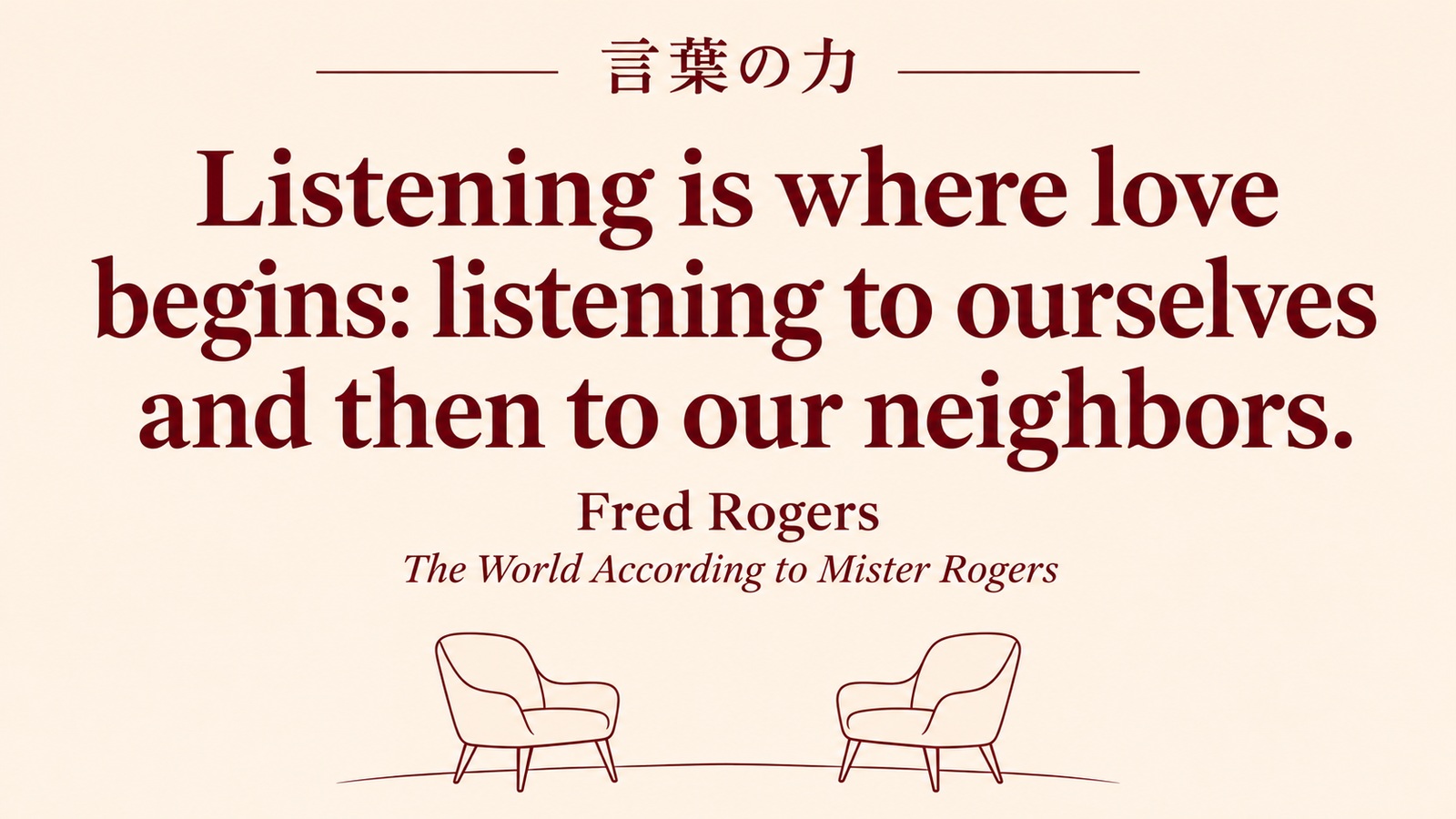
Fred Rogers: Listening is where love begins: listening to ourselves and then to our neighbors. The World According to Mister Rogers.

Imagine a friend telling you something difficult over the phone.

You want to offer encouragement, but “Everything will be fine” would promise too much. You consider sharing a similar experience, then wonder whether that is what they need right now.

A little silence appears while you search for words.

Fred Rogers, known for his children’s television program, offers a thought worth placing beside that moment.

Today’s quote

Listening is where love begins: listening to ourselves and then to our neighbors.

— Fred Rogers
The World According to Mister Rogers: Important Things to Remember (2003), p. 93, as cited by the Fred Rogers Institute.

A person who spoke—and listened

The Fred Rogers Institute reproduces this sentence with its book and page reference. Its accompanying article also discusses how Rogers made room for stillness and pauses in Mister Rogers’ Neighborhood.

Someone whose work involved communicating with an audience placed such importance on listening. And in this sentence, listening to ourselves comes before listening to our neighbors.

The specific date or occasion on which he first said or wrote these words has not been established here. This article treats them as words collected in the cited book.

Preparing a reply is not quite the same as listening

The following is this article’s reflection.

Sometimes, while another person speaks, we are already preparing our answer.

We want to help. We want to make things easier. The more we care, the busier we can become searching for something useful to say.

Yet there may still be more of the story to hear.

“What happened then?”

Or simply a quiet acknowledgment. It may not solve anything, but it can leave room for the next part.

The sentence also includes listening to ourselves. If we have little capacity to listen today, that tiredness need not be ignored. Caring about someone does not have to mean being endlessly available.

After the call, you may think you offered nothing particularly wise.

But perhaps your friend finished speaking without being hurried. What happened during that time need not be measured only by the quality of your reply.

Source note

Fred Rogers Institute, Rachel Hutson, “Reflections on Fred Rogers’ Healing Power of Presence,” March 1, 2024.

The Institute cites The World According to Mister Rogers: Important Things to Remember (2003), p. 93.

The quotation is the verified English wording, not a back-translation of the Japanese edition of this article. The phone-call example and reflections are original to this article.


Advertisement / Affiliate disclosure: The link below leads to our Rakuten ROOM. Product links within the ROOM are affiliate links, and we may earn a commission from purchases.

Here is a selection of things for everyday life.

言葉の力|フレッド・ロジャース——いい返事が浮かばない電話の向こうで

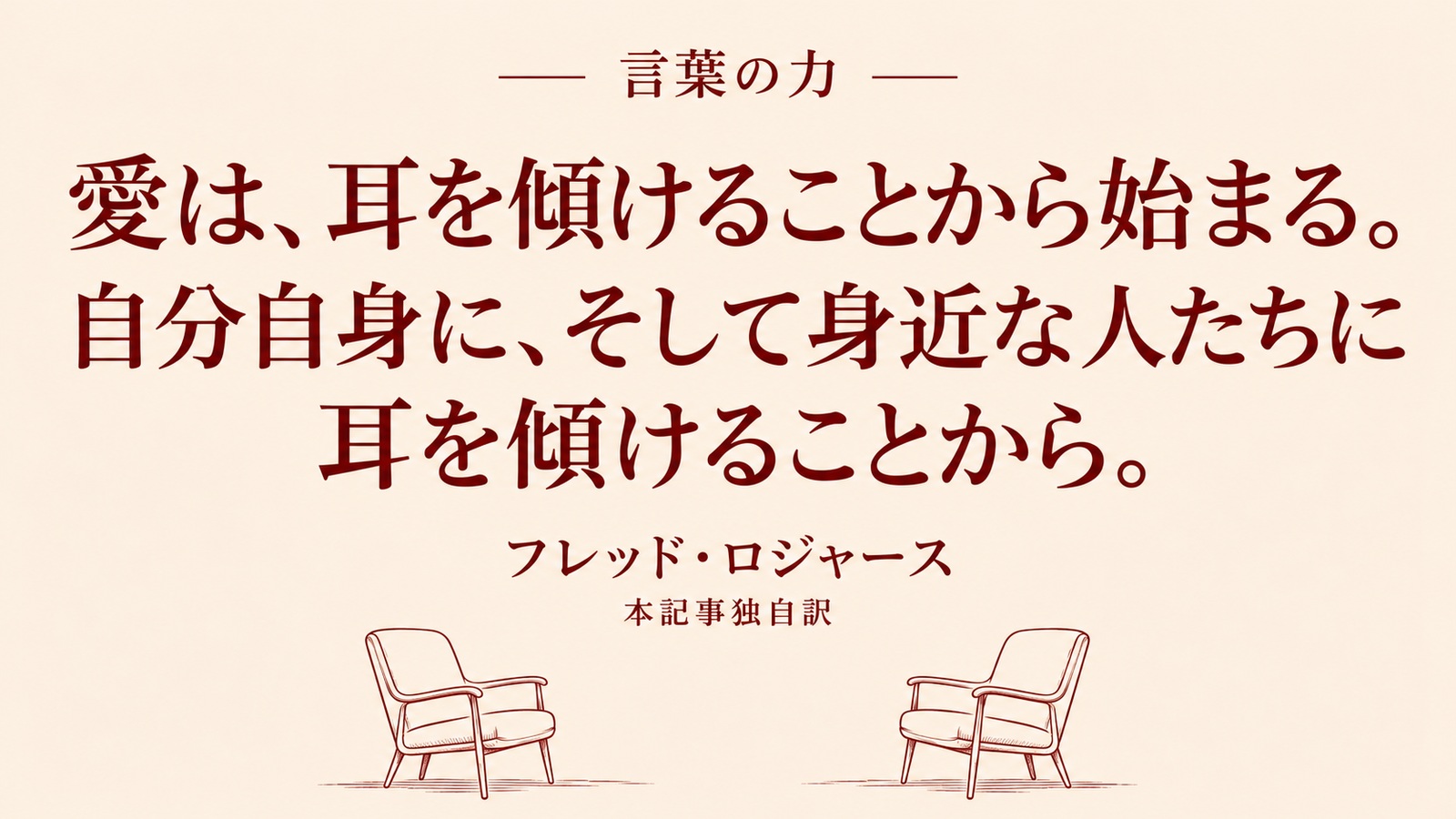
フレッド・ロジャースの言葉:愛は、耳を傾けることから始まる。自分自身に、そして身近な人たちに耳を傾けることから。本記事独自訳。

友人が電話で、少し困った話をしている。

励ましたい。でも、「大丈夫」と言い切れる話ではない。自分の似た経験を話そうとしても、今はそれを聞きたいわけではなさそうです。

言葉を探しているうちに、少し沈黙ができる。

そんな場面に置いてみたいのが、アメリカの子ども向け番組で知られるフレッド・ロジャースの言葉です。

今日の名言

愛は、耳を傾けることから始まる。自分自身に、そして身近な人たちに耳を傾けることから。

— フレッド・ロジャース
英語原文からの本記事独自訳。

話す人でもあり、聞く人でもあった

原文は、次の一文です。

“Listening is where love begins: listening to ourselves and then to our neighbors.”

Fred Rogers Instituteは、この言葉を『The World According to Mister Rogers: Important Things to Remember』(2003年)の93頁から紹介しています。同研究所の記事では、番組『Mister Rogers’ Neighborhood』で、彼が静けさや間を大切にしていたことにも触れています。

画面を通して何かを伝える人が、耳を傾けるところに目を向けている。そして、相手より先に、自分自身への傾聴が置かれている。短い一文ですが、その順序にも立ち止まりたくなります。

この引用について、特定の放送回や発言した日時までは確認していません。書籍に収録された言葉として扱います。

返事を考える時間と、話を聞く時間

ここからは、この言葉から考えたことです。

人の話を聞きながら、頭の中では返事を準備していることがあります。

役に立つことを言いたい。少しでも楽にしてあげたい。そう思うほど、よい返事を探すほうに忙しくなってしまう。

それも、相手を大切に思うからなのでしょう。ただ、こちらが言葉を探している間にも、話の続きはまだ残っているかもしれません。

「それで、どうなったの」

あるいは、短くうなずくだけ。何かを解決できる返事ではなくても、その先を話せる余白にはなりそうです。

一方で、引用にある「自分自身に耳を傾ける」ことも忘れたくありません。今日は聞く余裕がないなら、その疲れまでなかったことにしなくてよい。相手を大切にすることと、無理をし続けることを、同じにしない受け止め方もできると思います。

電話が終わってから、「結局、何も気の利いたことを言えなかったな」と思うかもしれません。

それでも相手が、途中で急かされずに話を終えられたなら。その時間に何があったかを、返事の上手さだけで測らなくてもよさそうです。

出典・参照

Fred Rogers Institute, Rachel Hutson, “Reflections on Fred Rogers’ Healing Power of Presence,” March 1, 2024.

同記事が示す書籍出典:『The World According to Mister Rogers: Important Things to Remember』(2003年)、93頁。

日本語引用は本記事独自訳。「neighbors」は文脈上の広がりを踏まえ「身近な人たち」と訳しています。電話の例と後半の考察は本記事独自のものです。


【広告】この先は楽天ROOMへのご案内です。ROOM内の商品リンクにはアフィリエイト広告が含まれ、購入により運営者に報酬が発生する場合があります。

暮らしのものを、こちらにまとめています。

The Power of Words | Tetsuko Kuroyanagi: Before Searching for Something Fun, a Little Rest

Tetsuko Kuroyanagi: But sleeping well and making sure I get enough rest—perhaps those things are more important than you might expect. Excerpt; article translation from Japanese.

Imagine scrolling through possible plans for a day off.

There are films, exhibitions, and new places to visit. They all seem pleasant enough. Yet even picturing yourself getting ready feels tiring.

“Have I stopped being interested in things?”

It is possible to worry about your curiosity itself. When Tetsuko Kuroyanagi was asked about hers, however, she spoke about rest.

Today’s quote

But sleeping well and making sure I get enough rest—perhaps those things are more important than you might expect.

— Tetsuko Kuroyanagi
Translated from Japanese for this article; one sentence excerpted from her interview.

From curiosity to sleep

In a 2018 interview, Kuroyanagi discusses her work, daily life, and how she began using Instagram.

Masaharu Fukuyama suggested it. When he explained that she could photograph things she saw or found interesting and add words, she thought it sounded enjoyable. She also says she likes taking photographs and writes her own posts.

Asked about her seemingly inexhaustible curiosity, she turns to getting enough rest.

You might expect a suggestion to go out more or encounter more information. Instead, her answer begins somewhere quieter.

Not grading your capacity for enjoyment

The following is this article’s reflection.

When nothing catches your attention, it is easy to wonder whether you have become a less interesting person.

But one day’s response need not decide what you still love. Perhaps choosing plans, traveling, and meeting people simply feel like a lot today.

Kuroyanagi’s remark does not promise that sleep will solve everything. It is her reflection on her own life.

Nor does rest need to become another assignment: recover properly today so you can become an enthusiastic person tomorrow.

You might leave the film undecided and stop adding restaurants to your list.

While sitting on the sofa, you may notice a strangely shaped cloud outside. Or you may notice nothing and drift into a nap.

What you will find interesting next does not have to be decided right now.

Source and translation note

Numéro TOKYO, interview with Tetsuko Kuroyanagi, May 6, 2018.

The quotation is this article’s English translation of a sentence from her Japanese response about curiosity. The reflections are original to this article and are not medical advice about sleep.


Advertisement / Affiliate disclosure: The link below leads to our Rakuten ROOM. Product links within the ROOM are affiliate links, and we may earn a commission from purchases.

If you’re looking for things for time at home, you can browse this selection.

言葉の力|黒柳徹子——「何か楽しいことないかな」の前に、ひと休み

黒柳徹子の言葉:でも、よく寝て、休息をしっかり取っていること、そういうのが意外と重要なんじゃないかしら。インタビューより抜粋。

休日の予定を探して、スマホを眺める。

映画も展示も、新しくできたお店もある。どれも悪くなさそうなのに、今日は出かける支度を想像するだけで、ちょっと疲れる。

「最近、何にも興味が湧かないな」

そんなふうに、自分の好奇心まで心配になる日を思い浮かべてみてください。黒柳徹子さんは、好奇心について聞かれたとき、意外にも休息の話をしています。

今日の名言

でも、よく寝て、休息をしっかり取っていること、そういうのが意外と重要なんじゃないかしら。

— 黒柳徹子
『Numéro TOKYO』のインタビューより、一文を抜粋。

好奇心の話から、眠る話へ

2018年掲載のインタビューで、黒柳さんはInstagramを始めたきっかけや、仕事、日々の暮らしについて語っています。

Instagramは福山雅治さんに勧められ、見たものや面白いものを写真に撮って文章を付けると聞き、面白そうだと思って始めたそうです。写真を撮るのが好きで、文章も自分で書いていると話しています。

そんな黒柳さんに、尽きない好奇心について質問すると、返ってきたのが休息の大切さでした。

興味を持つには、もっと出かけること。もっと情報に触れること。そうした答えを想像していたところへ、まず休んでいることが出てくる。その順番が印象に残ります。

楽しめない自分を、すぐに採点しない

ここからは、この記事の考察です。

何を見ても気持ちが動かないと、「自分がつまらない人になったのかな」と考えてしまうことがあります。

でも、その日の反応だけで、好きなものがなくなったと決めなくてもよさそうです。予定を選び、移動し、人に会うことまで、今日は重たく感じているのかもしれません。

黒柳さんの言葉は、眠れば何でも解決するという約束ではありません。好奇心旺盛な本人が、自分の暮らしを振り返って語った言葉です。

だから記事も、休息を楽しさを取り戻すための課題にはしたくありません。「ちゃんと休んで、明日は楽しめる人になろう」となると、また一つ予定が増えてしまいます。

今日は映画を決めない。行きたい店の候補も増やさない。

ソファでぼんやりしているうちに、窓の外の雲が妙な形をしていることに気づくかもしれません。気づかず、そのままうとうとしてもよいのでしょう。

次に何を面白がるかは、今すぐ決めなくても大丈夫そうです。

出典・参照

『Numéro TOKYO』「黒柳徹子、好奇心の源はよく食べて、よく寝ること!?(後編)」、2018年5月6日掲載。

引用は、好奇心についての質問への回答から一文を抜粋したものです。休息と日常についての考察は本記事独自のもので、睡眠に関する医学的な助言ではありません。


【広告】この先は楽天ROOMへのご案内です。ROOM内の商品リンクにはアフィリエイト広告が含まれ、購入により運営者に報酬が発生する場合があります。

家で過ごす時間のものを探すときは、こちらもどうぞ。