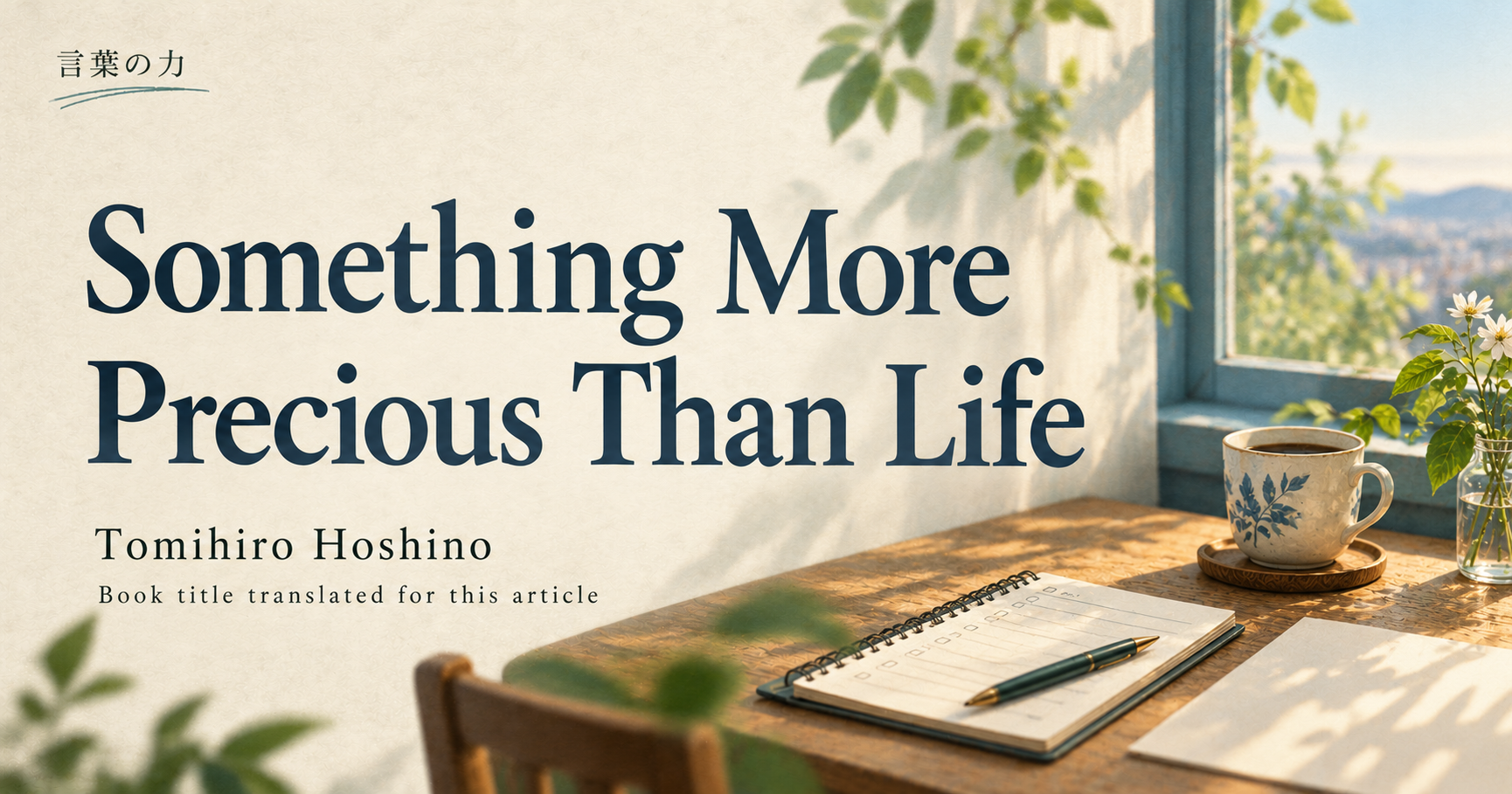
The Power of Words | Tomihiro Hoshino: When Your Day Becomes Only a To-Do List

Disclosure: This article includes affiliate links.

You did what needed doing today.

You answered work messages and finished the shopping. Yet by evening, you are not quite sure what all that busyness was for.

Rather than finding another way to work harder, take a moment to consider what you wanted to care for. Today, the title of a poetry-and-art collection offers a starting point.

Words for today

いのちより大切なもの

Tomihiro Hoshino — book title

For this article, we render the title as Something More Precious Than Life. This is our translation, not an official English title. The Japanese publisher, Inochi no Kotobasha / Forest Books, describes the collection as including poetry and artwork shaped by Christian faith, alongside an essay on the title theme. The words above are the book’s title, not a quoted line from a poem.

Our own reflection, starting from the title

This is not a summary of the book or an attempt to speak for Hoshino’s answer. Nor is it an invitation to treat your life as expendable or sacrifice yourself for something else.

What did you leave behind the busyness?

The tasks that keep a household running cannot simply disappear. Money and time matter. There is nothing inherently wrong with getting through your responsibilities.

Still, you can lose sight of what a task was meant to make possible. You came home early to talk with your family, then kept working while they spoke. Something you began for pleasure became a matter of how much you could finish.

Before criticizing your efficiency, ask: What was I actually trying to make room for?

You need not choose one thing that matters most

Family, work, friends, time alone: this reflection does not ask you to rank them. What you want to protect can differ with your circumstances and the day.

Today you may choose rest. Another day, you may keep a promise to someone. Choosing one does not mean the other has stopped mattering.

Leave some room for this discussion not to become another way of counting your shortcomings.

Include yourself among the people you care about

You may feel that pushing beyond your limits is acceptable when it is for someone else. But caring for another person and continually exhausting yourself are not the same thing.

You can say you cannot take something on today, ask for help, or change a plan. You can care about someone while being honest about your limits.

One thing for today: make space before adding more

Bring to mind one thing you want to care for. Then consider one nonessential task you could leave for another time.

You might stop checking every notification or postpone tidying that is not urgent. Use the space for a conversation or quiet rest. Necessary responsibilities do not have to be forced aside.

Caring for what matters need not mean adding another task. Sometimes it means leaving a little room.

Read in Japanese

日本語版を読む

Source

Inochi no Kotobasha: Tomihiro Hoshino’s いのちより大切なもの, poetry-and-art collection (Japanese). Reference for the title, author and publisher’s description. No poem text is reproduced or translated. Our examples and reflection are not a summary of the book.

A little inspiration for everyday living

In my Rakuten ROOM, I share everyday items we might put off buying for ourselves but would be happy to receive as gifts. Browse when you need something. (*^^*) You do not need to buy anything to consider what matters to you.

Shopping from outside Japan? Check Rakuten Global Express for current services, supported destinations, fees and restrictions before purchasing.

Pre-publication checklist — remove before publishing

Tenth manuscript for five themes, not a count of saved drafts. Draft only; no publication date or schedule. Three common English tags and Discovery applied. Person tag, category, mood navigation and English related-reading links need review. Japanese version is post 301; reciprocal link requires a separately approved update. Noriko Ibaragi and Shinmin Sakamura English drafts remain unsaved after HTTP 403 errors; do not invent links to them. Verify source wording, publisher’s description, title translation and image-use rights. This article uses the book title rather than the previously proposed poem excerpt. No full-poem quotation or translation, and no claim to summarize the book or speak for the author’s faith. Search demand unverified. Scenes are illustrative, not the owner’s experiences. Check mobile layout, remove editorial notes and let the owner decide publication.

Featured image not generated or assigned. Brief: landscape 1200×630, refined adult illustration with quiet playfulness, ivory, pale green and muted blue. A notebook with a schedule, an empty space beside it, and soft window light at lower right. No portrait or reproduction of Hoshino’s poetry paintings. Main text: Make Room for What Matters. Smaller text: Tomihiro Hoshino; The Power of Words. Main text is our editorial headline, not a quotation or book-title translation; do not add quotation marks. No imagery suggesting self-sacrifice or devaluing life. Review rights and series consistency before generation. Letter-by-letter image verification has not been performed.
The Power of Words | Kirin Kiki: When Someone Else’s Good News Makes You Feel Behind

Disclosure: This article includes affiliate links.

A classmate gets promoted. A friend shares holiday photos. Another family looks wonderfully happy.

You are pleased for them. That part is real. Yet after putting down your phone, your own ordinary day suddenly seems less impressive.

A moment ago, life felt reasonably normal. Now you are conducting an unexpected performance review of yourself.

Words for today

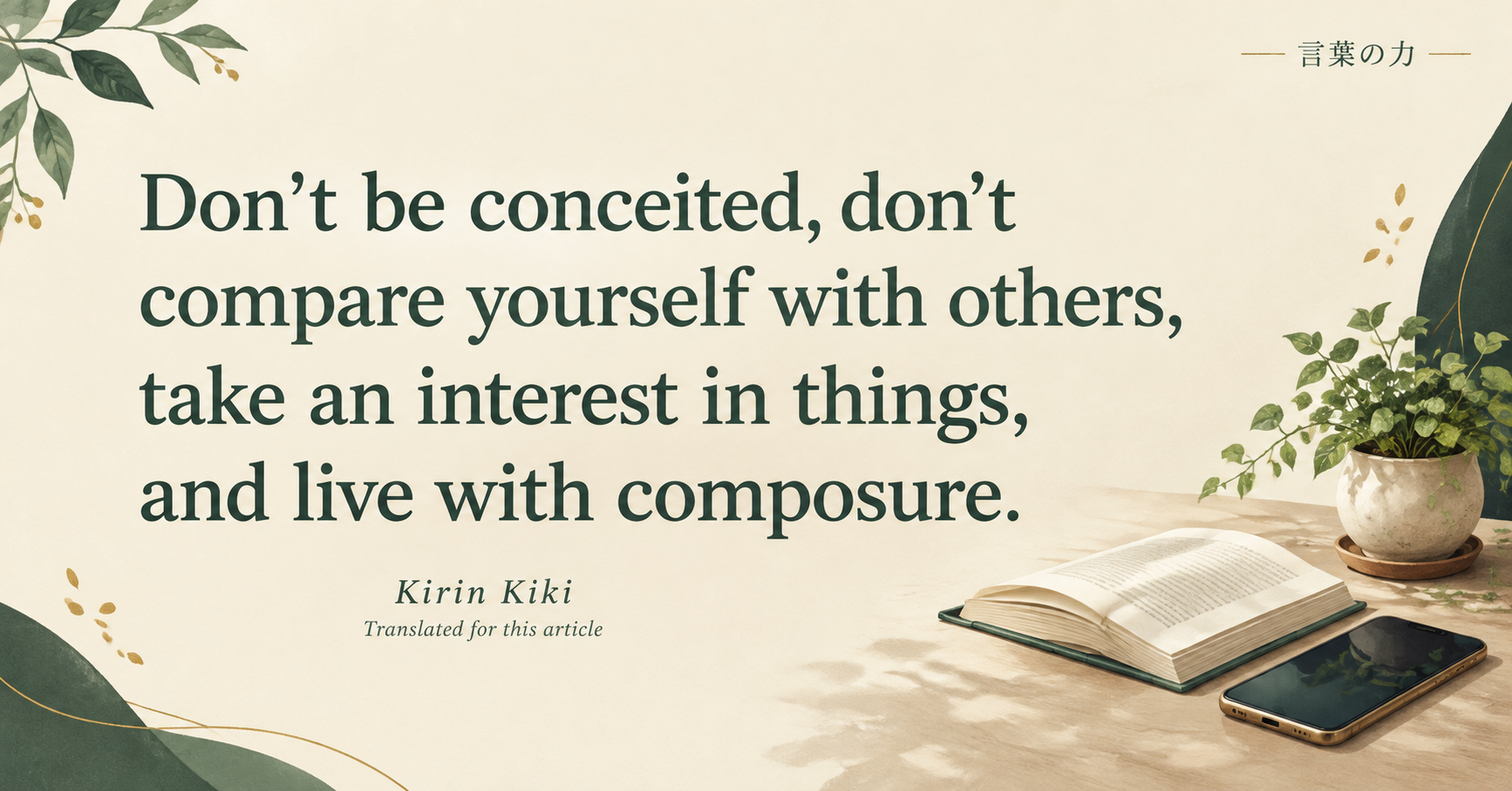
Don’t be conceited, don’t compare yourself with others, take an interest in things, and live with composure.

Kirin Kiki — translated for this article

Original: おごらず、人と比べず、面白がって、平気に生きればいい. According to Shukan Josei PRIME’s report of Kiki’s farewell ceremony, her daughter Yayako Uchida recalled these words as something her mother had told her. We present them as words passed on by her daughter, not as a direct transcript of a lecture by Kiki. The English above is this article’s translation, not an official translation.

An everyday reflection on these words

Their good news is not an instruction for you

A friend starting a new job is an event in your friend’s life. It is not a notification telling you to change yours immediately.

Still, while looking at the screen, you may begin grading your own days. What am I doing with my life?

You do not need to criticize yourself for comparing, either. First, notice what happened: you turned someone else’s news into your own score. Celebrating them and diminishing yourself do not have to come together.

Interest does not mean pretending everything is funny

For this reflection, taking an interest in things does not mean laughing away painful experiences. The following is our own everyday reading, not a claim to explain all of Kiki’s intentions.

It can mean returning your attention to something that quietly caught your interest: a shop on your way home, a neatly written line, or a pitch in a baseball game that made you look up.

These moments may not look as glamorous as someone else’s holiday. But something moved in your own day. Not posting it or receiving praise does not erase the enjoyment.

You can step back when composure feels out of reach

We need not read composure as a command to become someone who never gets hurt.

If scrolling is making you miserable, close the screen for now. Give yourself time before replying. Talk to someone you trust. Taking some distance is an option too.

One thing for today: return to a private pleasure

Think of one small thing you have wanted to enjoy. Open a book for one page, listen to a song, or look at the plant by your window. It need not cost money or become another appointment.

After visiting someone else’s life on a screen, come back to your own. Even without impressive news to share, your day may still contain something worth noticing.

How are you feeling? Explore more words for being yourself.

Related reading

Misuzu Kaneko: Someone Else’s Strength Does Not Make You Smaller
Shigeru Mizuki: You Do Not Have to Earn Your Day Off
日本語版を読む

Source

Shukan Josei PRIME: report of Kirin Kiki’s farewell ceremony (Japanese). The quotation is attributed through her daughter’s recollection. The translation and reflection are this article’s own.

A little inspiration for everyday living

In my Rakuten ROOM, I share everyday items we might put off buying for ourselves but would be happy to receive as gifts. Browse when you need something. (*^^*) Buying something is not the conclusion of this reflection.

Shopping from outside Japan? Rakuten Global Express offers international forwarding from Japan. Please check supported destinations, shipping fees, and item restrictions before using the service.

Pre-publication checklist — remove before publishing

Second of ten drafts for five selected themes. Draft only, no publication date or schedule requested. Three common English tags, Be Yourself and Discovery applied. Person tag and category still need review and assignment. Add the reciprocal English link to Japanese post 295 after creation. Verify source wording, quotation, translation and image-use rights, related articles’ publication status, links and mobile layout. Attribution is through the daughter’s recollection in a secondary report, not a direct recording of Kiki. Search demand unverified. Scenes are illustrative, not the owner’s experiences. Image not generated or assigned. Remove editorial notes after review; the owner decides publication.

Featured-image brief: 1200×630 landscape, refined adult editorial illustration with quiet playfulness, ivory, muted forest green and restrained gold. A face-down phone, open book and small plant at lower right; no portrait or logo. The largest text must exactly match the article quotation: Don’t be conceited, don’t compare yourself with others, take an interest in things, and live with composure. Smaller text: Kirin Kiki; The Power of Words; Translation for this article. Adjust line breaks only; do not shorten or change punctuation. Keep generous margins and readable serif typography. Do not generate or publish before reviewing image-use rights. Compare the generated image letter by letter against the English quotation; image verification has not been performed.

The Power of Words | Misuzu Kaneko: Someone Else’s Strength Does Not Make You Smaller

Disclosure: This article contains affiliate advertising.

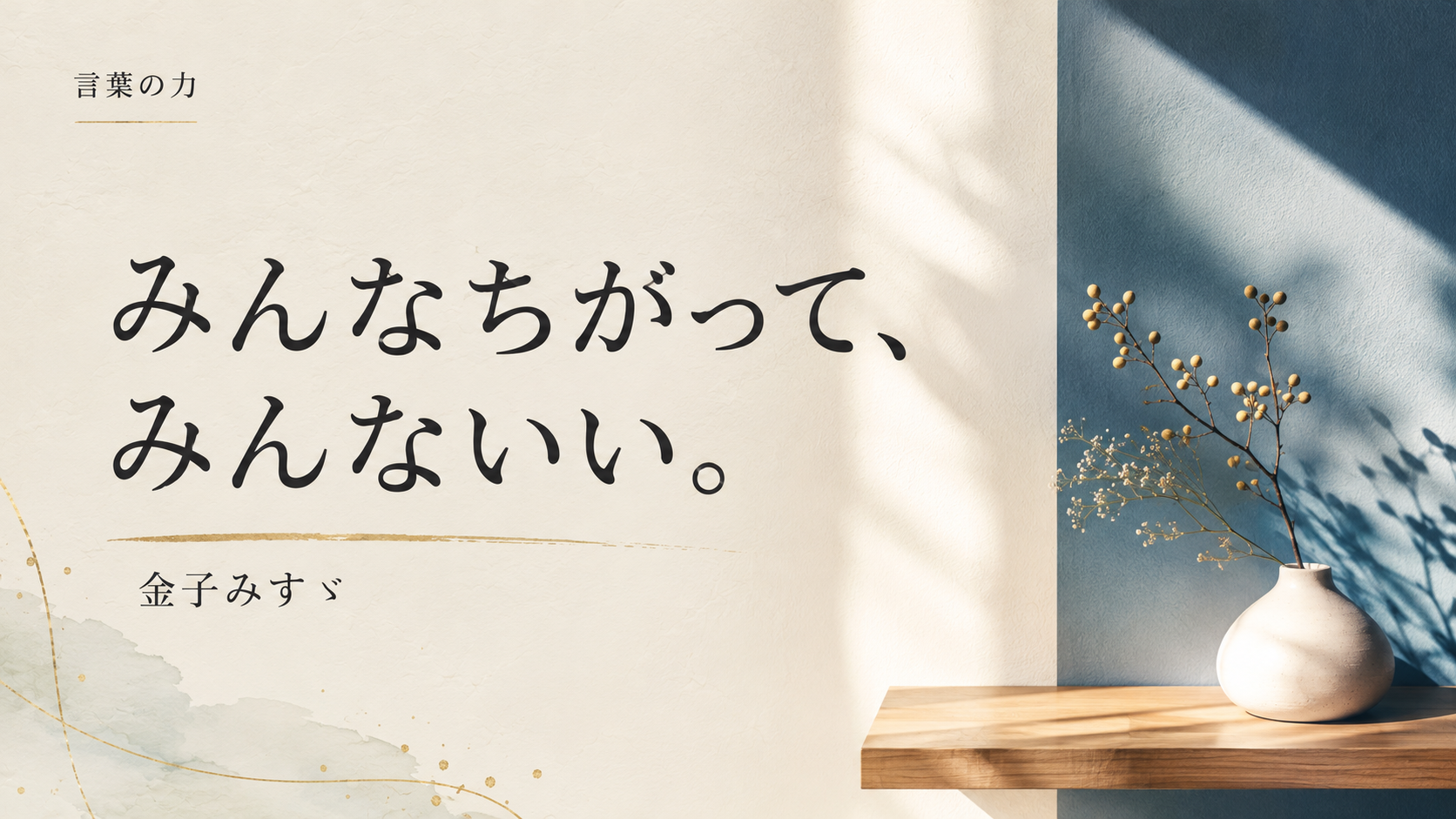
“We are all different, and each of us is good.”

Misuzu Kaneko, “私と小鳥と鈴と” (“Me, the Little Bird, and the Bell,” title translated for this article).

The quotation is translated here from the Japanese text published in the Kaneko Misuzu Memorial Museum director’s column on Nagato City’s website; this is not an official English translation.

Someone else’s strengths can make us suddenly notice everything we think we lack.

They speak confidently. Work quickly. Feel at ease with people they have just met.

Once we begin comparing, our own strengths seem remarkably good at hiding.

On days like that, I want to return to Misuzu Kaneko’s words.

Her poem brings together a little bird, a bell, and the speaker, describing things each can and cannot do.

What follows is my personal reflection on everyday life.

Do not turn someone’s strength into your shortcoming

We hear someone explain something well and immediately think, “I am too slow when I speak.”

But appreciating them and judging ourselves are separate acts.

We can stop at “That was clear.” We can think, “There is something I could learn from that.”

We do not have to lower ourselves every time we praise someone else.

Their strength does not reduce our worth.

Some contributions are quieter

One person offers an idea immediately. Another notices something missing after listening carefully.

One person gets a project moving. Another makes it easier to sustain.

Different situations make different contributions more visible.

When reflecting on your day, ask not only, “Did I stand out?” but also, “What did I help support?”

You checked a detail. Organized someone’s thoughts. Left a note so the next person would not struggle.

Those contributions do not have to disappear because they were quiet.

Being different and choosing to grow can coexist

I do not want to narrow this quotation into “Nothing ever needs to change.”

We can practice a difficult skill or reconsider a troublesome habit.

But we do not have to begin with the belief that our present selves are worthless.

We can change without rejecting ourselves. Respecting differences also does not mean ignoring someone’s needs or accepting harmful behavior.

If someone seems especially impressive today, acknowledge one good thing about them.

Then notice one thing you did, too.

Being different does not automatically mean being deficient. I would like to keep that thought close, like a small note at the corner of a desk.

Quotation and poem source: Nagato City: Kaneko Misuzu Memorial Museum director Setsuo Yazaki’s column, “私と小鳥と鈴と” (Japanese).

The Power of Words | The Little Prince: A Day Is More Than What You Can Count

日本語で読む | English

Disclosure: This article contains affiliate advertising.

“What is essential is invisible to the eye.”

Antoine de Saint-Exupéry, The Little Prince. English wording as presented on the work’s official website.

At the end of a day, we sometimes want to count what we accomplished.

How many tasks did we finish? How many pages did we read? Did anyone respond to what we shared?

Numbers can help us notice things. But when the numbers are small, calling the whole day empty may be too quick.

These words from The Little Prince invite me to look beyond what is easiest to measure. What follows is my personal reflection.

Some meaningful time comes before a visible result

Not everything immediately takes shape.

The time spent listening to someone. The care taken to rewrite a message before sending it. The decision to remove a plan because you needed rest.

None of these may appear in a completed-task count. Yet they can support our relationships and daily lives.

A day with few visible results does not have to erase everything that happened before those results.

What is invisible may still need to be expressed

I do not want to read this quotation as “If you care, you never need to say so.”

Tell someone they matter. Thank them for helping. Ask when you think something has been misunderstood.

Valuing what is invisible is different from assuming we know what another person feels.

Sometimes a small sentence matters more than leaving something unspoken.

Remember one thing you cared for today

Tonight, ask not only, “What did I add?” but also, “What did I take care of?”

You kept a promise. Noticed your tiredness. Waited without rushing someone. Paused before saying too much.

These may not be impressive achievements, but they reveal choices you made.

Numbers are useful. They do not have to define the entire meaning of a day.

This is not a reason to ignore practical problems. It is a way to acknowledge that meaningful time can exist outside visible accomplishments.

Even if today moved more slowly than you hoped, it does not have to become a day in which nothing mattered.