言葉の力|J.K.ローリング——短い返信の向こうに、まだ知らない一日がある

人は、想像の中で他の人の立場に身を置くことができます。 J.K.ローリング/本記事訳|言葉の力

友人から、今度の集まりには行けそうにないと連絡が来る。短い文面を見て、少しそっけないなと思う。けれど、こちらに見えているのは、その人の一日のうち、送信ボタンを押した数秒だけかもしれません。

自分の知らない事情に思いを向けること。『ハリー・ポッター』の作者、J.K.ローリングは、想像力を物語の中だけの力としては語りませんでした。

今日の名言

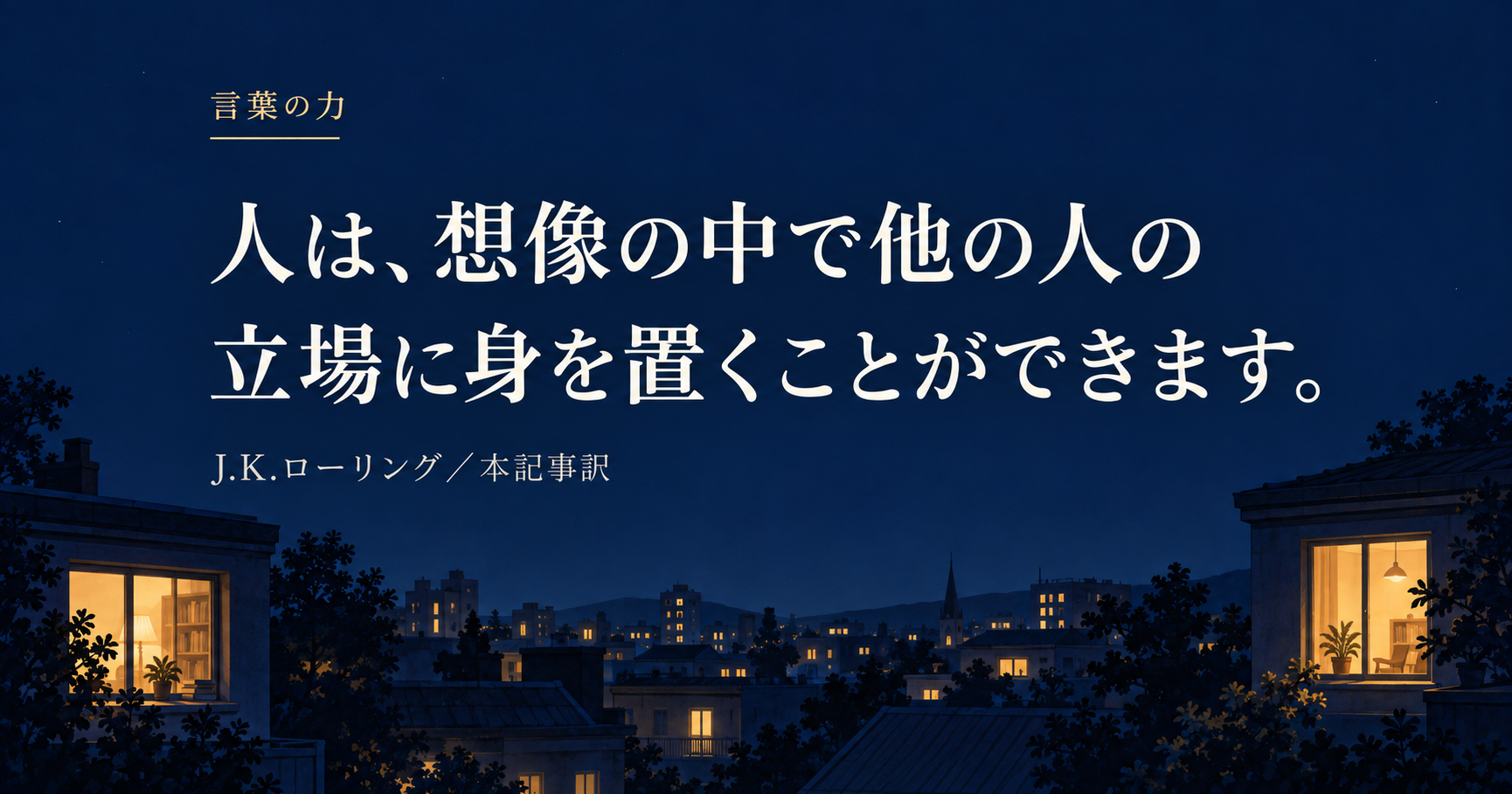
人は、想像の中で他の人の立場に身を置くことができます。

J.K.ローリング/ハーバード大学卒業式スピーチ、2008年6月5日(本記事訳)

魔法の物語を書く人が語った、もう一つの想像力

原文は “They can think themselves into other people’s places.”。直前の文にある人間を指す “They” を、日本語では「人は」と訳しています。

ローリングは卒業式のスピーチで、失敗と想像力という二つのテーマを選びました。想像力については、存在しないものを思い描く力だけでなく、自分が経験していないことを生きる人に共感する力でもある、と説明しています。

その背景として語ったのが、ロンドンのアムネスティ・インターナショナルで働いていた経験です。人権侵害の証言に触れ、また、同じ経験をしていない人々が支援のために行動する姿を知ったと述べています。

今回の一文は、その文脈にあります。空想すれば願いがかなう、という意味ではありません。他者の置かれた状況を理解しようとする想像力の話です。また、その力は人を操るためにも使えるとして、無条件に美化してはいません。

分からない部分を、決めつけで埋めない

ここからは、その大きな主題を身近な場面に重ねた、本記事独自の考察です。友人とのやりとりと、スピーチで語られた人権問題を同じ重さで扱うものではありません。

たとえば、集まりを断った友人には、疲れや家族の用事があるかもしれません。ただ、想像できるからといって、こちらが事情を当てられるわけではない。忙しいに違いない、気を使わせたに違いないと、別の物語で決めつけてしまうこともあります。

だから、この言葉を日常で受け取るなら、相手の事情が分かったつもりになるより、まだ見えていない部分があると気づく方が近い気がします。

残念に思う気持ちは、そのままでもいい。相手に必ず共感しなければ、と自分を追い込む必要もありません。自分の気持ちと、相手についてまだ知らないことは、両方あってよいのでしょう。

一通の連絡の向こうにも、一日がある

物語を読むとき、私たちは主人公が見ているものをたどります。実際の相手には、作者が説明してくれる地の文がありません。

短い連絡の向こうに、まだ読んでいない時間がある。その余白を残したまま、今回は残念、また会おうねと返す。そんなやりとりも、この想像力の小さな使い道かもしれません。

出典・参照

Harvard Gazette, Text of J.K. Rowling’s speech, June 5, 2008. スピーチ題目:The Fringe Benefits of Failure, and the Importance of Imagination。

引用原文:They can think themselves into other people’s places. 日本語訳は本記事による独自訳です。小説中の台詞ではなく、本人の卒業式スピーチの一文です。導入と友人の例は説明用の創作です。日常への読み替えは本記事独自の考察です。


※本記事にはアフィリエイト広告が含まれます。

暮らしの小さな楽しみを集めた、127のROOMもご覧いただけます。

The Power of Words | J.K. Rowling: The Unseen Day Behind a Short Reply

They can think themselves into other people’s places. J.K. Rowling|言葉の力

A friend sends a message saying they cannot make the next get-together. The wording is brief, and it feels a little distant. Yet what you can see may be only the few seconds in their day when they pressed send.

What about the circumstances you cannot see? J.K. Rowling, author of Harry Potter, spoke about imagination as a power that reaches beyond storytelling.

Today’s quote

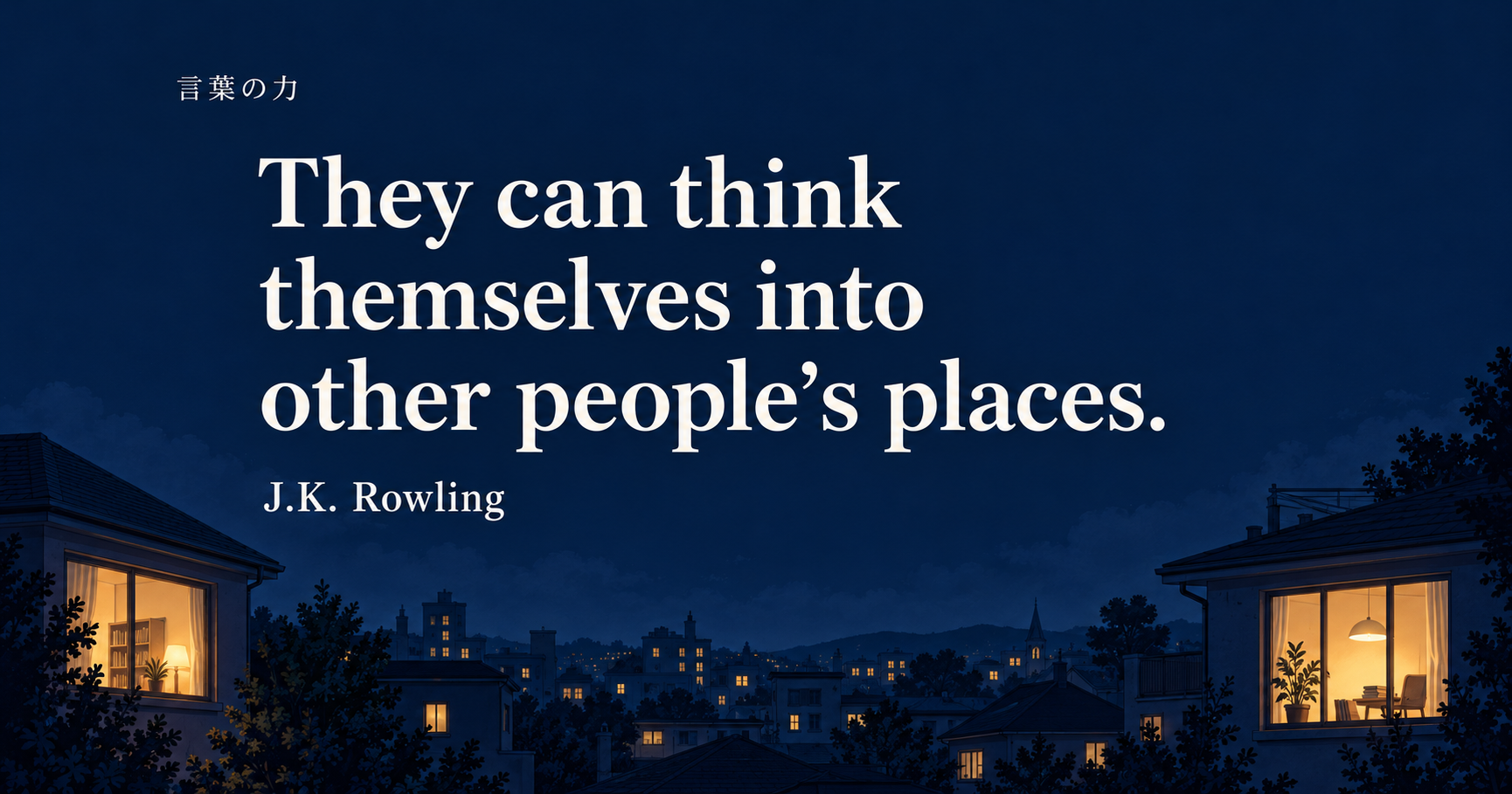
They can think themselves into other people’s places.

J.K. Rowling / Harvard commencement address, June 5, 2008

Another kind of imagination

“They” refers to humans in the preceding sentence of the speech. The Japanese companion article makes that reference explicit in translation.

Rowling chose failure and imagination as the two themes of her commencement address. She described imagination not only as the ability to envision things that do not exist, but also as the capacity to empathize with people whose experiences we have never shared.

She connected this to her work at Amnesty International in London, where she encountered testimony about human rights abuses. She also described learning how people who had not endured those abuses could act on behalf of those who had.

The featured sentence belongs to that context. It is not a promise that imagining a wish will make it come true. It concerns trying to understand another person’s situation. Nor did Rowling idealize the power unconditionally: she noted that the same capacity could be used to manipulate people.

Leaving room for what we do not know

What follows is this article’s own everyday reflection on that larger subject. It does not equate a missed social gathering with the human rights issues discussed in the speech.

Perhaps the friend who declined is tired, or has family commitments. But being able to imagine possibilities does not mean we can correctly guess the circumstances. Assuming they must be busy, or must feel pressured, can simply replace one unsupported story with another.

An everyday reading of the quotation might therefore begin not with believing that we understand someone, but with noticing how much remains out of view.

You can still feel disappointed. There is no need to turn empathy into another demand on yourself. Your feelings and the things you do not yet know about the other person can both exist.

There is a day on the other side of a message

In a novel, we can follow what a character sees. In real life, there is no narrator explaining the other person’s circumstances.

Behind a brief message are hours we have not read. Leaving that space open, you might answer that you are sorry to miss them and hope to meet another time. Perhaps that, too, is a small use for imagination.

Source and translation notes

Harvard Gazette, Text of J.K. Rowling’s speech, June 5, 2008. Address title: The Fringe Benefits of Failure, and the Importance of Imagination.

The featured quotation reproduces the English wording of Rowling’s speech, not dialogue from a novel. The Japanese companion uses this article’s own translation: 人は、想像の中で他の人の立場に身を置くことができます。 The opening and friendship examples are fictional illustrations. The everyday application is the article’s interpretation.

Affiliate link — This link opens a Japanese shopping site.


Disclosure: This article contains affiliate links.

For small everyday discoveries, you can also explore 127’s ROOM.

The Power of Words | Jun Miura: Looking at Old Photos Without Keeping Score

Of course, I’d say, ‘Right?’ (laughs). Jun Miura / translated for this article|言葉の力

Imagine looking through old photographs. First comes surprise at the hairstyle, then laughter at the clothes. After that, you notice how different your face looks now. Some days, nostalgia is not the only feeling that follows.

Changes with age often invite a familiar measure: do I still look young? Jun Miura finds a way to change the rules of that measurement.

Today’s quote

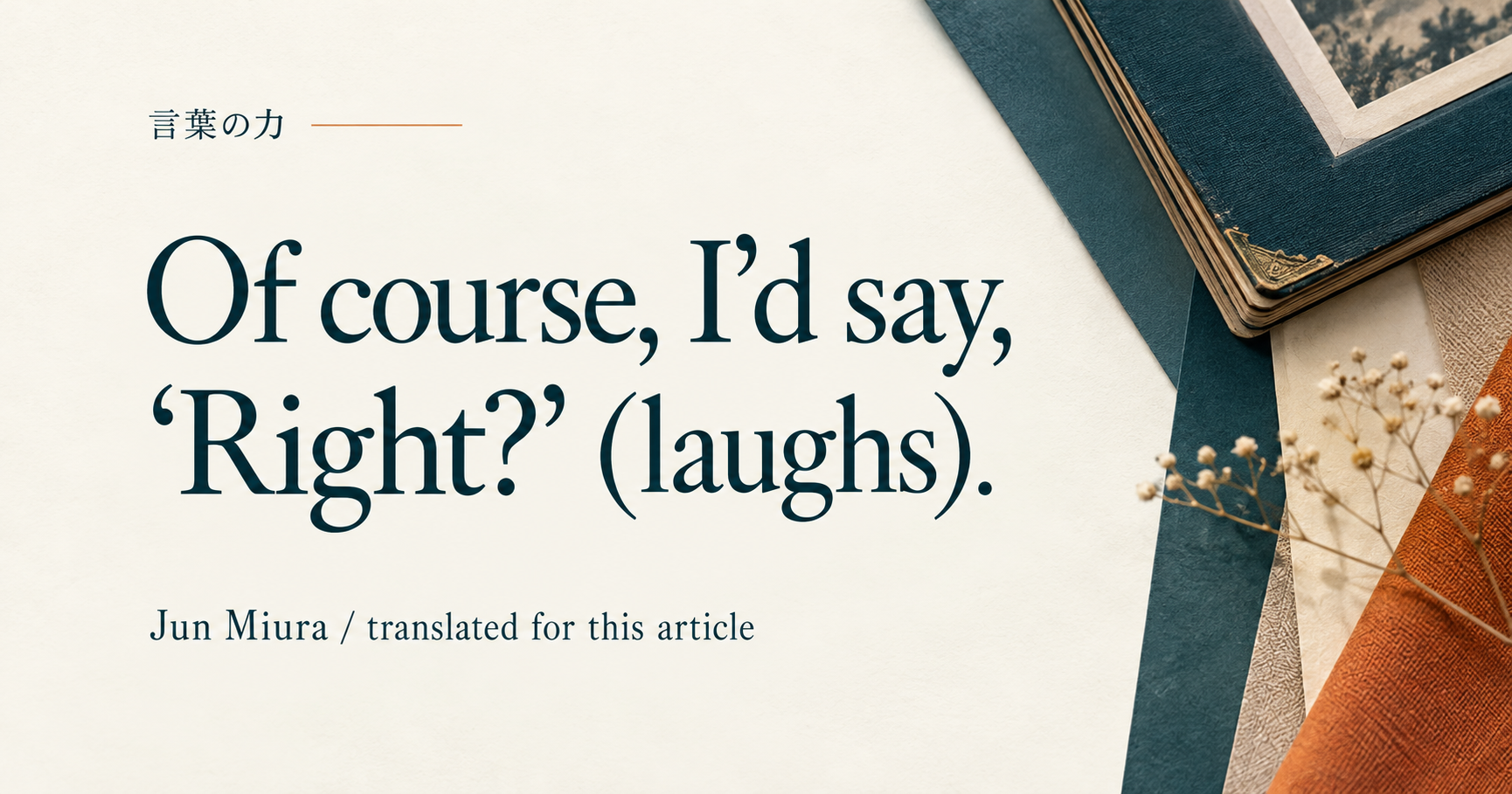
Of course, I’d say, ‘Right?’ (laughs).

Jun Miura / Hobonichi interview, November 13, 2024. Translated for this article.

An unexpected answer to “You look older”

This was not an account of something Miura had actually said to someone. In the interview, he was developing an imaginary exchange about how he would respond if told that he suddenly looked older.

He began with the descriptive names of old men in Japanese folk tales, including the old man who makes flowers bloom and the old man whose lump is removed. What label might fit him? He proposed the old man of personal enthusiasms, playing on the expression “my boom,” associated with his work. He shortened the Japanese label to “Maijii.”

From there, he jokingly described deliberately cultivating an older appearance to fit the character. Under those rules, being told that he looked older would mean his project was working. Hence the reply featured here. The joke continues: if someone heard his age and said he was still young, he would have to pretend that his efforts were not yet enough.

This is less a one-line cure for anxiety about aging than a playful reversal of an ordinary judgment.

No need to compete with your old photographs

What follows is this article’s own reflection on the exchange.

When an old photograph makes the present feel like the losing side, appearance may be doing most of the comparing. Yet today might also include a favorite restaurant you had not discovered then, or friends with whom you no longer need to put on a performance.

That does not mean changes in appearance stop mattering. But the same photograph can support another conversation: apparently I thought that hairstyle was an enormous success. A moment of comparison has room to become a story instead.

In Miura’s joke, even the compliment that he looks young misses the character he is trying to become. Change what counts as praise, and a familiar conversation suddenly resembles a comedy sketch.

Of course, some people do not want comments about their age or appearance. Nobody owes an amused answer to an unwelcome remark. This is not a universally correct response to copy, but one person’s playful way of looking at his own changes.

An album is not a scorecard

Once the photograph is put away, the face in the mirror is your present one. You may not return to the old hairstyle, but you do have this present moment in which to laugh about it.

Miura’s reply has the lightness of stepping away, briefly, from waiting to be judged or praised. Perhaps our changes need not be viewed through the same old measure every time.

Source and translation notes

Hobonichi, “Miura Jun ni Kike! Out-Rou Hen,” part 2, “My Boom Jiisan,” November 13, 2024 (Japanese). Read the interview.

Original: もちろん、「でしょ?」と返しますね(笑)。 The featured English wording is this article’s own translation, not an English statement by Miura. The source exchange is hypothetical, not a reported incident. The photograph scenes are fictional illustrations; the everyday reflections are the article’s interpretation.

Affiliate link — This link opens a Japanese shopping site.


Disclosure: This article contains affiliate links.

For small everyday discoveries, you can also explore 127’s ROOM.
言葉の力|みうらじゅん——昔の写真と、今の自分を比べてしまう日に

もちろん、「でしょ?」と返しますね(笑)。 みうらじゅん|言葉の力

昔の写真を見返して、まず髪形に驚く。こんな服を着ていたのかと笑って、それから、今とはずいぶん顔が違うことに気づく。懐かしいだけでは済まない日もあるかもしれません。

年齢の変化を前にすると、若く見えるかどうかの物差しを持ち出しがちです。みうらじゅんさんは、その物差しの使い方から、ひょいと変えてみせます。

今日の名言

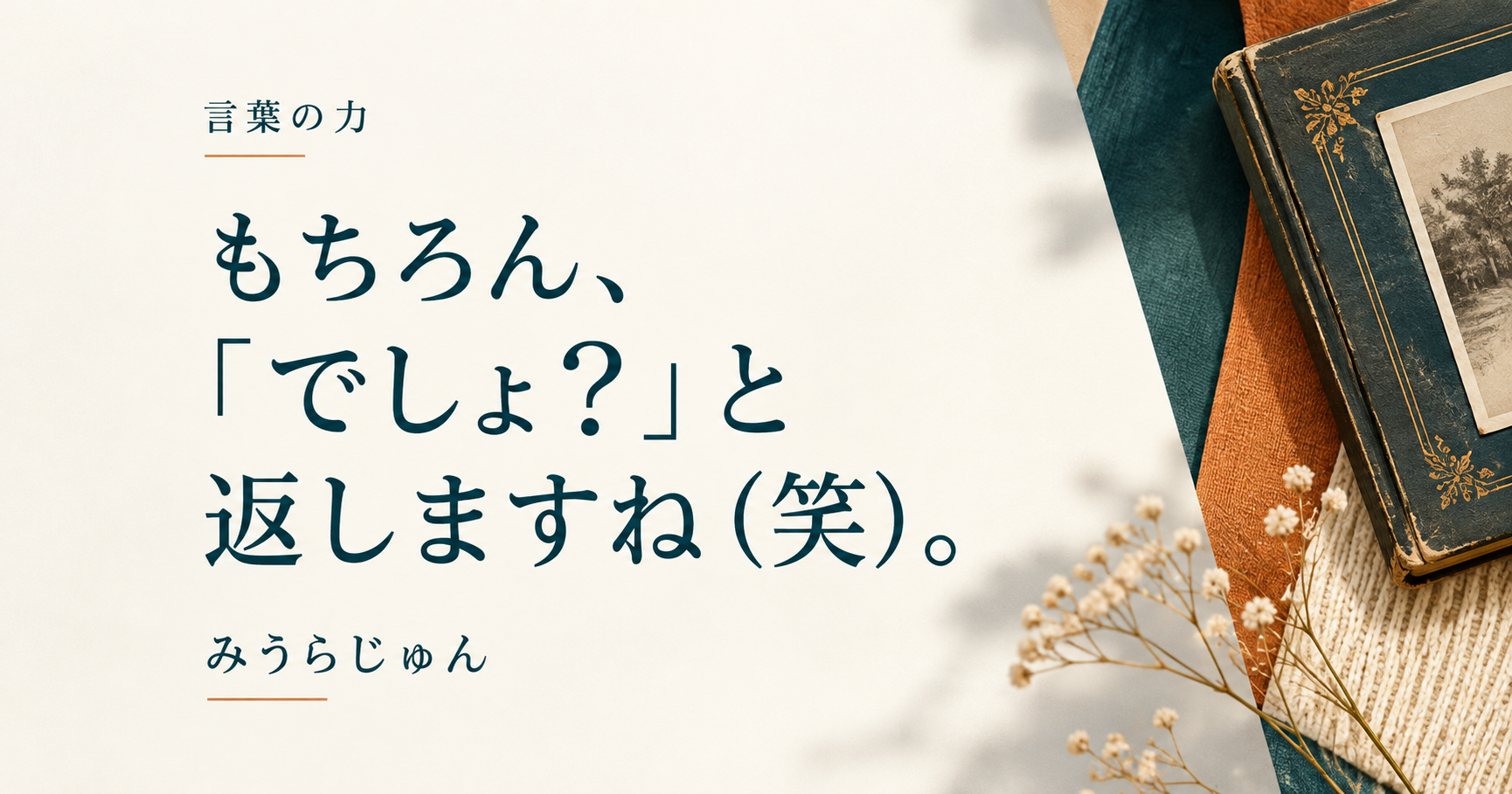
もちろん、「でしょ?」と返しますね(笑)。

みうらじゅん/ほぼ日「みうらじゅんに訊け! アウト老編」第2回、2024年11月13日

「老けた?」への、意外な返し方

この言葉は、誰かに実際に言い返した体験談ではありません。インタビューで、もし最近急に老けたと言われたらどうするか、という仮の会話を展開した場面での発言です。

みうらさんは、昔話の「花さかじいさん」や「こぶとりじいさん」を引き合いに、自分ならどんな呼び名になるかを考えます。「マイブームじいさん」、縮めて「マイジー」。そして、その人物像に合わせて、あえて老けて見えることを楽しむ「老けづくり」を始める、という話になるのです。

その設定なら、老けたと言われても、取り組みが伝わったことになる。そこで出てくるのが、今日の返答です。さらに、年齢を答えて若いと言われたら、まだ足りないというふりをするところまで、冗談は続きます。

老いの悩みを一言で解決する助言というより、ふだんの評価をひっくり返す、みうらさんらしい言葉遊びです。

写真の中の自分と、勝負しなくても

ここからは、このやりとりを日常に重ねた本記事独自の考察です。

昔の写真を見て、今の自分が負けたように感じるとき、比べているのは主に見た目かもしれません。でも、その写真の頃には知らなかった好きな店や、気を張らずに会える友人が、今はいることもあります。

外見の変化が気にならなくなる、という話ではありません。ただ、同じ写真を見ながら、あの頃はこの髪形が大成功だと思っていたんだな、と別の話もできる。比較の時間が、思い出話に変わる余地はありそうです。

みうらさんの冗談では、若く見えるという褒め言葉さえ、目指す人物像とは違うということになる。何をよい評価とするかが変わると、いつもの会話が急にコントのように見えてきます。

もちろん、年齢や容姿について言われたくない人もいます。嫌な言葉に笑って返す義務はありません。この返答は、誰にでも勧める受け答えの正解ではなく、本人が自分の変化を面白がるための一例です。

アルバムは、採点表ではない

写真を閉じたあと、鏡に映るのは今の自分です。昔の髪形には戻らなくても、昔の写真を笑って見られる今の時間はあります。

みうらさんの「でしょ?」には、ほめられる側の席から、いったん降りてみるような軽さがあります。自分の変化を、いつもの物差しだけで眺めなくてもいい。そんな余韻が残ります。

出典・参照

ほぼ日「みうらじゅんに訊け! アウト老編」第2回「マイブームじいさん。」、2024年11月13日。掲載インタビュー。

引用は掲載インタビューの日本語原文です。英語版の確定訳は “Of course, I’d say, ‘Right?’ (laughs).”(本記事独自訳)。本人が英語で述べた言葉ではありません。仮の会話と実際の体験談を区別しています。写真の導入や日常例は本記事の創作で、本人の体験ではありません。


※本記事にはアフィリエイト広告が含まれます。

暮らしの小さな楽しみを集めた、127のROOMもご覧いただけます。