
A friend sends a message saying they cannot make the next get-together. The wording is brief, and it feels a little distant. Yet what you can see may be only the few seconds in their day when they pressed send.
What about the circumstances you cannot see? J.K. Rowling, author of Harry Potter, spoke about imagination as a power that reaches beyond storytelling.
Today’s quote
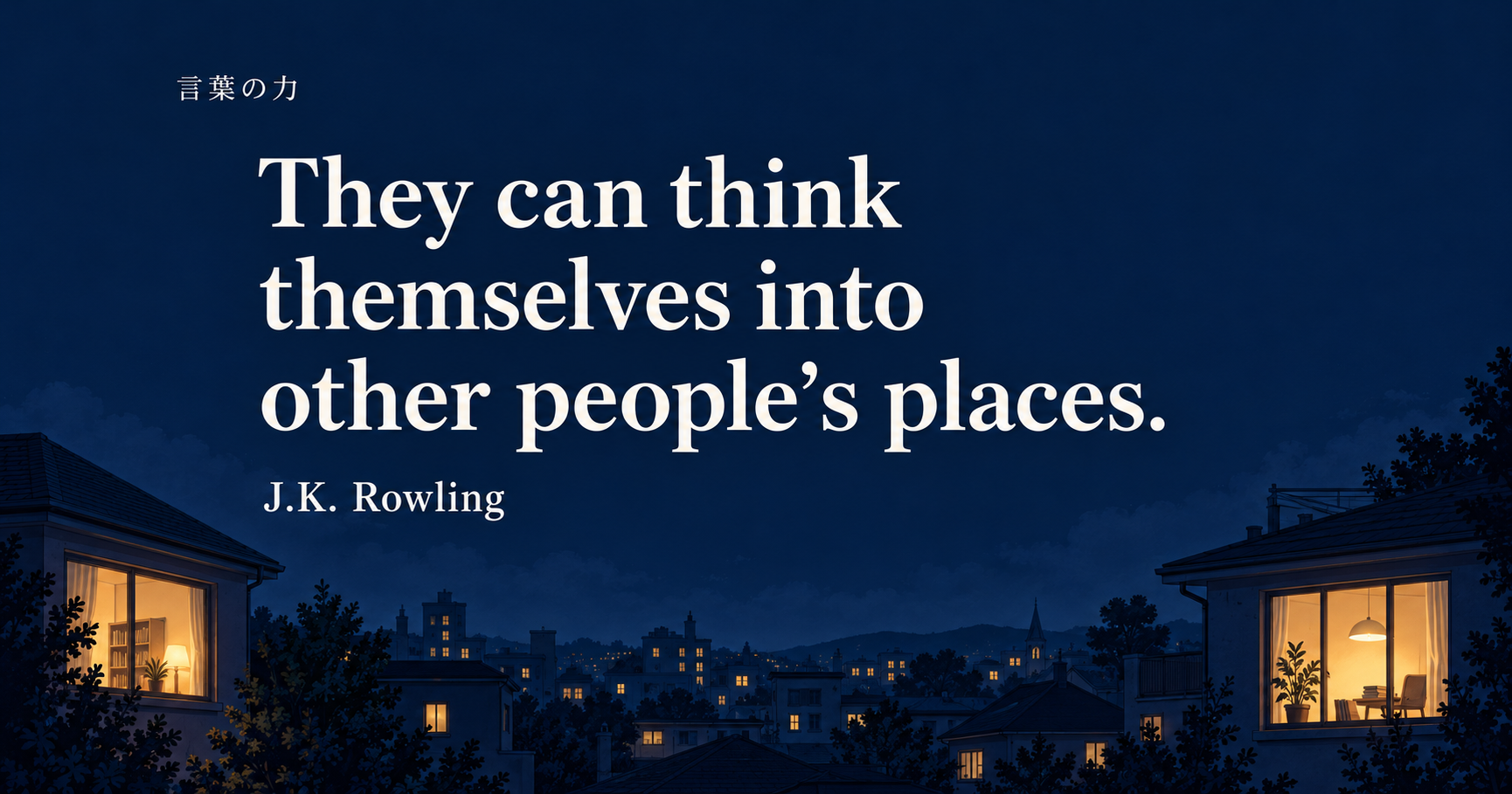
They can think themselves into other people’s places.
J.K. Rowling / Harvard commencement address, June 5, 2008
Another kind of imagination
“They” refers to humans in the preceding sentence of the speech. The Japanese companion article makes that reference explicit in translation.
Rowling chose failure and imagination as the two themes of her commencement address. She described imagination not only as the ability to envision things that do not exist, but also as the capacity to empathize with people whose experiences we have never shared.
She connected this to her work at Amnesty International in London, where she encountered testimony about human rights abuses. She also described learning how people who had not endured those abuses could act on behalf of those who had.
The featured sentence belongs to that context. It is not a promise that imagining a wish will make it come true. It concerns trying to understand another person’s situation. Nor did Rowling idealize the power unconditionally: she noted that the same capacity could be used to manipulate people.
Leaving room for what we do not know
What follows is this article’s own everyday reflection on that larger subject. It does not equate a missed social gathering with the human rights issues discussed in the speech.
Perhaps the friend who declined is tired, or has family commitments. But being able to imagine possibilities does not mean we can correctly guess the circumstances. Assuming they must be busy, or must feel pressured, can simply replace one unsupported story with another.
An everyday reading of the quotation might therefore begin not with believing that we understand someone, but with noticing how much remains out of view.
You can still feel disappointed. There is no need to turn empathy into another demand on yourself. Your feelings and the things you do not yet know about the other person can both exist.
There is a day on the other side of a message
In a novel, we can follow what a character sees. In real life, there is no narrator explaining the other person’s circumstances.
Behind a brief message are hours we have not read. Leaving that space open, you might answer that you are sorry to miss them and hope to meet another time. Perhaps that, too, is a small use for imagination.
Source and translation notes
Harvard Gazette, Text of J.K. Rowling’s speech, June 5, 2008. Address title: The Fringe Benefits of Failure, and the Importance of Imagination.
The featured quotation reproduces the English wording of Rowling’s speech, not dialogue from a novel. The Japanese companion uses this article’s own translation: 人は、想像の中で他の人の立場に身を置くことができます。 The opening and friendship examples are fictional illustrations. The everyday application is the article’s interpretation.
Affiliate link — This link opens a Japanese shopping site.
Disclosure: This article contains affiliate links.
For small everyday discoveries, you can also explore 127’s ROOM.