
Disclosure: This article contains affiliate links.
You settle onto the sofa for a breather. In your head, however, you are replaying a conversation, rearranging tomorrow’s plans, and finding time to worry about next week. Your body has gone on a break. The office in your mind still has every light on.
You made time to rest, yet actually receiving that time turns out to be difficult. Here is a sentence so straightforward that it almost catches you off guard.
When you dance, dance
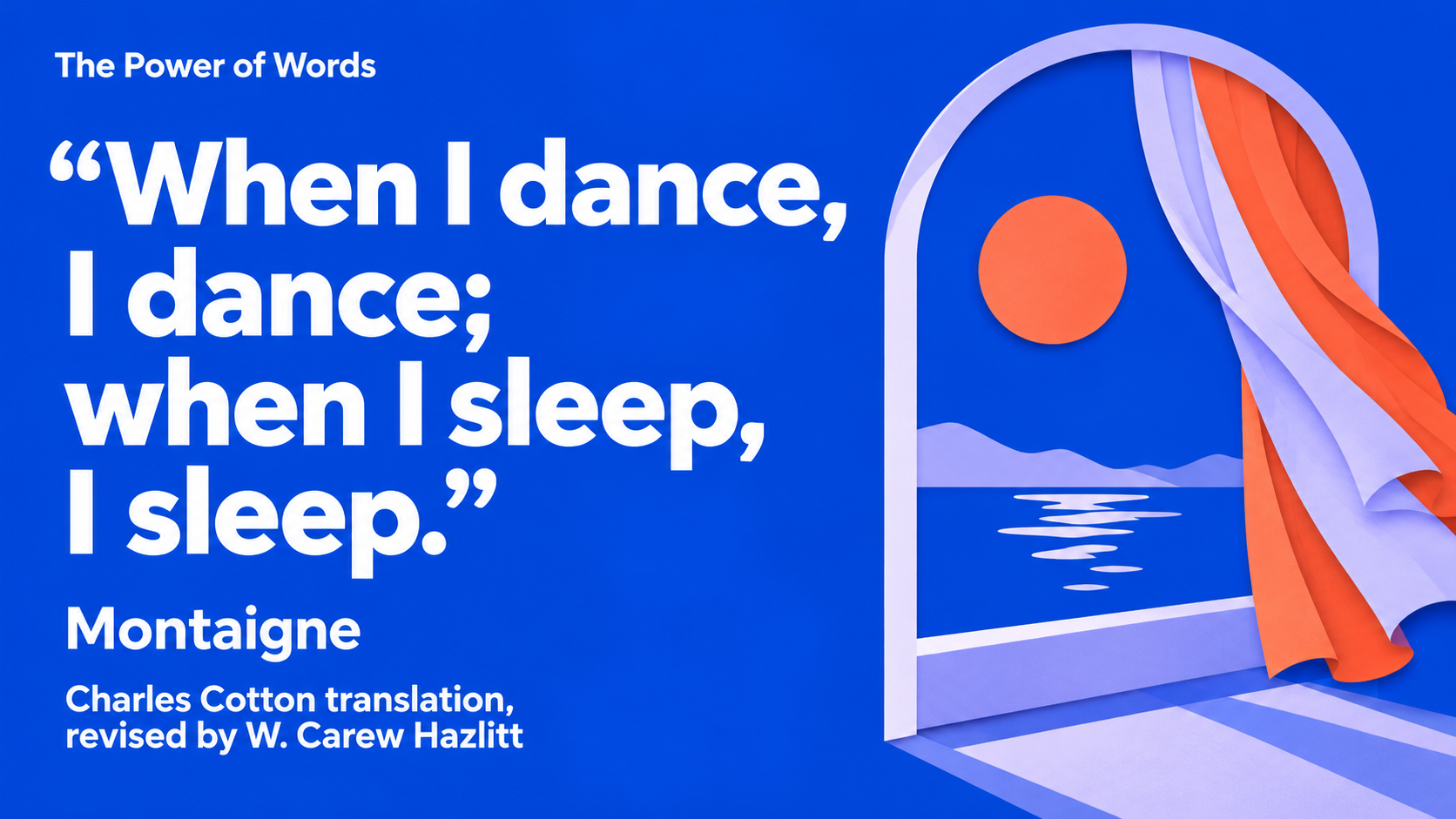
When I dance, I dance; when I sleep, I sleep.
Michel de Montaigne, Essays, Book 3, Chapter 13, On Experience. Translated by Charles Cotton; revised by W. Carew Hazlitt.
In the passage that follows, Montaigne describes walking in a beautiful orchard. When thoughts turn to other matters, he brings some of his attention back to the walk and the pleasant surroundings. Read this not as the account of someone who never gets distracted, but as someone finding his way back, and it feels a little more approachable.
A break need not be preparation for more work
You play a useful work-related recording while drinking tea. You compose a reply while walking. Some days, that is enjoyable. But when you are tired, insisting on getting something out of every spare moment can make even a break require a deliverable.
Perhaps listening to one song you like is enough. You do not have to memorize the lyrics, post a review, or turn it into something useful. Let the listening itself be time that belongs to you.
You do not need to stop every thought. If you mark yourself down for thinking about work again, you have added another assignment to your break. Notice, and come back when you can. That degree of looseness is enough.
Let a few minutes be for those few minutes
During your next break, choose one thing for a few minutes. Music, if it is music. The view outside, if you are looking through the window. If a task you must not forget comes to mind, leave yourself a one-line note and return to what you were doing.
There is no need to hold a review meeting about how well you rested. A break is not an assignment to finish impressively. When you dance, dance. When you drink tea, drink tea. Some days, a small piece of time need not carry any further responsibility.
Share words you remember when you pause through our Words from Everyone submission page (Japanese-language page).
Explore more in the Words Library.
Source and interpretation
Michel de Montaigne, On Experience, Book 3, Chapter 13, HyperEssays. Translated by Charles Cotton (1685), revised by W. Carew Hazlitt (1877). The quotation follows that English text. The Japanese companion uses our own Japanese translation of it. The connections to work, music, and breaks are this article’s reflections.
Our Rakuten ROOM features everyday items for a quiet moment and things that can be lovely to receive as gifts. Browse when you need something. You do not need to buy anything new to pause. Your usual place and what you already have are enough.