
Disclosure: This article contains affiliate links.
You plan the explanation, revise the slides, and finally present your proposal. The response is quieter than you expected. On the way home, you hold the presentation again in your head. Should you have sounded more cheerful? Soon it feels as though supplying the other person’s approving nod was part of your assignment, too.
Preparing carefully and making sure someone is pleased may look like the same task. Perhaps they are not quite the same.
What is up to us, and what is not
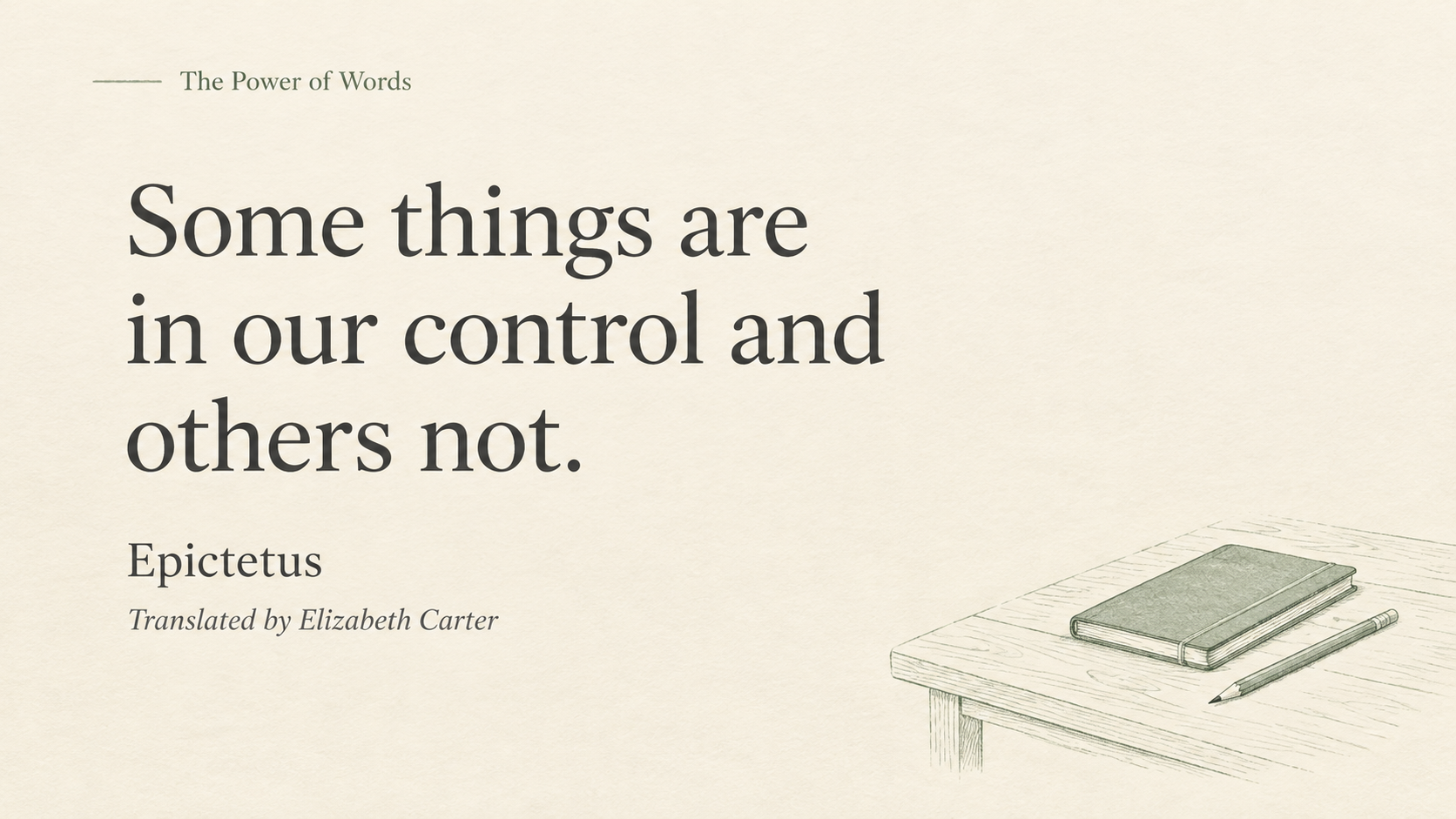
Some things are in our control and others not.
Epictetus, The Enchiridion, section 1. Translated by Elizabeth Carter.
The passage goes on to distinguish our own judgments and actions from things such as property and reputation. Rather than using it as a reason not to care, we can read it as a way to consider what responsibility is actually ours to carry.
What you can do is not the same as what you can guarantee
Check the proposal. Listen to questions. Be clear about what you do not know. These are actions you can choose. Whether the other person agrees immediately, and what expression they wear, also involves their circumstances. Even an honest explanation cannot come with a guaranteed vote of approval attached.
Of course, there may be something to learn from the response. Do not stop at saying it is beyond your control: check what was unclear and improve it. But looking for useful feedback is different from treating another person’s entire reaction as your own failure.
Nor should this distinction become a way to tell someone in difficulty that their attitude is the problem. You do not have to accept unfair treatment. Asking for support or changing your circumstances can remain among your options.
Choose one part of today’s responsibility
For one task that is bothering you, write down the next thing you can do. Send a clarifying question. Check the figures in the document. Once you have done that, you can leave the other person’s answer or evaluation unresolved for a while.
If everything becomes your responsibility, work never seems to end. Take care with what you can do. You do not have to carry the outcome alone as well. Today’s work is allowed to have a finishing time.
Share a phrase that helped take a weight off your shoulders through our Words from Everyone submission page (Japanese-language page).
Explore related words in the Words Library.
Source and interpretation
Epictetus, The Enchiridion, section 1, translated by Elizabeth Carter, MIT Internet Classics Archive. Commentary: Dickinson College Commentaries, Chapter 1 essay. The quotation reproduces Carter’s English wording. The Japanese companion uses our own Japanese translation of that wording. The proposal, feedback, and workplace examples are this article’s applications, not examples given in the quoted passage.
Our Rakuten ROOM features everyday items for work and home, including things that can be lovely to receive as gifts. Browse when you need something. You do not need to buy a new tool to try the idea in this article.