言葉の力|アンネ・フランク「やさしさだけでも、渡せるものはある」——大きなことができない日にも

※本記事にはアフィリエイト広告が含まれます。

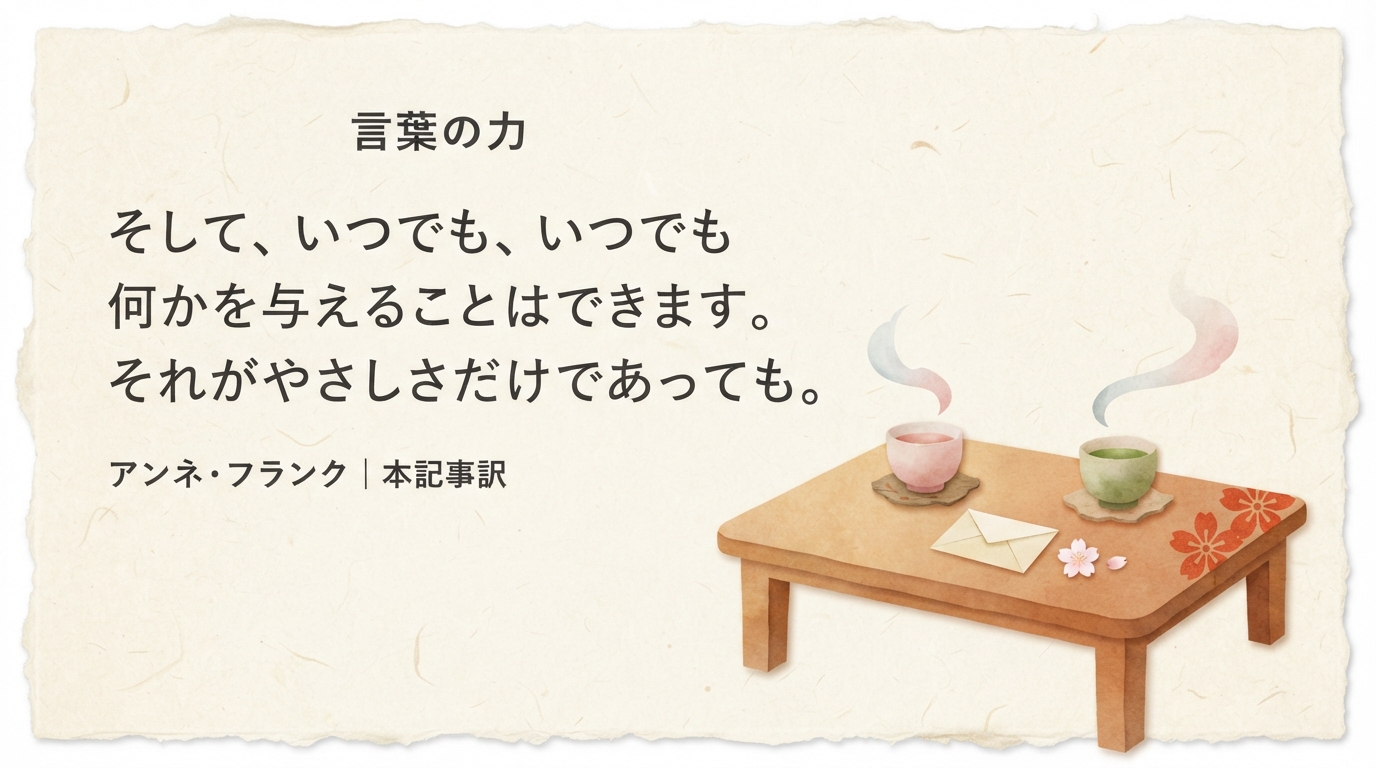
“And you can always, always give something, even if it is only kindness!”

「そして、いつでも、いつでも何かを与えることはできます。それがやさしさだけであっても。」(本記事訳)

アンネ・フランクの文章「Give」にある言葉。引用の出典と表記は、Snopesの検証記事で確認しています。タイトルの日本語はテーマの要約です。

誰かの役に立ちたいと思っても、自分には十分なものがないと感じる日があります。

時間に余裕がない。
お金も多くは使えない。
特別な知識があるわけでもない。

そう考えているうちに、何もしないまま一日が過ぎてしまう。

アンネ・フランクのこの言葉は、「何かを渡す」ということを、もう少し身近なところへ戻してくれます。

ここからは、引用から私が考えた日常への重ね方です。

大きな助けだけが、助けではない

誰かの問題を全部解決できなくても、できることはあるかもしれません。

話を途中で遮らずに聞く。
してもらったことへ、具体的にお礼を伝える。
困っていそうな相手に、決めつけず声をかける。

「それくらい」と思う行動でも、受け取る人にとっては、ひと息つけるきっかけになることがあります。

立派な行動を用意しないと、やさしさを渡せないわけではありません。

相手のためを、自分だけで決めない

一方で、よかれと思ったことが、相手の望むこととは限りません。

話を聞いてほしいのに、すぐ助言をする。
一人で考えたいのに、何度も声をかける。

そんなすれ違いもあります。

だから私は、「何かしてあげなければ」と急ぐより、「今、どんなことなら助けになる?」と確かめたいと思います。

手伝うことも、そっとしておくことも、相手を大切にする選び方になり得るでしょう。

自分をすり減らすこととは、分けて考える

やさしくするために、すべての頼みを引き受ける必要はありません。

今日は難しいと伝える。
自分ができる範囲を示す。
別の人や方法につなぐ。

それも、無理のない関わり方です。

自分の余裕をなくしてしまうほど与えることを、この記事では勧めたいわけではありません。

今日、誰かに渡せるものは何だろう。

大きな答えが見つからなくても、まずは一つ、言葉にしてみる。

「助かりました」
「話してくれてありがとう」
「今は難しいけれど、ここまでならできます」

やさしさは、特別な日だけの贈り物ではありません。いつもの一日の中にも、その置き場所はありそうです。

The Power of Words | Coach Anzai: One Difficult Day Does Not Have to Be the End

日本語で読む | English

Disclosure: This article contains affiliate advertising.

“If you give up, that is where the game ends.”

Coach Anzai in Takehiko Inoue’s SLAM DUNK. English translation prepared for this article from the Japanese wording; not an official English translation. Japanese wording checked against a quotation commentary (Japanese); the original manga wording and scene still require final verification before publication.

Sometimes one disappointing result makes everything we have done feel uncertain.

A piece of writing receives no response. We cannot remember what we studied. A proposal we worked hard on is turned down.

“Perhaps I am simply not suited to this.”

At such moments, I think of Coach Anzai’s words. What follows is my personal reflection on everyday life, not an explanation of the scene in the story.

Separate today’s result from tomorrow’s possibilities

Something did go wrong today. We do not have to erase our disappointment or pretend it was not a setback.

But one result does not have to decide everything that comes next.

“This did not get through this time” is different from “My words will never reach anyone.” “I could not do it today” is different from “I will never be able to do it.”

When we feel discouraged, we can cross that distance too quickly. First, let today’s experience remain the size of one day.

Continuing can mean changing your approach

Trying again does not require repeating the same method.

Make a long piece of writing more focused. Reduce the scope of a study session. Ask someone to help with a problem you could not solve alone.

Changing how you continue is not necessarily giving up. Sometimes it is how you protect something you still care about.

Rest is not the final whistle

I do not want to turn this quotation into a demand that tired people keep pushing.

We do not have to sacrifice our health or safety. Leaving an unsuitable situation or choosing another goal can also be a thoughtful decision.

For me, these words are a reminder not to close off every possibility in a moment of disappointment.

Rest today. Reconsider tomorrow. Leave yourself one line about what you might try next.

One difficult day does not have to be the end. You can decide whether to continue, change direction, or pause when you have a little more room to think.

言葉の力|安西先生「あきらめたらそこで試合終了ですよ」——うまくいかない今日で、全部を終わりにしない

※本記事にはアフィリエイト広告が含まれます。

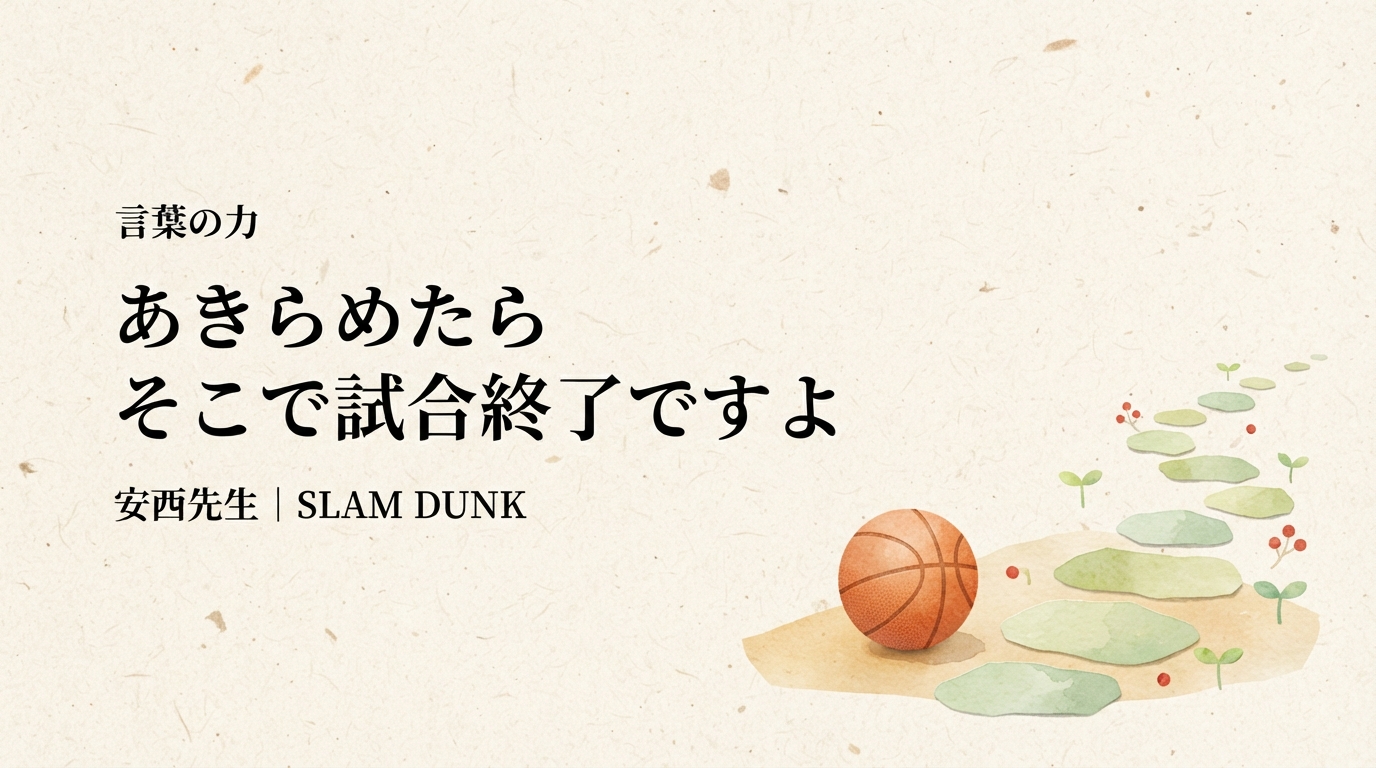
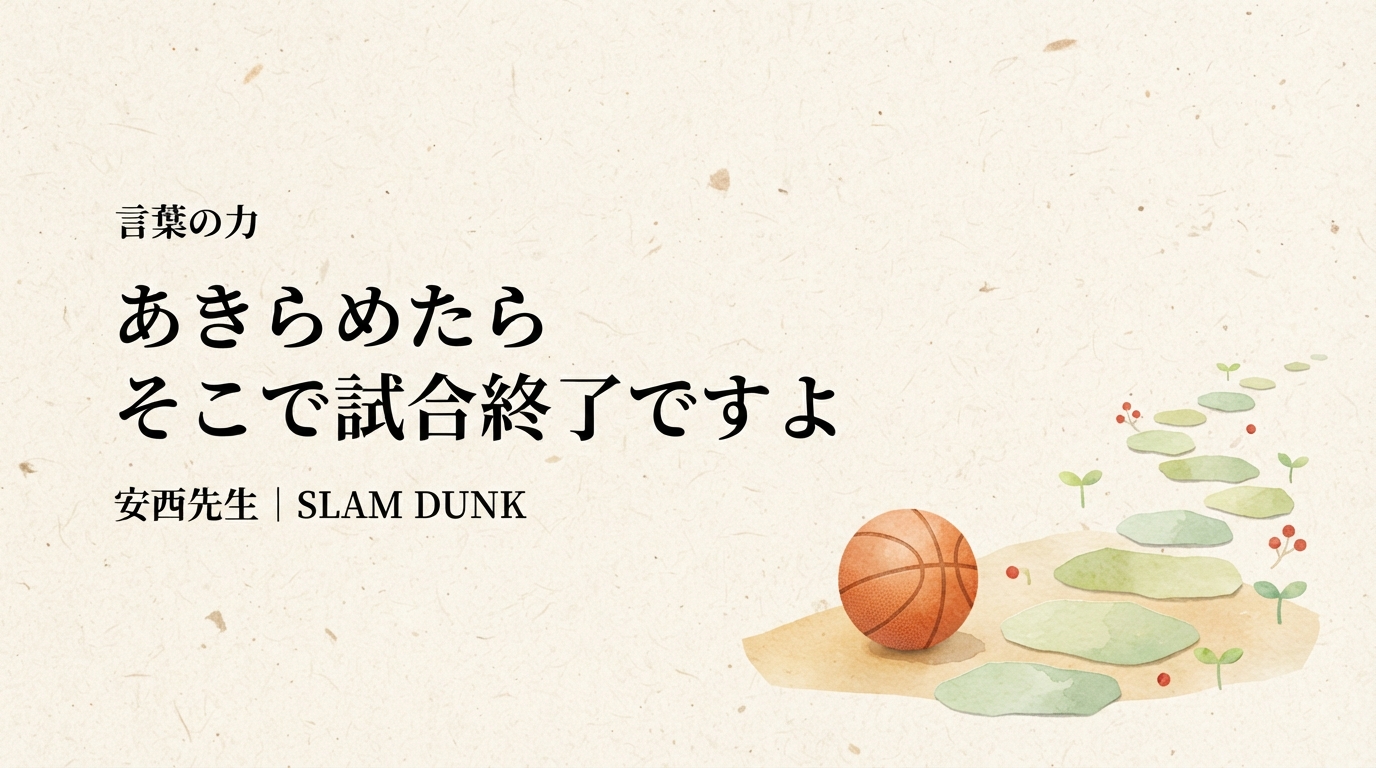
「あきらめたらそこで試合終了ですよ」

井上雄彦『SLAM DUNK』の安西先生の言葉。名セリフ紹介で確認した表記です。原作の語句・句読点・場面は公開前に最終照合が必要です。

一度うまくいかなかっただけなのに、これまでやってきたことまで頼りなく感じる日があります。

書いた文章に反応がない。
勉強したところを思い出せない。
勇気を出して提案したのに、通らなかった。

「やっぱり、自分には向いていないのかもしれない」

そう思ったとき、安西先生の言葉を思い出します。

ここから先は、作品の場面を説明するものではなく、この言葉を日常に重ねた私自身の受け止め方です。

今日の結果と、これからの可能性を分ける

今日うまくいかなかったことは、確かにあります。

悔しさを無理に消す必要はありませんし、「失敗ではない」と言い換えなくてもいいでしょう。

ただ、その一度の結果だけで、これから先まで決めなくてもいいのだと思います。

「今回は伝わらなかった」と、
「自分の言葉は二度と伝わらない」は違います。

「今日はできなかった」と、
「自分にはできる日が来ない」も違います。

落ち込んでいるときほど、その間を一気に飛び越えてしまいます。だからこそ、まずは今日の出来事を、今日の大きさに戻してみたいのです。

続けることは、同じ方法を繰り返すことではない

もう一度取り組むとしても、まったく同じやり方でなくてかまいません。

文章が長すぎたなら、伝えたいことを一つに絞る。
勉強が進まなかったなら、時間より範囲を小さくする。
一人では難しかったなら、誰かに相談する。

やり方を変えることまで、「あきらめた」と呼ばなくてもいいでしょう。

続けたいものを守るために、続け方を変える。そんな選び方もあります。

休むことを、試合終了にしない

この言葉を、疲れた人へ「まだ頑張れ」と押し付けるためには使いたくありません。

健康や安全を犠牲にしてまで続ける必要はありません。合わない場所から離れることや、別の目標を選ぶことも、自分で決めてよいことです。

私がこの言葉から受け取りたいのは、「どんなことでもやめてはいけない」という命令ではなく、落ち込んだ勢いだけで、自分の可能性を閉じなくてもよいという視点です。

今日は休んで、明日あらためて考える。
次に試したいことを、一行だけ残しておく。

それくらいの小さな余白があれば十分な日もあります。

今日の結果で、全部を終わりにしない。
続けるか、変えるか、休むかを、少し落ち着いてから選ぶ。

そんなふうに、この言葉を持っておきたいものです。

言葉の力|ヘレン・ケラー『一人でできることはわずかでも、一緒なら多くのことができる』(本記事訳)

※本記事にはアフィリエイト広告が含まれます。

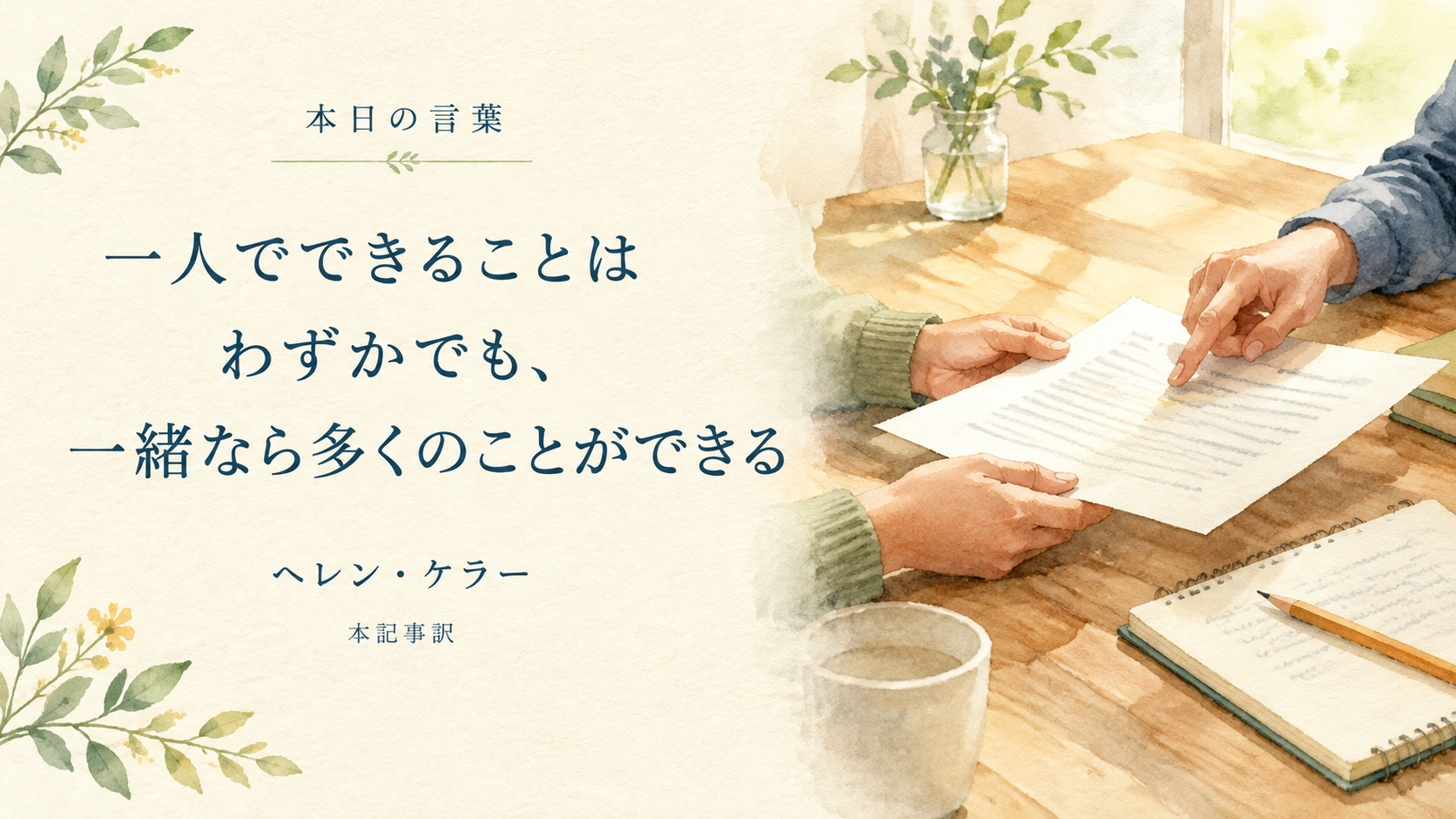
“Alone we can do so little; together we can do so much.”

一人でできることはわずかでも、一緒なら多くのことができる。(本記事での訳)

ヘレン・ケラー(米国盲人財団の引用集掲載)

「大丈夫です。一人でできます」

そう答えたあとで、こっそり困っていることがあります。本当は手伝ってほしい。でも、相手も忙しそうだし、できない人だと思われたくない。

その結果、仕事も家事も、頭の中の心配事も、自分一人の担当になってしまう。

今日の言葉は、そんな抱え込みに、別の見方をくれます。

「一緒に」は、能力を否定しない

米国盲人財団の引用集は、この一文を、ヘレン・ケラーとアン・サリヴァンの舞台出演用台本の言葉として紹介しています。

一人の限界を嘆くのではなく、誰かと力を合わせたときの可能性に目を向ける言葉。私はそこに、「全部自分でできることだけが立派なのではない」というメッセージを感じます。

自分にできることと、相手にできることは違います。その違いを持ち寄ることは、どちらかが劣っている証明にはならないでしょう。

むしろ、違うからこそ助け合える。そう考えると、頼むという行為の見え方も変わってきます。

頼む前から、断らないでいい

誰かにお願いしようとして、「きっと迷惑だろう」と引っ込める。相手がまだ何も言っていないのに、自分で自分の依頼を断ってしまう。

気遣いのつもりですが、相手がどう感じるかまで、こちらで決めているのかもしれません。

もちろん、頼めば必ず応じてもらえるわけではありません。相手には相手の事情があり、断る自由もあります。

だからこそ、「この部分だけ手伝ってもらえる?」「難しければ大丈夫」と、必要なことを具体的に伝える。相手に選んでもらえる形で、助けを求めてみる。

全部を預けるか、全部を抱えるか。その二択ではなく、一部分だけ一緒に考えるという道もありそうです。

助けてもらう側にも、できることがある

人に頼ったあと、「申し訳ない」とばかり言ってしまうことがあります。

でも、どこが助かったのかを言葉にして伝えることもできます。「確認してくれたので安心できた」「一緒に考えてもらえて整理できた」。

それは、お返しを急いで用意することとは違います。相手の働きかけを、ちゃんと受け取ったと伝えることです。

この言葉を、私は「人と一緒なら何でも解決する」という保証ではなく、一人で抱える以外の選択肢を忘れないための言葉として受け取りたいと思います。

今日、どうしても進まないことがあったら、自分の能力を責める前に考えてみる。

これは、本当に一人でやる必要があるのだろうか。

「手伝って」と言う一言が、誰かと一緒に進むための、最初の一歩になるかもしれません。

言葉の力|松下幸之助『自分には自分に与えられた道がある。』

「自分には自分に与えられた道がある。」

松下幸之助『道をひらく』より。引用出典:PHP研究所の書籍紹介

誰かの近況を見て、急に自分の歩みが遅く感じられることがあります。

新しい仕事を始めた人。勉強を続けて資格を取った人。ずっと抱えていた目標を、形にした人。

「よかったね」と思う気持ちは本当です。それでも、そのあとに小さな焦りが残る。

私は何をしているのだろう。
このままでいいのだろう。

そんな日に、松下幸之助さんのこの言葉を読み返したくなります。

人の道を見て、自分の道をなくさない

『道をひらく』の冒頭では、自分に与えられた道について、広いときも狭いときも、上りも下りもあると語られています。また、他人の道に心を奪われて立ちすくむのではなく、自分の道を歩むことへと話がつながります(PHP研究所の書籍紹介)。

ここから先は、私なりの受け止め方です。

人と比べて苦しくなるとき、私たちは相手の「見えている結果」と、自分の「まだ途中の姿」を並べているのかもしれません。

相手がそこへたどり着くまでの迷いや、表に出していない苦労は、こちらからは見えません。

一方で、自分の足りないところはよく見える。

その比べ方では、自分の道ばかりが頼りなく感じられてしまいます。

誰かの歩みを参考にすることと、自分の歩みを否定することは、同じではありません。

「あの人の方法は、少し取り入れてみたい」

そう思えたなら、学べるところだけを受け取る。それ以外まで、同じにしなくてもいいのだと思います。

自分らしさは、小さな選び方にも表れる

「自分の道」と言われても、特別な才能や大きな夢が必要な気がするかもしれません。

でも、私はもっと身近なところにも、自分の道はあると感じます。

予定を詰め込みすぎない。
わからないことを、わからないままにしない。
誰かの頼みを引き受ける前に、自分の余裕を確かめる。

そうした選び方にも、自分が大切にしたいものは表れます。

目立つ成果にならなくても、今の暮らしに合う方法を探すことには意味がある。

人と同じ速さで進むことより、続けられる歩き方を見つけることが必要な時期もあるでしょう。

歩き方を変えてもいい

この言葉を、「今いる場所で我慢し続けなければならない」という意味にはしたくありません。

私なりには、自分の道を大切にすることと、今の方法に固執することは別だと受け止めています。

疲れたら休む。
一人では難しければ、誰かに相談する。
合わないと感じたら、やり方を見直す。

それも、自分の暮らしを自分で選び直すことです。

今日は、誰かに追いつくためではなく、自分が少し納得できることを一つ選ぶ。

後回しにしていた用事を片づけてもいい。
反対に、無理に入れた予定を一つ減らしてもいい。

人の道がまぶしく見える日にも、自分の足元まで暗いと決めなくていい。

今立っている場所から、自分に合う歩き方を考えていきたいものです。

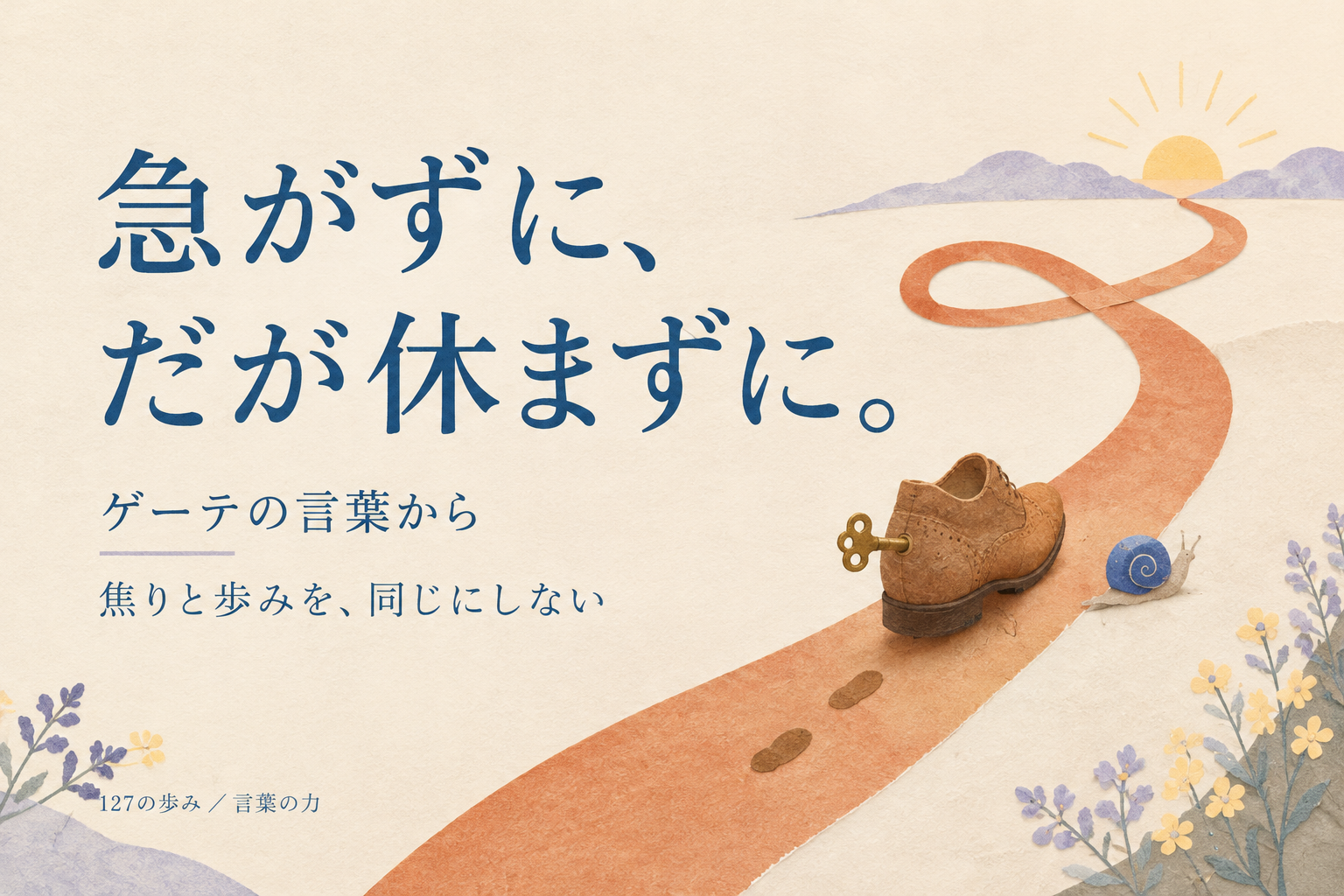
言葉の力|ゲーテ『急がずに、だが休まずに。』——焦りと歩みを、同じにしない

※本記事にはアフィリエイト広告が含まれます。

「急がずに、だが休まずに。」

ゲーテ。引用表記:東進の名言紹介に掲載された日本語訳。

誰かの成果を見たあと、急に自分の予定を増やしたくなることがあります。

もっと勉強しよう。
もっと仕事を進めよう。
今日こそ、遅れを取り戻そう。

それまで自分なりに歩いていたはずなのに、いつの間にか「追いつくための一日」に変わっている。

そんなとき、ゲーテの言葉として紹介されている「急がずに、だが休まずに。」を読むと、焦ることと進むことは違うのだと考えさせられます。

「急がずに」と「休まずに」の間にあるもの

この言葉には、一見すると反対の方向を向いた二つの表現があります。

急がない。
けれど、歩みは止めない。

私には、その間に「自分の速度を持つ」という考え方があるように感じられます。

ここから先は、私なりの解釈です。

急ぐとき、私たちは、ときどき自分の足元よりも、遠くにいる誰かを見ています。

あの人はもうできている。
同じ時期に始めたのに、自分はまだここにいる。
このままでは間に合わない。

もちろん、本当に期限が迫っていることもあるでしょう。

でも、誰かとの比較から生まれた焦りまで、すべて今日の予定に入れなくてもいいのだと思います。

今の自分に必要なことと、焦った勢いで増やしたこと。

その二つを分けるだけでも、今日やることは変わりそうです。

遅い歩みまで、失敗と呼ばない

すぐに結果が見えないと、続けていることまで頼りなく感じられます。

少しずつ読んでいる本。
何度も直している文章。
繰り返し練習していること。

「これだけやって、まだこの程度なのか」

そう思うと、もっと速く、もっと多く、と自分に求めたくなります。

でも、私は、速さだけでは見えない変化も確かめたいと思います。

以前は意味がわからなかった一文を、今日は読めた。

昨日まで気づかなかった不自然な表現を、自分で直せた。

できなかった理由を、少し具体的に言えるようになった。

まだ目標に届いていなくても、途中にある変化まで、なかったことにはしない。

遅いという評価だけで、今の取り組みを片づけたくないのです。

休息を禁じる言葉にはしない

一方で、「休まずに」という部分は、疲れている人には厳しく響くかもしれません。

だから、この言葉を、そのまま毎日の義務にしたくはありません。

私なりには、休息を取らないことではなく、休んだあとに戻れる道を残しておくことへと引き寄せて読みたいと思います。これは原意を断定するものではなく、暮らしの中での私自身の受け止め方です。

今日はここまで、と区切る。

次に取りかかる場所を、一行だけ書いておく。

今の方法が合わなければ、続け方そのものを見直す。

休むことと、もう二度と取り組まないことは同じではありません。

一日空いたからといって、それまでの時間が消えるわけでもないでしょう。

続けることを、「一度も途切れないこと」だけにしないでおきたいと思います。

今日の一歩を、自分で選ぶ

この言葉を読んで、私が今日考えたいのは、「どれだけ頑張れるか」ではありません。

「今の自分は、何を一つ進めたいのか」です。

誰かに追いつくための予定ではなく、自分が必要だと思うことを選ぶ。

本を一ページ読む。
気になっていた連絡を返す。
書きかけの文章の、最初の一文を整える。

それ以上できる日もあれば、そこで終わる日もあるでしょう。

焦りは、早く進めと急かします。

けれど、歩みは、次に足を置く場所を選ぶことから始まります。

今日の速度を、誰かの成果に決めさせない。

急がずに、自分の一歩を選ぶ。

そんなふうに、この言葉を持っておきたいものです。

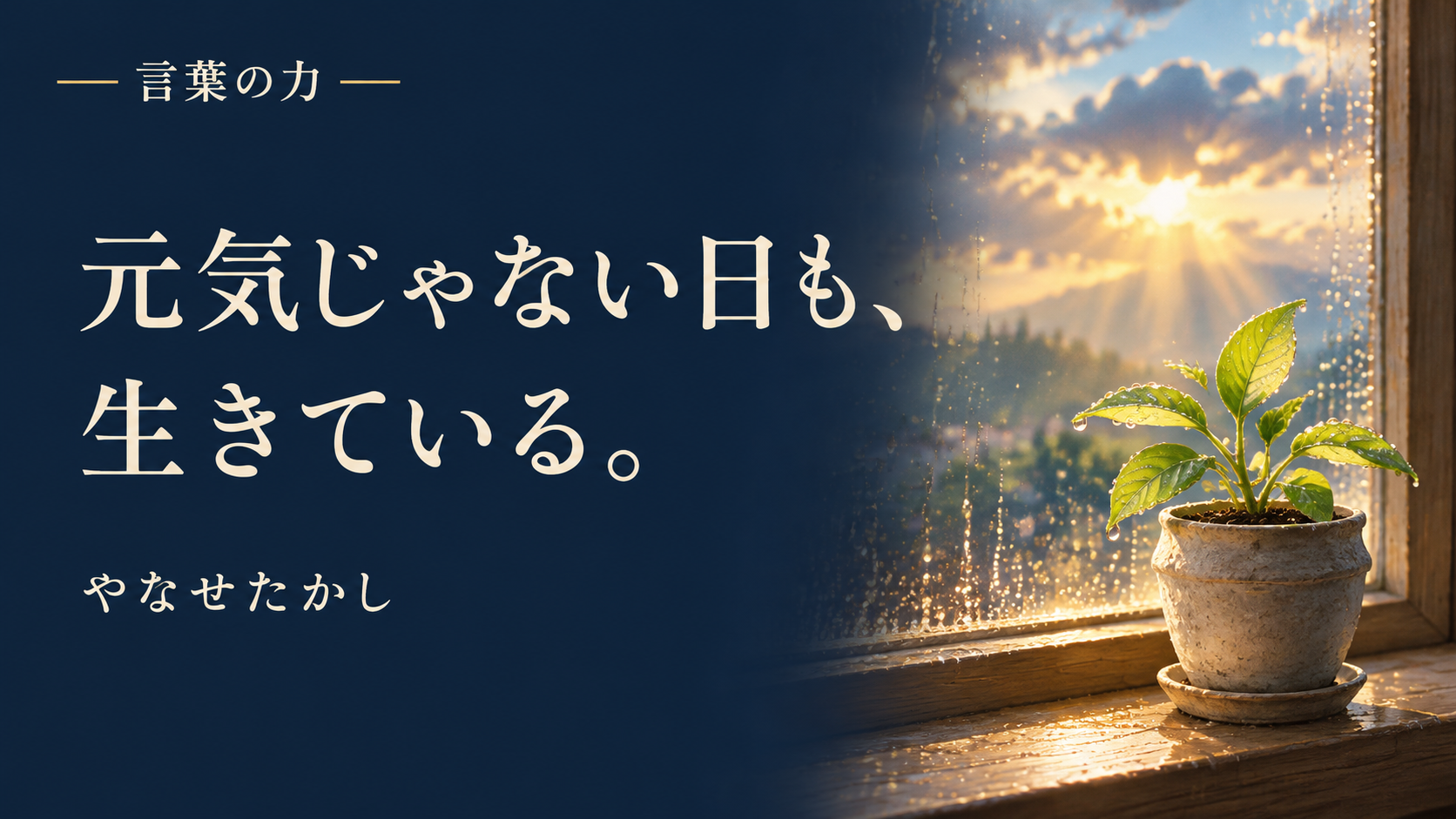
The Power of Words | Takashi Yanase: You Are Alive, Even on Days You Do Not Feel Cheerful

日本語で読む | English

Disclosure: This article contains affiliate advertising.

“It is because we are alive that we feel sad.”

From Te no Hira o Taiyo ni, lyrics by Takashi Yanase (lyrics published on Uta-Net, in Japanese). English translation prepared for this article; not an official translation.

“Keep smiling today.” “Stay positive and do your best.”

Some days, words like these encourage us. On others, they feel a little too bright.

We know they are well meant. But we do not have that energy right now. The more cheerful words we encounter, the more we may feel left behind because we cannot be cheerful ourselves.

On such a day, today’s words reach us from a different angle.

A cheerful song has room for sadness

Te no Hira o Taiyo ni is a song with lyrics by Takashi Yanase and music by Taku Izumi. It first aired on NHK’s Minna no Uta in 1962.

Although it feels like a lively song, its lyrics include sadness.

Being alive brings enjoyment and happiness. But that is not all. For me, the depth of these words lies in making room for more than those feelings.

In an article from PHP (Japanese), Yanase explains that hardship and pain are also signs of being alive, and discusses why he placed sadness before joy.

Sadness is not treated as a wrong emotion. I find a quiet kindness in that.

Even your feelings do not have to behave perfectly

You made a mistake at work. You could not communicate well with someone important to you. Plans you were looking forward to were canceled.

At such times, we sometimes find another reason to blame ourselves, on top of the event itself.

“I am weak for still worrying about this.” “I need to be more positive.”

Sadness is hard enough, yet we also scold ourselves for being sad. We seem to keep a very demanding boss inside our minds.

But considering today’s words allows a slightly different perspective.

You are sad because it mattered. You are disappointed because you had hopes. You feel frustrated because you wanted to do well.

Behind those feelings may lie something you deeply valued.

Words can stay beside us without rushing us

Of course, we do not have to find meaning in every sadness. Nor do we need to force a painful experience into the conclusion that it was a good experience.

I want to receive today’s words not as an instruction to endure sadness, but as a reminder that we do not have to reject ourselves for remaining sad.

The power of words is not limited to stirring people into action. Words can also sit beside someone who has stopped and say, “You do not have to feel better right away.”

You could not smile today. Even so, it is all right to drink something warm, rest a little, and bring the day to a close.

A day without a smile is still a day you lived.

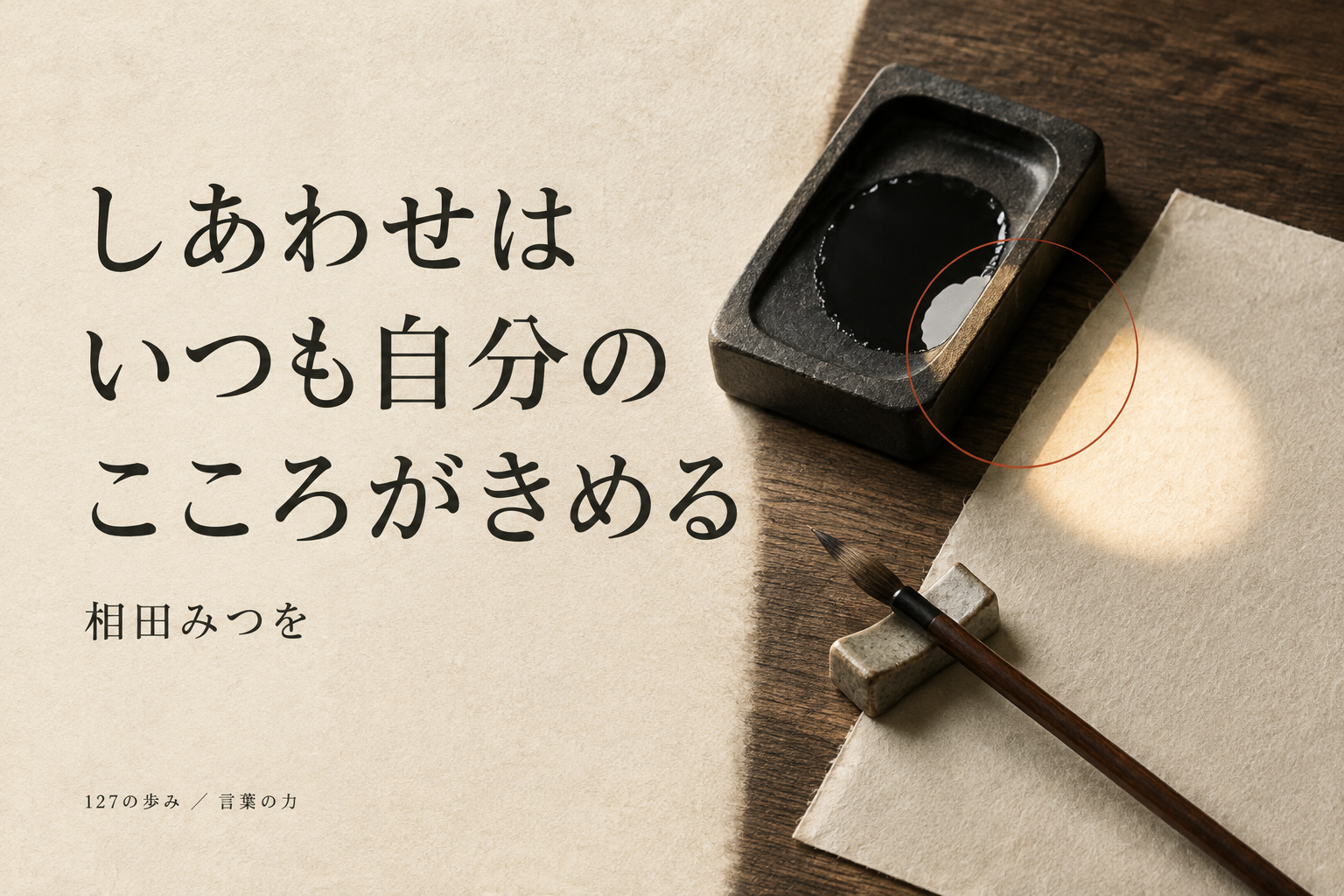
The Power of Words | Mitsuo Aida: Happiness Is Always Decided by Your Own Heart

日本語で読む | English

Disclosure: This article contains affiliate advertising.

“Happiness is always decided by your own heart.”

Mitsuo Aida. Wording quoted in an article from Koka Gakuen (Japanese). English translation prepared for this article; not an official translation.

Some days, as the day draws to a close, we remember only what we could not do.

The message we never answered.
The tidying we made no progress on.
The work that did not go as planned.

In the morning, we had meant to get a little more done.

Looking back this way can leave us feeling as though nothing remained of the day.

For me, these words from Mitsuo Aida offer a chance to look at today from a slightly different angle.

Do not pressure yourself to feel happy

“Happiness is decided by your own heart.”

I do not want to use these words to dismiss painful experiences as merely a matter of attitude.

A sad day is sad.
When you are tired, you are tired.

I do not think we have to force difficult feelings into cheerful words.

What follows is my own interpretation.

I want to hold on to these words not as a reason to blame myself for being unable to feel happy, but as a reminder not to leave it entirely to others to decide what feels good to me.

A fulfilling day for someone else is not necessarily the same for us.

On some days, eating a quiet meal brings more relief than getting through a packed schedule.

On others, spending time slowly at home feels better than traveling somewhere far away.

I think we are allowed to discover what is good for us within our own lives.

Was there a moment today that felt a little easier?

When we look for great happiness, sometimes nothing comes to mind.

At those times, I would like to make the question smaller.

“Was there a moment today when I felt a little relieved?”

When I drank something warm.
When I finished one task.
When I exchanged a few words with someone.

Having that moment does not erase the difficulties of the day.

Still, it may keep unpleasant experiences from coloring everything about today.

Some things did not go well.
But there were also moments that felt a little easier.

I think both can be true.

On days when you find nothing, begin with rest

Of course, there may be days when we cannot remember even a moment of relief.

We do not have to force ourselves to count good things on those days, either.

“Today was hard.”

Acknowledging that and bringing the day to an end can also be a way of caring for ourselves.

If there is something you can do tonight, let it be just one thing that makes tomorrow a little easier.

Leave a nonurgent task until tomorrow.
Write down what has been worrying you and set it aside for now.
Draw a line and say, “That is enough for today.”

If the word happiness feels distant, it is enough to begin by choosing something that feels a little easier.

Even if today was not ideal, do not reject the self who lived through it.

Even when a day does not look impressive by someone else’s standards, I want to keep moments of relief within everyday life.

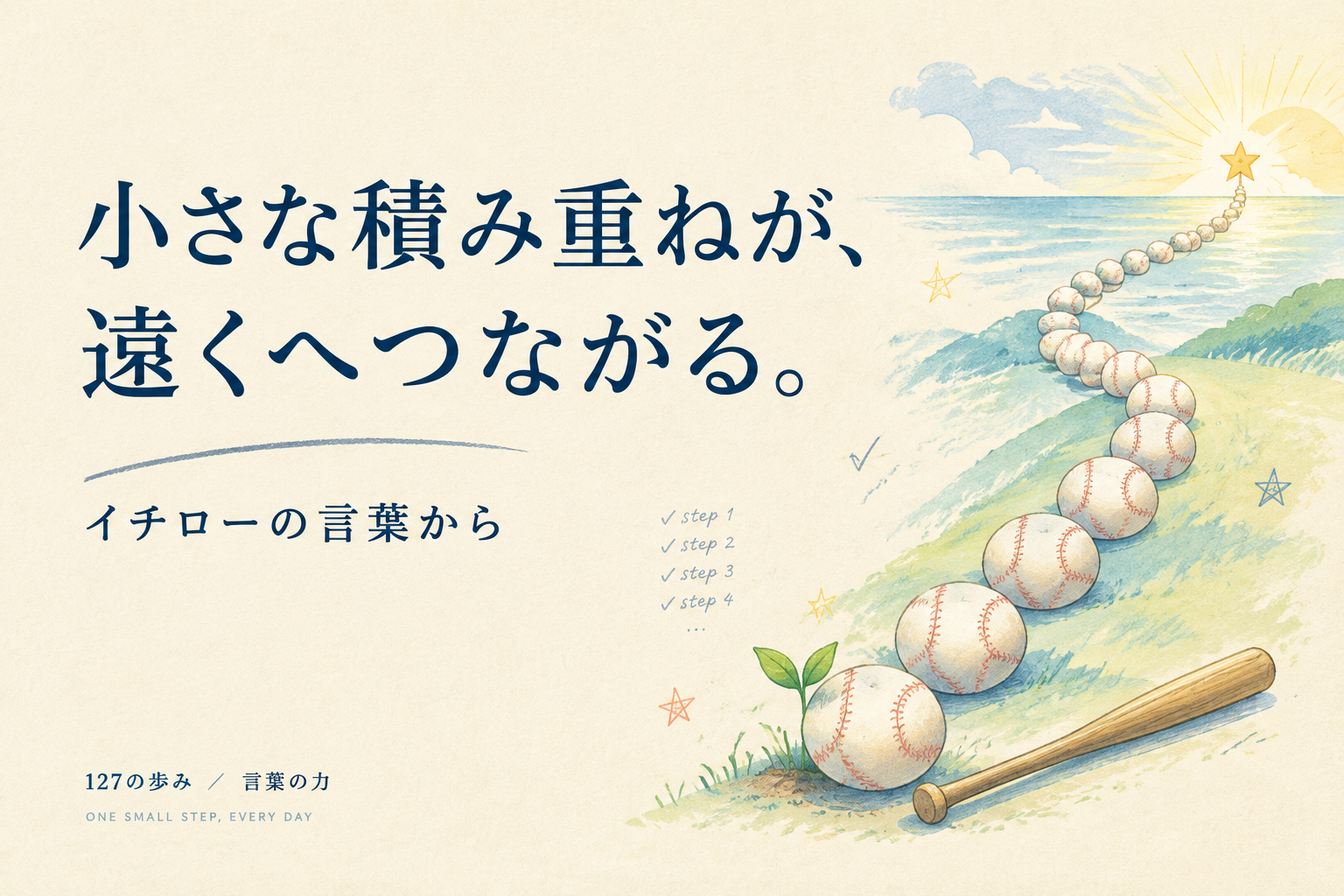
The Power of Words | Ichiro: Small Steps Take Us Somewhere Extraordinary

日本語で読む | English

Disclosure: This article contains affiliate advertising.

“Building up small things is the only way to reach somewhere extraordinary.”

Ichiro, wording quoted on the official Yunker website (Japanese). English translation prepared for this article; not an official translation.

When we set a big goal, our feelings grow bigger, too.

Exercise every day starting tomorrow. Begin studying something new. Produce different results at work.

Yet what we can actually do today is smaller than we imagined. Read a few pages. Finish one preparation. Revise a little of what we have written.

“Can something like this really make a difference?” When facing that question, I want to remember Ichiro’s words.

Think about big results through small actions

Toshin’s introduction to this quotation (Japanese) also presents these words about building up small things as a remark from the press conference after Ichiro broke the Major League Baseball single-season hits record in 2004.

What I want to notice is that, when speaking about a great result, his words begin with “small things.”

It is not a shortcut where one extraordinary act takes us somewhere extraordinary. It is about building on the small things right in front of us.

I find encouragement here: even someone overwhelmed by the size of a goal has a place to begin.

Building on experience is more than repetition

Suppose you write an article every day.

Instead of simply writing as you did yesterday, shorten today’s opening. Fix a sentence that was hard to read. Check the source of a quotation.

From the outside, each looks like a small task. But checking and changing things one by one gives you more to notice as you write.

What follows is my own interpretation of these words. Perhaps building things up means not only doing something more often, but also carrying yesterday’s experience into today’s actions.

Even if something did not go well, thinking “Next time, I will try this” means the day does not simply disappear.

Do not judge today’s step only by its size

Of course, continuing small actions does not mean everyone will reach the same result. Circumstances, health, and the methods we choose also affect how we move forward.

So I do not want these words to become a guarantee of success or an instruction never to rest.

Instead, I want to keep them as a reminder not to dismiss what we managed today as worthless simply because results are not immediately visible.

You read one page. Checked one thing. Started writing one line.

On some days, that may be enough. When your energy returns, you can build on it again.

The power of words lies not in erasing what we cannot do, but also in helping us turn our attention back to what we can.

Change “I can only do something this small” into “I can begin with this small thing.”

You do not have to produce an extraordinary result today.

Add one small thing that connects to the future. Let us try not to undervalue that one thing ourselves.

The Power of Words | Tamori: What We Miss When We Try Too Hard

日本語で読む | English

Disclosure: This article contains affiliate advertising.

“Those full of motivation should leave.”

Tamori. Source: a Diamond Online article (Japanese) introducing the book Datsuryoku Meigen. English translations of quoted words are prepared for this article, not official translations.

“I need to try harder.”

When we think this, we usually have a particular goal in mind.

We want results.
We want recognition.
We want to meet expectations.

So we keep preparing, remain on edge, and try to anticipate problems before we make mistakes.

Yet sometimes, the harder we try, the less we hear the voices around us.

At such moments, Tamori’s words, “Those full of motivation should leave,” can come as a surprise.

Why tell motivated people to leave?

The Diamond Online article connects this remark with Tamori’s observation that motivated people “look only at the center.” In comedy, interesting things begin at the edges, but these people overlook them.

What follows is my own interpretation.

I feel these words are not rejecting people who make an effort, but questioning how narrow our vision can become when we tense up too much.

The moment we decide, “It has to be done this way,” everything else disappears from view.

We try to speak as planned and miss the other person’s expression.
We try to explain our ideas and stop listening before the other person finishes.
We try to be helpful and take on things nobody asked us to do.

None of this comes from bad intentions.

On the contrary, we want to make things better.

Even so, our eagerness can sometimes pull us away from the person or situation right in front of us.

Relaxing is not the same as being careless

When we hear “relax,” it may sound like cutting corners.

But I want to distinguish between the two.

Cutting corners means leaving out what needs to be done.

Relaxing means not making ourselves more rigid than necessary.

Prepare.
Keep promises.
Check what you do not understand.

Then ease, just a little, the feeling that you absolutely must get everything right.

This leaves room to hear something unexpected, or to admit a mistake and try again.

You can listen carefully without trying to look impressive.

You can say, “I didn’t know that,” even when you cannot give a perfect answer.

That kind of room is something I want to value when connecting with others.

Look at what is in front of you, not just your own effort

When something goes wrong, I can imagine myself thinking only about increasing my effort.

Prepare more.
Explain more.
Do more myself.

But before that, there are things worth reconsidering.

How is the other person responding right now?
What is actually needed?
Am I moving the conversation forward on my own?

Instead of increasing our effort, broaden the area we are looking at.

What makes these words interesting, I think, is how they invite us to question “motivation,” something that usually sounds entirely positive.

If you feel a little tense in your interactions today, do not rush to an answer. Listen to one more thing the other person has to say.

Before trying to prove something, look at what is happening in front of you.

Leave room for someone else in the space that was filled with your own effort.

Perhaps there are things we can receive precisely because we have relaxed.