The Power of Words | Takashi Yanase: You Are Alive, Even on Days You Do Not Feel Cheerful

日本語で読む | English

Disclosure: This article contains affiliate advertising.

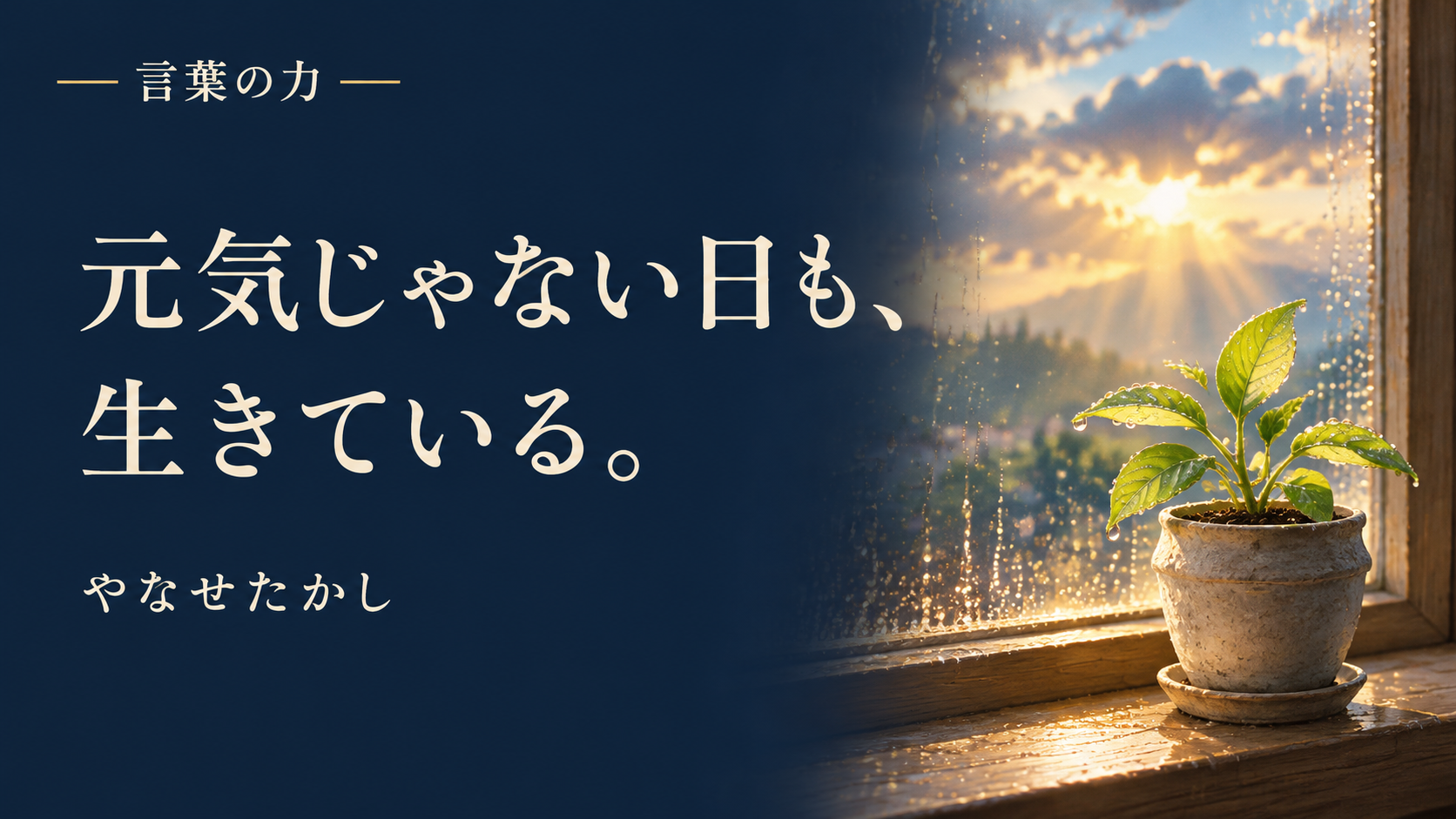
“It is because we are alive that we feel sad.”

From Te no Hira o Taiyo ni, lyrics by Takashi Yanase (lyrics published on Uta-Net, in Japanese). English translation prepared for this article; not an official translation.

“Keep smiling today.” “Stay positive and do your best.”

Some days, words like these encourage us. On others, they feel a little too bright.

We know they are well meant. But we do not have that energy right now. The more cheerful words we encounter, the more we may feel left behind because we cannot be cheerful ourselves.

On such a day, today’s words reach us from a different angle.

A cheerful song has room for sadness

Te no Hira o Taiyo ni is a song with lyrics by Takashi Yanase and music by Taku Izumi. It first aired on NHK’s Minna no Uta in 1962.

Although it feels like a lively song, its lyrics include sadness.

Being alive brings enjoyment and happiness. But that is not all. For me, the depth of these words lies in making room for more than those feelings.

In an article from PHP (Japanese), Yanase explains that hardship and pain are also signs of being alive, and discusses why he placed sadness before joy.

Sadness is not treated as a wrong emotion. I find a quiet kindness in that.

Even your feelings do not have to behave perfectly

You made a mistake at work. You could not communicate well with someone important to you. Plans you were looking forward to were canceled.

At such times, we sometimes find another reason to blame ourselves, on top of the event itself.

“I am weak for still worrying about this.” “I need to be more positive.”

Sadness is hard enough, yet we also scold ourselves for being sad. We seem to keep a very demanding boss inside our minds.

But considering today’s words allows a slightly different perspective.

You are sad because it mattered. You are disappointed because you had hopes. You feel frustrated because you wanted to do well.

Behind those feelings may lie something you deeply valued.

Words can stay beside us without rushing us

Of course, we do not have to find meaning in every sadness. Nor do we need to force a painful experience into the conclusion that it was a good experience.

I want to receive today’s words not as an instruction to endure sadness, but as a reminder that we do not have to reject ourselves for remaining sad.

The power of words is not limited to stirring people into action. Words can also sit beside someone who has stopped and say, “You do not have to feel better right away.”

You could not smile today. Even so, it is all right to drink something warm, rest a little, and bring the day to a close.

A day without a smile is still a day you lived.
The Power of Words | Ichiro: Small Steps Take Us Somewhere Extraordinary

日本語で読む | English

Disclosure: This article contains affiliate advertising.

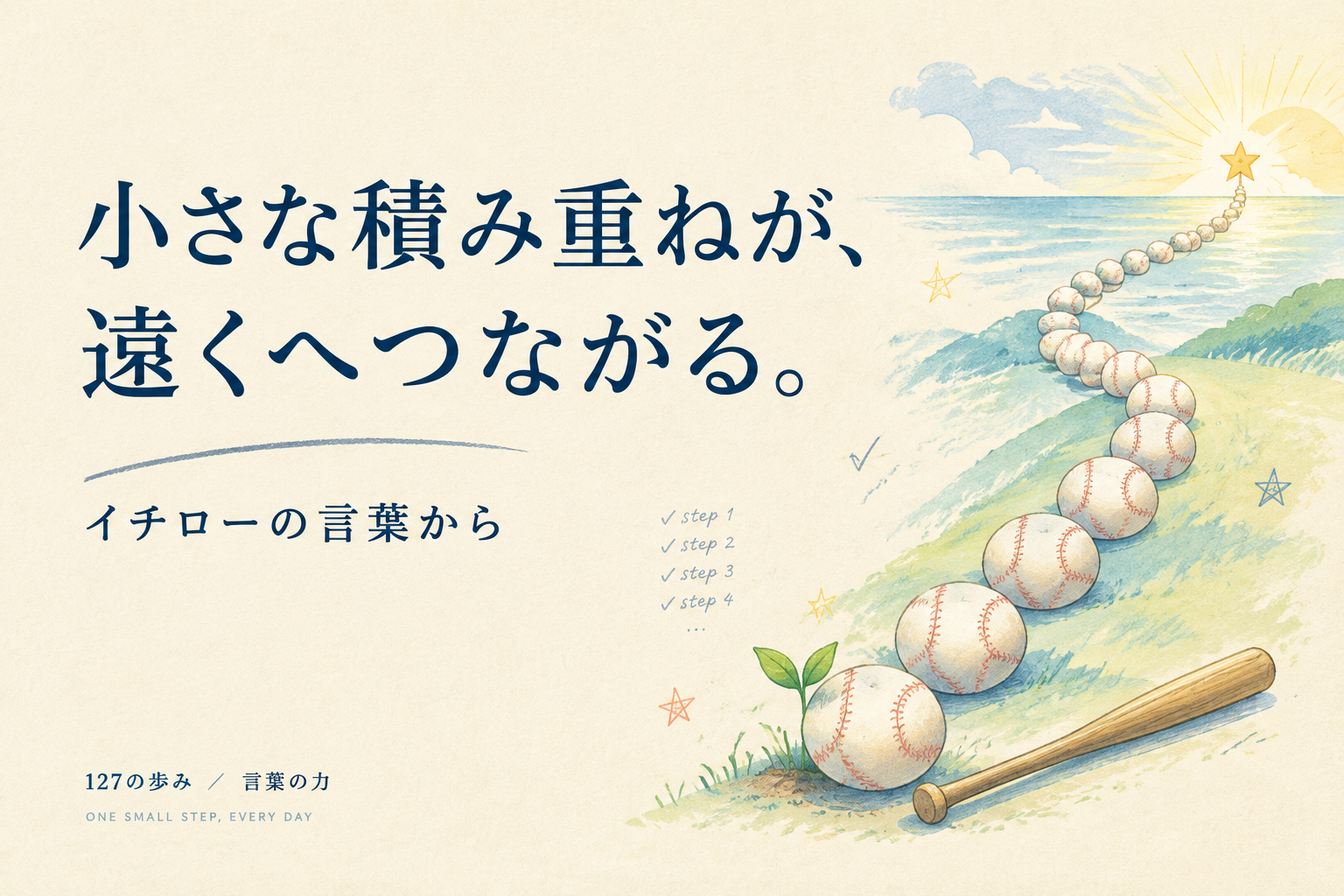
“Building up small things is the only way to reach somewhere extraordinary.”

Ichiro, wording quoted on the official Yunker website (Japanese). English translation prepared for this article; not an official translation.

When we set a big goal, our feelings grow bigger, too.

Exercise every day starting tomorrow. Begin studying something new. Produce different results at work.

Yet what we can actually do today is smaller than we imagined. Read a few pages. Finish one preparation. Revise a little of what we have written.

“Can something like this really make a difference?” When facing that question, I want to remember Ichiro’s words.

Think about big results through small actions

Toshin’s introduction to this quotation (Japanese) also presents these words about building up small things as a remark from the press conference after Ichiro broke the Major League Baseball single-season hits record in 2004.

What I want to notice is that, when speaking about a great result, his words begin with “small things.”

It is not a shortcut where one extraordinary act takes us somewhere extraordinary. It is about building on the small things right in front of us.

I find encouragement here: even someone overwhelmed by the size of a goal has a place to begin.

Building on experience is more than repetition

Suppose you write an article every day.

Instead of simply writing as you did yesterday, shorten today’s opening. Fix a sentence that was hard to read. Check the source of a quotation.

From the outside, each looks like a small task. But checking and changing things one by one gives you more to notice as you write.

What follows is my own interpretation of these words. Perhaps building things up means not only doing something more often, but also carrying yesterday’s experience into today’s actions.

Even if something did not go well, thinking “Next time, I will try this” means the day does not simply disappear.

Do not judge today’s step only by its size

Of course, continuing small actions does not mean everyone will reach the same result. Circumstances, health, and the methods we choose also affect how we move forward.

So I do not want these words to become a guarantee of success or an instruction never to rest.

Instead, I want to keep them as a reminder not to dismiss what we managed today as worthless simply because results are not immediately visible.

You read one page. Checked one thing. Started writing one line.

On some days, that may be enough. When your energy returns, you can build on it again.

The power of words lies not in erasing what we cannot do, but also in helping us turn our attention back to what we can.

Change “I can only do something this small” into “I can begin with this small thing.”

You do not have to produce an extraordinary result today.

Add one small thing that connects to the future. Let us try not to undervalue that one thing ourselves.

The Power of Words | Natsume Soseki: The Seeds You Sow Today

日本語で読む | English

Disclosure: This article contains affiliate advertising.

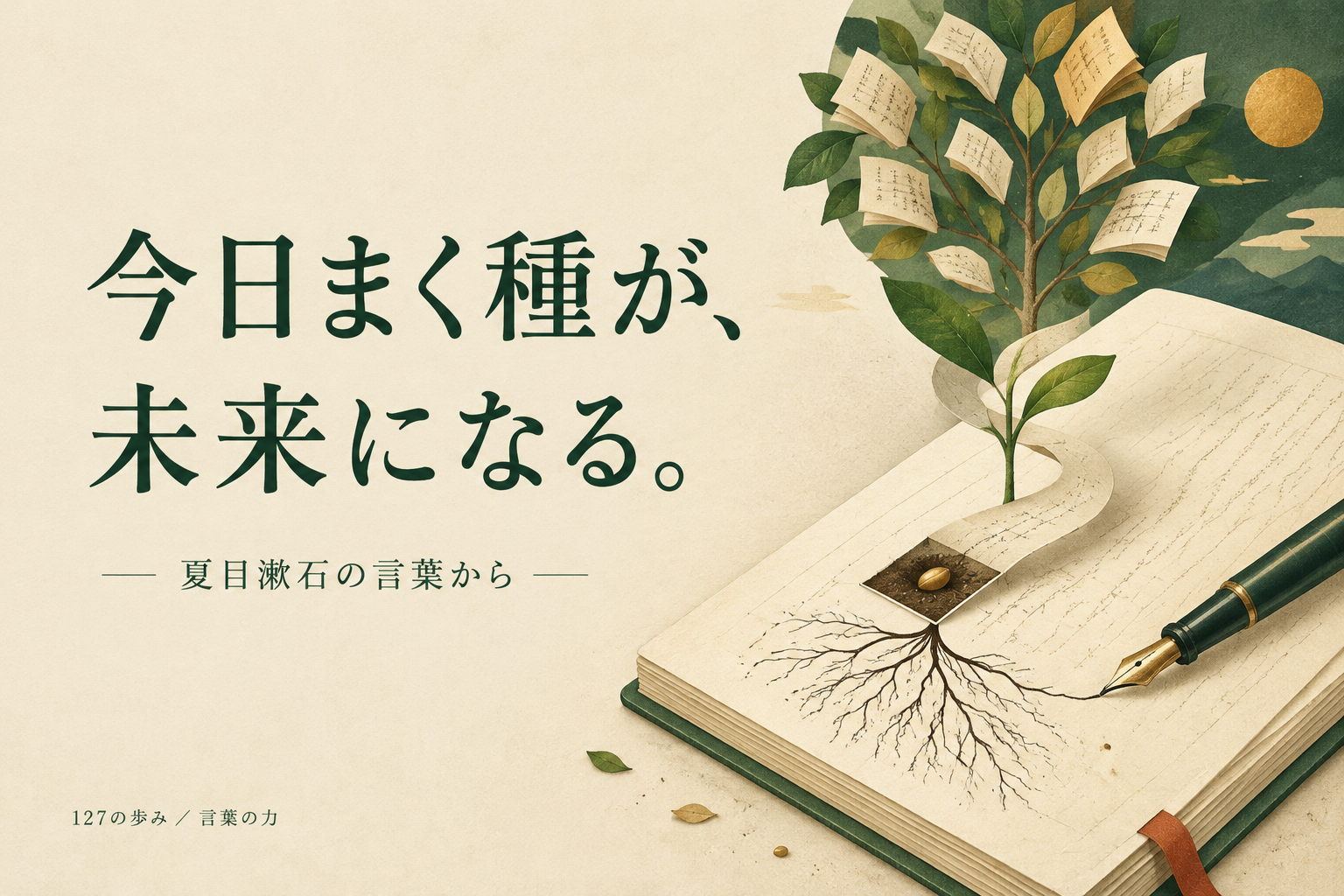
“The seeds you sow in the present will eventually appear as the future you are to reap.”

Natsume Soseki, diary entry dated March 21, 1901, as quoted in Sarai (Japanese). English translation prepared for this article; not an official translation.

When we think about the future, it is easy to place our hopes in “someday.”

Someday, when I have more time. Someday, when life feels less demanding. Someday, when I feel more confident.

We imagine we will do better then. Yet what our future selves receive is not unrelated to what we do today.

These words from Natsume Soseki connect the distant future with the day right in front of us.

What are the seeds we sow today?

The Sarai article presents this sentence as a passage from Soseki’s diary entry of March 21, 1901.

The seeds we sow now eventually emerge as the future we receive. I want to apply this metaphor not only to great efforts, but also to the small choices we make every day.

Look up one thing you do not understand. Keep a promise. Listen until someone has finished speaking. Start a task that has been on your mind.

Even if these actions seem unremarkable at the time, they may grow into knowledge we can use later or relationships with other people.

Acting for the future is not something reserved for special days. An ordinary day may offer opportunities to sow seeds, too.

Not seeing a sprout does not mean nothing is happening

When we begin something, we often want to see results straight away.

We study, but still struggle to answer. We write an article, but fewer people read it than we hoped. We take care with our work, but receive no response.

Then we start to wonder whether our efforts mean anything.

But expecting a harvest on the very day we sow a seed may be asking too much, too soon. Before results become visible, there may be time needed to learn, grow accustomed to something, or reach another person.

This is my own reflection on how these words might relate to daily life, not a claim about the circumstances or intentions behind Soseki’s original statement.

We do not have to judge the entire value of today’s actions by today’s results. Leaving that room may help us think more calmly about how to continue.

Do not make the future entirely your own responsibility

At the same time, I would avoid reading these words as saying that everything happening now is the fault of our past selves.

Life includes circumstances we cannot choose and events we cannot foresee. The same effort does not always produce the same result.

I prefer to receive these words as an invitation to consider the actions available to us, rather than a guarantee that we will harvest exactly the future we want.

What will we sow? How will we tend it? If a method does not suit us, how might we change it?

Even when we cannot control everything, there may still be a small part of today’s choices we can influence.

The seeds we sow today need not be large. Read one page of a book you have wanted to open. Thank someone. Prepare one thing for your future self tomorrow.

The power of words lies not only in describing distant goals, but also in restoring meaning to the small things we do today.

Rather than simply waiting for the future, prepare one thing to pass on to it.

Let us quietly begin sowing seeds with what we can do right now.